Embedded and industrial
Controllers in machines, appliances, factories and instruments. 495 chips on EveryChip so far.
Embedded chips run machines rather than people's programs: the controller inside a washing machine, a lift, a printer, a medical pump, a factory robot or a power meter. Most are microcontrollers, small chips with processor, memory and input/output on one die. They must be cheap, reliable, often low-power and available for many years, since an industrial product may be made for a decade or more.
What embedded designers want
An embedded chip is chosen for its peripherals (timers, motor controls, analogue inputs, communication ports), its power use, its operating temperature range and how long the maker promises to keep producing it. Real-time behaviour matters: a motor controller must respond within microseconds, every time. Many products run a small real-time operating system or no operating system at all.
The families
Intel's 8051, Microchip's PIC, Atmel's AVR and TI's MSP430 defined the field for decades. Since the late 2000s Arm's Cortex-M cores, licensed to ST, NXP, Renesas, Infineon and many others, have become the default, and RISC-V is rising. Raspberry Pi's RP2040 and Espressif's ESP32 brought cheap, powerful controllers to hobbyists and small makers.
Famous embedded and industrial chips


Further reading
 🇺🇸 United States and 1 moreSignetics 8X300
A 1976 bipolar microcontroller and signal processor from SigneticsCPU · Other · 1976
 🇺🇸 United States4000 series
Versatile CMOS logic chips for low-power digital circuitsAnalog · Other · 1968
 🇺🇸 United StatesElectronic Arrays 9002
An 8-bit CPU with on-chip RAM, sold briefly in the mid-1970s.CPU · Other · 1976
 🇺🇸 United StatesNational Semiconductor PACE
First commercial single-chip 16-bit microprocessor, from National Semiconductor in 1974CPU · Other · 1974
 🇺🇸 United StatesMotorola 6800
An 8-bit microprocessor from Motorola, launched in 1974 as the core of the M6800 family.CPU · Other · 1974
 🇺🇸 United StatesIntel 4040
Intel's second 4-bit microprocessor, a 1974 upgrade of the 4004CPU · Other · 1974
 🇺🇸 United States and 1 moreMCP-1600
A 1975 multi-chip 16-bit microprocessor from Western DigitalCPU · Other · 1975
🇺🇸 United StatesAT&T Hobbit
A C-optimised microprocessor from AT&T with a stack cache instead of registersCPU · Other · 1992
WorldRTX 2010
Radiation-hardened 16-bit stack processor for real-time space workCPU · Other · 1988
 🇺🇸 United States and 1 moreNS32000
National Semiconductor's 32-bit CISC microprocessor family from the 1980sCPU · Other · 1982
WorldZilog Z280
A 16-bit Zilog microprocessor extending the Z80 with an MMU and on-chip RAMCPU · Other · 1987
🇺🇸 United StatesZilog Z800
A 16-bit Z80-compatible microprocessor with cache and an MMU, planned for 1985CPU · Other · 1985
 🇬🇧 United KingdomFerranti F100-L
A 16-bit military microprocessor built on Ferranti's bipolar CDI processCPU · Other · 1977
 🇺🇸 United States and 1 moreDEC T-11
DEC's first single-chip PDP-11 microprocessor, built for embedded control workCPU · Other · 1982
 🇬🇧 United KingdomTransputer
A 1980s microprocessor series designed for parallel computing with integrated memory and serial links.CPU · Other
🇺🇸 United StatesTMS6100
Serial mask ROM for speech synthesis data storageMemory · Other · 1978
 🇺🇸 United StatesGeneral Instrument CP1600
A 16-bit microprocessor from 1975, best known inside the Intellivision consoleCPU · Other · 1975
🇺🇸 United StatesWDC 65C816
16-bit microprocessor from the 6502 family with 24-bit addressingCPU · Other · 1985
 🇺🇸 United StatesTMS9900
A 16-bit single-chip microprocessor from Texas Instruments, launched in 1976.CPU · Other · 1976
 🇺🇸 United StatesHewlett-Packard Nanoprocessor
An 8-bit control microcontroller with no arithmetic unit, released by HP in 1974Microcontroller · Other · 1974
 WorldGAL22V10
Programmable logic device with configurable inputs and outputsFPGA · Other
 🇺🇸 United States and 2 moreMicroVAX 78032
DEC's first single-chip VAX microprocessor, used in MicroVAX II systems from 1985CPU · Other · 1985
 WorldGA144
A 144-core asynchronous stack microprocessor built from tiny F18A nodesCPU · Other · 2011
🇺🇸 United StatesMostek MK5065
Early 8-bit PMOS microprocessor from Mostek, aimed at control tasksCPU · Other · 1974
🇺🇸 United StatesEssex SX 200
4-bit single-chip microcontroller with on-board ROM, RAM and display driversMicrocontroller · Other · 1976
 🇺🇸 United StatesIntel 4004
The first commercial microprocessor, a 4-bit chip released by Intel in 1971.CPU · Other · 1971
🇺🇸 United StatesWD16
A 16-bit CISC microprocessor from Western Digital, built from five DIP chips.CPU · Other · 1976
🇯🇵 JapanRL78
16-bit embedded microcontroller family by Renesas ElectronicsMicrocontroller · Other · 2010
 WorldBeetle
Analog readout chip for the LHCb experiment at CERNAnalog · Other
🇺🇸 United StatesMOS Technology 6532
Integrated circuit combining RAM, I/O ports and a timer for 1970s systems.Microcontroller · Other
 🇺🇸 United States and 1 moreDEC J-11
Two-chip CMOS implementation of the PDP-11 ISA for high-end DEC machinesCPU · Other
🇺🇸 United StatesFour-Phase Systems AL1
An early 8-bit slice CPU built for Four-Phase's System IV/70 minicomputer.CPU · Other · 1970
WorldIMP-16
A 1973 bit-slice microprocessor built from five PMOS chipsCPU · Other · 1973
 🇳🇱 NetherlandsMIFARE
Contactless smart card chip series for tickets, access control and paymentsMining or security · Other
 🇳🇴 NorwayMali
A family of graphics processing unit cores licensed by Arm for mobile and embedded chips.GPU · Other · 2005
 WorldIntersil 6100
A 12-bit CMOS microprocessor that runs the PDP-8 instruction set on one chipCPU · Other · 1975
🇺🇸 United StatesHP Saturn
HP's 4-bit calculator microprocessor family, introduced in 1984CPU · Other · 1984
WorldSHARC
A 32-bit floating-point DSP family from Analog Devices with VLIW instructionsDSP · VLIW · 1999
🇺🇸 United StatesBellmac 32
Bell Labs CMOS microprocessor, first to move 32 bits per clock cycleCPU · Other · 1980
 WorldMOS 6507
A low-cost 8-bit 6502 variant in a 28-pin package with an 8 KB address rangeCPU · Other · 1975
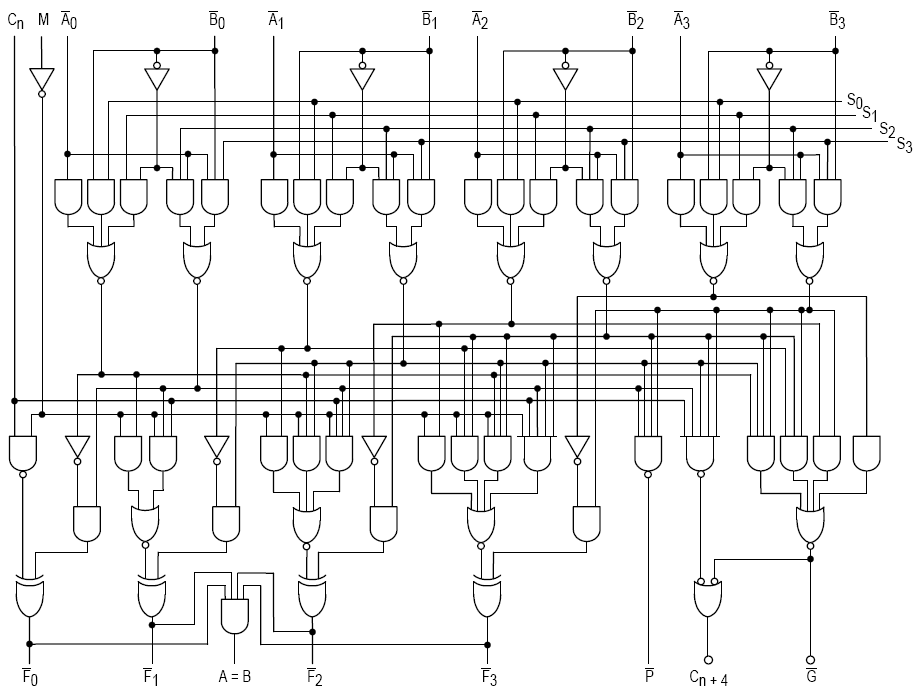 🇺🇸 United States74181
4-bit slice ALU, the first complete arithmetic logic unit on one chipCPU · Other · 1970
🇬🇧 United KingdomRekursiv
A four-chip object-oriented CPU with a writable microcode instruction setCPU · Other · 1988
 🇺🇸 United StatesCVAX
DEC's second-generation single-chip VAX microprocessor with DRAM cacheCPU · Other · 1987
 🇺🇸 United StatesIntel 8251
Universal synchronous and asynchronous receiver transmitter chip by IntelNetwork chip · Other · 1975
🇯🇵 JapanExmor
Sony's CMOS image sensor series with on-chip conversion and noise reductionSensor · Other · 2008
 🇺🇸 United States and 1 moreAMD Am2900
AMD's 1975 bipolar bit-slice IC family for building custom control unitsCPU · Other · 1975
 🇺🇸 United StatesPIC microcontroller
Microchip's long-running family of 8-bit to 32-bit microcontrollersMicrocontroller · MIPS · 1976
 🇺🇸 United StatesMSP430
A 16-bit mixed-signal microcontroller family designed for very low power use.Microcontroller · Other · 1992
Photo credits on this page
The small pictures above come from Wikimedia Commons under free licences. Some are cropped to fit.
- MIFARE: Adontz, CC BY-SA 4.0, source
- 4000 series: Teravolt ( talk ), CC BY 3.0, source
- TMS9900: Konstantin Lanzet, CC BY-SA 3.0, source
- Transputer: NobbiP, CC BY-SA 3.0, source
- Intel 4040: Thomas Nguyen, CC BY-SA 4.0, source
- Motorola 6800: Swtpc6800 en:User:Swtpc6800 Michael Holley, Public domain, source
- Intersil 6100: Christian Bassow, CC BY-SA 4.0, source
- MOS 6507: Konstantin Lanzet, CC BY 3.0, source
- GAL22V10: Raimond Spekking, CC BY-SA 4.0, source
- DEC T-11: Pauli Rautakorpi, CC BY 3.0, source
- Ferranti F100-L: Logg Tandy, CC BY 4.0, source
- Mali: Open Grid Scheduler / Grid Engine, CC0, source
- DEC J-11: Konstantin Lanzet, CC BY-SA 3.0, source
- CVAX: wdwd, CC BY-SA 3.0, source
- 74181: Unknown author, CC BY-SA 3.0, source
- GA144: Cartheur, CC BY-SA 4.0, source
- MicroVAX 78032: Pauli Rautakorpi, CC BY 3.0, source
- Intel 4004: the Science Museum, CC BY 4.0, source
- WD16: RastaKins, CC BY-SA 4.0, source
- Beetle: Larosch, CC BY-SA 4.0, source
- Intel 8251: Myself User:ZyMOS, CC BY-SA 4.0, source
- AMD Am2900: Konstantin Lanzet (with permission), CC BY-SA 3.0, source
- PIC microcontroller: Raimond Spekking, CC BY-SA 4.0, source
- MSP430: Travis Goodspeed, CC BY 2.0, source
- Hewlett-Packard Nanoprocessor: Pauli Rautakorpi, CC BY 3.0, source
- General Instrument CP1600: Evan-Amos, CC BY-SA 3.0, source
- NS32000: Konstantin Lanzet, CC BY-SA 3.0, source
- Electronic Arrays 9002: Electronics Arrays, Inc., Public domain, source
- National Semiconductor PACE: Pauli Rautakorpi, CC BY 3.0, source
- Signetics 8X300: Konstantin Lanzet, GFDL, source
- Intel MCS-51: Konstantin Lanzet (with permission), CC BY-SA 3.0, source
- AVR: Pengo, CC BY-SA 3.0, source
- STM32: ZeptoBars, CC BY 3.0, source
- RP2040: Phiarc, CC BY-SA 4.0, source
- ARM Cortex-M: Viswesr, CC BY-SA 3.0, source