
MOS 6507
A low-cost 8-bit 6502 variant in a 28-pin package with an 8 KB address range
The 6507 is an 8-bit microprocessor from MOS Technology, produced from 1975. It is the 6502 core in a cheaper 28-pin package with a reduced address bus, and it powered the Atari 2600 console and Atari disk drive peripherals.
- 8-bit CPU from MOS Technology, produced from 1975
- 6502 core in a cheaper 28-pin DIP instead of 40 pins
- 13-bit address bus limits memory to 8 KB instead of 64 KB
- Same silicon as the 6502, differing only in the top metal layer
- Processor of the Atari 2600 console and Atari disk drive peripherals
What it is
The 6507 is an 8-bit microprocessor made by MOS Technology from 1975. It is a reduced version of the company's 40-pin 6502, repackaged in a 28-pin dual in-line package so that it cost less to package and to build into a system. Fewer pins meant a narrower address bus: 13 bits instead of 16, so the chip can reach 8 KB of memory rather than 64 KB. Several pins used only in specialised setups were dropped too. That trade-off was acceptable in 1975 for small, cheap systems, and the chip became the heart of the Atari 2600 games console.
How it came about
The whole 6500 family was planned as a line of very inexpensive processors aimed at small embedded systems. The 6507 followed that plan by cutting the package down to 28 pins. Around 1980, as the 6502 line spread widely, memory chip prices had dropped far enough that the 6507's simplification no longer paid off, and it disappeared from new designs. The Atari 2600 that used it kept selling until 1 January 1992, although later consoles did not always carry a separate 6507 chip.
Inside the chip
Inside, the 6507 is the same silicon as the 6502. The two share every layer except the final metal layer, which is why the last digit of the part number differs while the first three match. Micro-photography shows the difference. On the 28-pin package, thirteen pins carry addresses A0 to A12 and eight carry data D0 to D7. The rest handle power, the two clock phases, reset, a ready signal and the read/write line. Address lines A15 to A13 and the interrupt pins are absent, and the interrupt inputs are tied inactive on the die so noise cannot trigger stray interrupts. There is no IRQ or NMI pin.
How it was made
MOS Technology manufactured the 6507 itself. The chip holds 3,510 or 3,218 transistors, depending on the count given. It uses the same underlying silicon layers as the 6502, with only the final metallisation layer changed to tie off the unused signals. Packaging is a 28-pin dual in-line package, a smaller and cheaper alternative to the 6502's 40-pin version. No process node is stated.
Where it went
Two main applications carried the 6507. One was the best-selling Atari 2600 console, where it sat alongside two other main chips. The console's cartridge slot cut the reachable external memory to 4 KB, with the other 4 KB mapped to RAM and I/O registers through cheap partial address decoding, which made those registers appear at several aliased addresses. The second was Atari 8-bit computer peripherals: the 850 Serial & Parallel Interface and the 810 and 1050 disk drives. Home computers generally preferred the standard 6502 or wider versions so they could use more memory.
Versions and family
The 6507 is a packaged variant of the MOS 6502, sharing its silicon apart from the top metal layer. It is listed as following the Motorola 6800 and the MOS 6501/6502. Other 28-pin cut-down 6502 versions exist, but they do not all include the RDY pin that the 6507 keeps. Later Atari 2600 consoles sometimes integrated the function rather than using a discrete 6507.
Why it matters
The 6507 gave one of the best-known games consoles its processing power at very low cost, and it also served Atari's disk drives and interface box. Its 8 KB limit shaped how the Atari 2600 mapped cartridges, RAM and I/O. Once memory prices fell around 1980, the pin-saving compromise stopped making sense for new designs, and the wider 6502 family took over. The console itself stayed on sale into the early 1990s.
Problems and reception
Tying the interrupt lines inactive on the die removed a failure mode: noise could not raise spurious interrupts. The reduced address range was seen as acceptable for the small systems of 1975 rather than a defect. No recalls or controversies are recorded.

Questions people ask about MOS 6507
How is the 6507 different from the 6502?
It is the same processor design in a smaller 28-pin package. The address bus drops from 16 bits to 13, so it reaches 8 KB of memory instead of 64 KB, and the interrupt pins are removed. The silicon is identical apart from the final metal layer.
Why does it only see 8 KB of memory?
Address lines A15 to A13 are not brought out to the package, leaving 13 address pins. Thirteen bits select 8 KB. In 1975 that was enough for many small embedded systems, and it saved money on both the chip package and the surrounding circuitry.
What used the 6507?
The Atari 2600 games console used it as one of its three main chips, and Atari 8-bit computer peripherals used it too, including the 850 Serial & Parallel Interface and the 810 and 1050 disk drives.
How much memory did the Atari 2600 give it?
The cartridge slot allowed only 4 KB of external memory to be addressed. The remaining 4 KB was assigned to RAM and I/O registers, decoded cheaply so those registers appeared at several aliased addresses across the 4 K space.
Does the 6507 have interrupt pins?
No. There is no IRQ or NMI pin on the package, and the interrupt inputs are tied to their inactive level on the die so electrical noise cannot raise a spurious interrupt.
Good reading and sources
- MOS Technology 6507 on WikipediaEncyclopedia
- More photos on Wikimedia CommonsPhotos
- Wikidata recordOpen data
The facts on this page come from the Wikipedia article "MOS Technology 6507", written by its contributors and used under the CC BY-SA 4.0 licence, and from its Wikidata record (CC0). EveryChip rewrote the text in its own words, with AI assistance, and compares every page with the article to make sure no passage is copied. It may be reused under the same CC BY-SA 4.0 licence with a link back.
It may contain mistakes, and figures change over time. Nothing here is investment or buying advice. If something is wrong, tell us. Last refreshed 2026-11-14.
Like MOS 6507
All CPUs and microprocessors 🇯🇵 JapanNEC μCOM series
NEC microprocessor and microcontroller family from the 1970s and 1980sCPU · x86 · 1973
 🇺🇸 United States and 1 moreAMD Am2900
AMD's 1975 bipolar bit-slice IC family for building custom control unitsCPU · Other · 1975
 WorldIntersil 6100
A 12-bit CMOS microprocessor that runs the PDP-8 instruction set on one chipCPU · Other · 1975
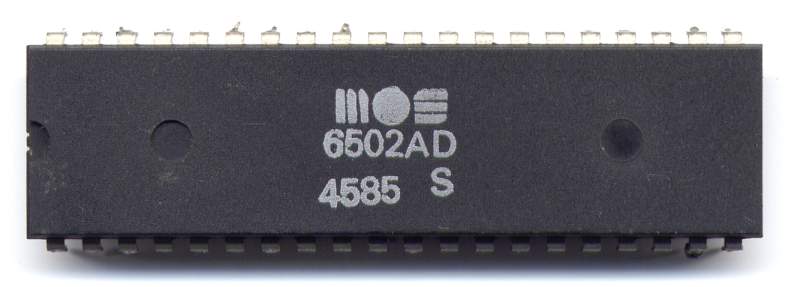 🇺🇸 United StatesMOS Technology 6502
Low-cost 8-bit microprocessor that powered the home computer revolutionCPU · Other · 1975
More from MOS Technology
All of them
🇺🇸 United StatesMOS Technology 6502
An 8-bit microprocessor from 1975 that made cheap home computing possibleCPU · 8-bit · 1975
 🇺🇸 United StatesPeripheral Interface Adapter
Parallel I/O chip for early microprocessor systemsAnalog · Other · 1976
 🇺🇸 United StatesMOS Technology VIC
Video and sound chip for the Commodore VIC-20 computerGPU · Other · 1979
 🇺🇸 United StatesVIC-II
Video and graphics chip for the Commodore 64 home computer.GPU · Other · 1982