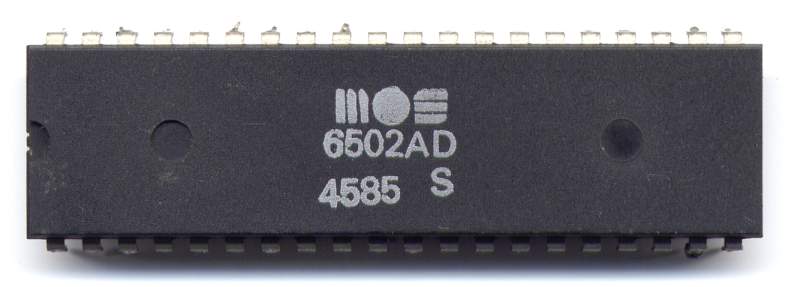
MOS Technology 6502
An 8-bit microprocessor from 1975 that made cheap home computing possible
The MOS Technology 6502 is an 8-bit microprocessor designed by a small team led by Chuck Peddle at MOS Technology and launched in September 1975. It undercut rival chips on price and helped power the home computer and console boom of the late 1970s and early 1980s.
- Launched September 1975 as an 8-bit microprocessor
- Sold for less than one sixth of rival chips at introduction
- 3,510 or 3,218 transistors in a 40-pin DIP package
- Clocked between 1 MHz and 3 MHz
- Family production estimated in the hundreds of millions
What it is
The 6502 is an 8-bit microprocessor, meaning it moves data in 8-bit chunks and can address 16 bits of memory. MOS Technology released it in September 1975 at a price far below rival parts from Motorola and Intel, which helped pull the whole market down. It was built with depletion-load NMOS logic, a technique that cut power use and let the clock oscillator sit on the chip itself. Together with the Zilog Z80, it drove the wave of home computers and game consoles from the mid-1970s into the early 1980s, and it remains in wide use inside embedded systems today.
How it came about
Chuck Peddle joined Motorola in 1973 to support the 6800 project. On sales trips he kept hearing that customers wanted far fewer instructions and much lower prices, so he sketched a stripped-down design. Motorola's management refused to fund it and told him to stop. Peddle treated that letter as an abandonment of the work and left, joining MOS Technology in Valley Forge on 19 August 1974 with several colleagues. The group aimed at a $5 volume price and a die about half the size of the 6800. MOS was bought by Commodore International shortly after launch.
Inside the chip
Peddle, Rod Orgill and Wil Mathys shaped the architecture. The address bus dropped three-state drivers, saving space because the part was meant as a simple controller rather than a shared-bus multiprocessor. One of the two accumulators was cut, and the stack pointer shrank from 16 bits to 8, limiting the stack to 256 bytes. The old 16-bit index register became separate X and Y registers, with the base address held in the instruction and the 8-bit register added to it. The instruction set was trimmed from the 6800's 72 down to 56, simplifying the decoder and control logic.
How it was made
The design used depletion-load NMOS, needing only a single +5 V supply and running cooler than earlier enhancement-mode parts. Perkin-Elmer's 1973 Micralign projection aligner lifted CPU yields from about 10% to 60 or 70%, so prices fell sharply. MOS Technology built a new NMOS line, ready by June 1975. The first chips measured 168 by 183 mils (4.3 mm × 4.6 mm), an area of 19.8 mm2, larger than the 153 by 168 mil target. They shipped in a 40-pin DIP, with 3,510 or 3,218 transistors.
Where it went
The processor appeared in a long list of home machines and consoles, and versions derived from it turned up in arcade titles such as Asteroids, Centipede and Missile Command. Commodore kept building and selling it after buying MOS Technology, and also licensed the design onward. Rockwell and Synertek were the first second sources, and further firms later produced it under licence. The family is still found in embedded hardware, with total production estimated in the hundreds of millions.
Versions and family
Two parts launched together: the 6501 fitted the same socket as the Motorola 6800, while the 6502 rearranged the pins to carry its own clock oscillator. Both worked alongside 6800 support chips. The first silicon lacked a rotate right instruction, so ROR was left out of the early documentation; a later revision shrank the die and added it. Successors include the MOS 6510 and, from 1981, the CMOS 65C02 developed by Western Design Center, plus the WDC 65C816.
Why it matters
By selling at under a sixth of the price of competing parts, the 6502 forced rivals to cut their own prices and helped turn the microprocessor into a commodity. It and the Z80 powered much of the microcomputer revolution. Commodore's purchase of MOS Technology secured supply and spread the design through licensing. Production across the family is counted in the hundreds of millions, and the line still runs in embedded systems.
Problems and reception
Motorola's chairman Bob Galvin later conceded that Peddle's low-cost idea had been sound and that the division had missed the chance. The Semiconductor Products Division was reorganised and its management replaced. The chip itself sold well from the start, and its pricing reset expectations across the industry.


Questions people ask about MOS Technology 6502
What is the MOS Technology 6502?
It is an 8-bit microprocessor introduced in September 1975 by MOS Technology. A small team led by Chuck Peddle designed it as a cheaper, simpler alternative to the Motorola 6800, and it went on to power many home computers, consoles and embedded products.
Why was it cheaper than other processors?
The team cut the die size roughly in half versus the 6800, dropped costly features such as three-state address drivers, and used depletion-load NMOS so only one supply voltage was needed. Projection masking also raised yields sharply, so far fewer chips had to be scrapped.
Who manufactured it?
MOS Technology built it first, with Rockwell and Synertek as early second sources. After Commodore International bought MOS Technology, that company continued production and licensed the design to further manufacturers.
What came after it?
The MOS 6510 followed, and Western Design Center began work in 1981 on a CMOS version called the 65C02. The WDC 65C816 is another later member of the family.
Is it still used today?
Yes. The processor family remains in service in embedded systems, and overall production is estimated in the hundreds of millions of units.
Good reading and sources
- Checking your browserAnandTech, Article
- Q&A With Co-Creator of the 6502 ProcessorIEEE Spectrum, Article
- MOS Technology 6502 on WikipediaEncyclopedia
- More photos on Wikimedia CommonsPhotos
- Wikidata recordOpen data
The facts on this page come from the Wikipedia article "MOS Technology 6502", written by its contributors and used under the CC BY-SA 4.0 licence, and from its Wikidata record (CC0). EveryChip rewrote the text in its own words, with AI assistance, and compares every page with the article to make sure no passage is copied. It may be reused under the same CC BY-SA 4.0 licence with a link back.
It may contain mistakes, and figures change over time. Nothing here is investment or buying advice. If something is wrong, tell us. Last refreshed 2026-11-14.
Like MOS Technology 6502
All CPUs and microprocessors 🇺🇸 United StatesRCA 1802
8-bit CMOS microprocessor family from RCA, first of its kindCPU · 8-bit · 1974
 🇺🇸 United StatesMotorola 68000
A 16/32-bit CISC microprocessor introduced by Motorola in 1979CPU · 68k · 1979
🇺🇸 United StatesWDC 65C816
16-bit microprocessor from the 6502 family with 24-bit addressingCPU · Other · 1985
 WorldMOS Technology 6510
8-bit 6502-derived CPU with a built-in I/O port, used in the Commodore 64CPU · 8-bit
More from MOS Technology
All of them WorldMOS 6507
A low-cost 8-bit 6502 variant in a 28-pin package with an 8 KB address rangeCPU · Other · 1975
🇺🇸 United StatesMOS Technology 6502
Low-cost 8-bit microprocessor that powered the home computer revolutionCPU · Other · 1975
 🇺🇸 United StatesPeripheral Interface Adapter
Parallel I/O chip for early microprocessor systemsAnalog · Other · 1976
 🇺🇸 United StatesZilog Z80
An 8-bit microprocessor released in 1976 that became a staple of early personal computing and embedded systems.CPU · Other · 1976