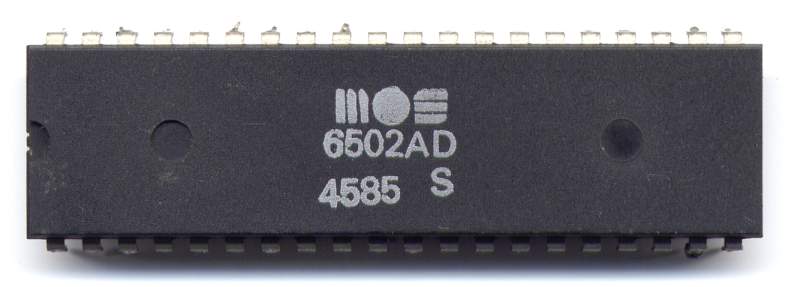
MOS Technology 6502
Low-cost 8-bit microprocessor that powered the home computer revolution
Designed by Chuck Peddle at MOS Technology and launched in September 1975, the 6502 is an 8-bit microprocessor. It offered a simplified, faster, and significantly cheaper alternative to the Motorola 6800, enabling the mass adoption of home computers and video game consoles.
- Launched in September 1975 for under one-sixth the price of rivals
- Used in Apple II, Commodore 64, and Nintendo Entertainment System
- Contains approximately 3,500 transistors using depletion-load NMOS
- Design team left Motorola after low-cost proposal was rejected
- Production yields jumped to 70% using projection masking technology
What it is
The MOS Technology 6502 is an 8-bit microprocessor introduced in September 1975. Designed by a small team led by Chuck Peddle, it served as a simplified and more affordable version of the Motorola 6800. By using depletion-load NMOS technology, the chip reduced complexity and cost, making it accessible for a wide range of computing devices. Its launch triggered price reductions across the microprocessor market and became a cornerstone of the microcomputer revolution.
How it came about
The design originated from engineers who left Motorola after their low-cost processor proposal was rejected. Led by Chuck Peddle, the team joined MOS Technology in Valley Forge, Pennsylvania, in 1974. They aimed to create a cheap microprocessor for embedded applications, targeting a volume price of five dollars. The team leveraged new fabrication techniques, such as projection masking, to improve yields and reduce size, resulting in a chip that was half the area of its predecessor.
Inside the chip
The architecture simplifies the Motorola 6800 by removing tri-state drivers and reducing register complexity. It features one accumulator instead of two and splits the 16-bit index register into separate 8-bit X and Y registers. The instruction set was trimmed to 56 commands, omitting complex operations to save space. These changes allowed the use of a single five-volt power supply and an on-chip clock oscillator, significantly lowering the cost of surrounding support circuitry.
How it was made
Manufactured using depletion-load NMOS logic, the chip required only a single voltage supply, unlike earlier designs needing three. The production utilized projection masking systems, which increased wafer yields from ten percent to roughly seventy percent by reducing defects. This efficiency allowed MOS Technology and second-source partners like Rockwell and Synertek to produce the chip at a fraction of the cost of competing processors from Intel and Motorola.
Where it went
The processor powered many iconic home computers and gaming systems during the late 1970s and early 1980s. Notable devices include the Apple I, Apple II, Commodore 64, Atari 2600, and Nintendo Entertainment System. It also appeared in arcade machines such as Asteroids and Centipede, as well as the BBC Micro and Atari Lynx. Its low cost made it ideal for embedded systems, where it continues to see use today.
Versions and family
MOS Technology initially released the 6501, which shared the pinout of the Motorola 6800, alongside the 6502 with a new pin configuration. Later variants included the MOS 6510 used in the Commodore 64. The Western Design Center developed the CMOS-based 65C02 in 1981, followed by the 16-bit 65C816. These successors maintained software compatibility while improving power efficiency and addressing capabilities.
Why it matters
The 6502 democratized access to computing by selling for less than one-sixth the price of rival chips. Its affordability enabled the proliferation of home computers and video game consoles, defining the microcomputer era. With estimated production volumes in the hundreds of millions, it remains one of the most widely used microprocessors in history, influencing the design of subsequent embedded controllers.


Questions people ask about MOS Technology 6502
Why was the 6502 so much cheaper than other processors?
It used depletion-load NMOS technology requiring only one voltage supply and had a smaller die size. Improved manufacturing yields from projection masking also lowered costs, allowing it to sell for less than one-sixth the price of competitors.
Which famous computers used the 6502 processor?
The chip powered the Apple I, Apple II, Commodore 64, Atari 8-bit family, and BBC Micro. It was also central to gaming consoles like the Atari 2600 and Nintendo Entertainment System, as well as arcade games like Asteroids.
How does the 6502 differ from the Motorola 6800?
It simplifies the design by removing tri-state bus drivers and one accumulator. The instruction set is smaller, and the index register is split into two 8-bit registers. These changes reduced chip size and allowed for a simpler, cheaper system design.
Good reading and sources
- Checking your browserAnandTech, Article
- Q&A With Co-Creator of the 6502 ProcessorIEEE Spectrum, Article
The facts on this page come from the Wikipedia article "MOS Technology 6502", written by its contributors and used under the CC BY-SA 4.0 licence, and from its Wikidata record (CC0). EveryChip rewrote the text in its own words, with AI assistance, and compares every page with the article to make sure no passage is copied. It may be reused under the same CC BY-SA 4.0 licence with a link back.
It may contain mistakes, and figures change over time. Nothing here is investment or buying advice. If something is wrong, tell us. Last refreshed 2026-11-14.
Like MOS Technology 6502
All CPUs and microprocessors 🇺🇸 United StatesSignetics 2650
8-bit microprocessor from 1975 modelled on the IBM 1130 minicomputerCPU · 8-bit · 1975
 🇺🇸 United States and 1 moreSignetics 8X300
A 1976 bipolar microcontroller and signal processor from SigneticsCPU · Other · 1976
 🇺🇸 United States and 1 moreCOP400
4-bit microcontroller family for embedded control tasksMicrocontroller · Other · 1977
 🇯🇵 JapanNEC μCOM series
NEC microprocessor and microcontroller family from the 1970s and 1980sCPU · x86 · 1973
More from MOS Technology
All of them
🇺🇸 United StatesMOS Technology 6502
An 8-bit microprocessor from 1975 that made cheap home computing possibleCPU · 8-bit · 1975
 WorldMOS 6507
A low-cost 8-bit 6502 variant in a 28-pin package with an 8 KB address rangeCPU · Other · 1975
 🇺🇸 United StatesPeripheral Interface Adapter
Parallel I/O chip for early microprocessor systemsAnalog · Other · 1976
🇺🇸 United StatesRockwell PPS-8
An early 8-bit microprocessor from Rockwell with unusual code-saving featuresCPU · 8-bit · 1974