
COP400
4-bit microcontroller family for embedded control tasks
National Semiconductor launched the COP400 in 1977 as a 4-bit microcontroller line. It integrated timing, memory and logic into single chips for dedicated controllers. Western Digital and Soviet factories also produced variants. The family reached annual sales of 40 million units by 1990.
- Introduced in 1977 by National Semiconductor
- Annual sales reached 40 million units by 1990
- Used in Apple Lisa and various electronic games
- Features compact one-byte instructions for code density
- Dual CPU variants share execution resources
What it is
The COP400 is a family of 4-bit microcontrollers introduced in 1977 by National Semiconductor. These chips function as complete microcomputers with internal timing, logic, read-only memory (ROM), random-access memory (RAM) and input-output ports. They were designed for dedicated control tasks in consumer electronics and industrial devices. The architecture uses separate memory spaces for program code and data. Variants were manufactured by Western Digital and in the Soviet Union under different model numbers.
How it came about
National Semiconductor developed the COP400 as a successor to its earlier PMOS-based COP microcontroller. The new line used CMOS or N-channel silicon gate technology for better performance and efficiency. Launching in 1977, it quickly found use in various electronic products. By 1990, annual sales reached approximately 40 million units. The design evolved to include dual processing units and larger memory addresses in later models to handle more complex applications.
Inside the chip
The processor features a 4-bit accumulator for arithmetic and logic operations. It uses a B register to point to data in RAM, which is organized into 4-bit digits. Program memory is addressed via an 11-bit program counter. Instructions are compact, often one byte long, to save space. A hardware stack supports subroutine calls. Input and output are handled through named registers rather than memory-mapped addresses. Some high-end models include additional bidirectional ports and expanded interrupt capabilities.
How it was made
Chips were fabricated using CMOS or N-channel silicon gate MOS processes. Packages included 24, 28 and 40-pin dual in-line formats. The fastest members had an instruction cycle time of 4 microseconds. Western Digital second-sourced the devices as the WD4200 family. Soviet manufacturers produced them as the 1820 series. The physical layout varied to support different memory sizes and pin configurations.
Where it went
These microcontrollers powered many consumer products. Notable examples include the Apple Lisa computer, Milton Bradley and Mattel electronic games, and Coleco Head to Head Basketball. The Grundy Newbrain also utilized COP400 chips. Their low cost and integrated features made them suitable for toys, handheld games and simple computing devices requiring dedicated control logic.
Versions and family
The family includes baseline devices like the COP410 and common types like the COP420. High-end models such as the COP440 offer more pins and ports. Dual CPU versions, announced in 1981, share execution resources but maintain separate architectural states. Later group 4 devices extended address spaces to support larger memory. The COP8 series eventually succeeded this line.
Why it matters
The COP400 achieved significant commercial success with millions of units sold annually. It demonstrated the viability of 4-bit controllers for mass-market consumer electronics. Its compact instruction set influenced design choices for low-cost embedded systems. The dual CPU implementation predated modern simultaneous multithreading concepts in mainstream processors.


Questions people ask about COP400
What is the COP400?
It is a 4-bit microcontroller family launched in 1977. It integrates memory, logic and I/O for dedicated control tasks in consumer electronics.
Which companies made this chip?
National Semiconductor designed and manufactured it. Western Digital produced second-source versions. Soviet factories also made clones under the 1820 series name.
What devices used the COP400?
It was found in the Apple Lisa, Milton Bradley and Mattel electronic games, Coleco basketball games and the Grundy Newbrain computer.
Good reading and sources
The facts on this page come from the Wikipedia article "COP400", written by its contributors and used under the CC BY-SA 4.0 licence, and from its Wikidata record (CC0). EveryChip rewrote the text in its own words, with AI assistance, and compares every page with the article to make sure no passage is copied. It may be reused under the same CC BY-SA 4.0 licence with a link back.
It may contain mistakes, and figures change over time. Nothing here is investment or buying advice. If something is wrong, tell us. Last refreshed 2026-11-14.
Like COP400
All microcontrollers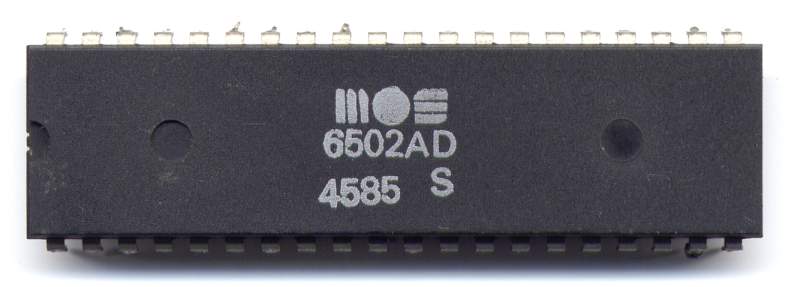 🇺🇸 United StatesMOS Technology 6502
Low-cost 8-bit microprocessor that powered the home computer revolutionCPU · Other · 1975
🇺🇸 United StatesMOS Technology 6532
Integrated circuit combining RAM, I/O ports and a timer for 1970s systems.Microcontroller · Other
🇺🇸 United StatesS2000
4-bit microcontroller for displays and controlMicrocontroller · Other · 1977
 🇺🇸 United States and 1 moreSignetics 8X300
A 1976 bipolar microcontroller and signal processor from SigneticsCPU · Other · 1976
More from National Semiconductor
All of them 🇺🇸 United StatesFairchild 9440
16-bit single-chip microprocessor running the Data General Nova 2 instruction setCPU · Other · 1977
 🇺🇸 United StatesWD16
A 16-bit CISC microprocessor from Western Digital, built from five DIP chips.CPU · Other · 1976
 🇺🇸 United StatesNational Semiconductor SC/MP
Early 8-bit microprocessor built for low-cost systems and shared-bus multiprocessor useCPU · 8-bit · 1976
 🇺🇸 United States and 1 moreLM317
Adjustable positive linear voltage regulator integrated circuitAnalog · 1976