
National Semiconductor SC/MP
Early 8-bit microprocessor built for low-cost systems and shared-bus multiprocessor use
SC/MP, short for Simple Cost-effective Micro Processor and pronounced scamp, is an 8-bit microprocessor from National Semiconductor that appeared in April 1976. It aimed at cheap systems needing few support chips and offered built-in bus arbitration so several processors could share memory, though its slow speed and paged memory kept use modest.
- Available April 1976 as an 8-bit PMOS microprocessor
- 46 instructions, 8-bit data path, 16-bit addresses
- Addressing limited to sixteen 4 KB pages
- Built-in bus arbitration for DMA and daisy-chained multiprocessors
- 40-pin DIP, clock range 1 MHz to 4 MHz
What it is
SC/MP is an early 8-bit microprocessor from National Semiconductor, available from April 1976. Its name stands for Simple Cost-effective Micro Processor and is pronounced scamp. The design goal was a system needing as few extra support chips as possible. It carries 46 instructions, an 8-bit data path and a 16-bit address space, and ships in a 40-pin DIP. What set it apart was built-in bus-access logic, letting several SC/MP chips share one memory bus in a daisy chain or hand the bus to direct memory access hardware. Speed was modest compared with the Intel 8080 or MOS 6502.
How it came about
National Semiconductor built SC/MP for cost-driven embedded work, favouring simple control logic over raw performance. It reached customers in April 1976. Signetics was named an authorised second source and issued SC/MP-II documentation, but whether it ever built SC/MP parts is unclear. The line continued with SC/MP-II, also called INS8060, and later the 70-Series (INS8070). Some later writers label that family SC/MP III or SC/MP-3, wording National Semiconductor itself did not use.
Inside the chip
The programmer sees an 8-bit accumulator (AC), an 8-bit Extension register (E), an 8-bit status register and four 16-bit pointer registers, P0 to P3. P0 is the program counter; by convention P1 points into ROM, P2 into RAM, and P3 holds addresses across interrupts and calls. There is no hardware stack. The ALU is accumulator-based, doing fixed-point two's-complement arithmetic plus two-digit BCD addition via DAE. E doubles as the serial shift register for the SIO instruction and can supply displacements in memory instructions. Addressing is page-based: only the low 12 bits of the address change automatically, so memory appears as sixteen 4 KB pages and crossing a page needs extra instructions.
How it was made
The original SC/MP was a PMOS device, as shown by the ISP-8A/500 part marking. It was supplied in a 40-pin dual in-line package. To keep pin count down, only 12 address pins are brought out; four more address bits are multiplexed onto the data bus.
Where it went
SC/MP was aimed at embedded systems where low cost mattered more than speed. Its bus-request, enable-in and enable-out lines let it serve direct memory access transfers and let several processors share a bus in a daisy chain, with priority going to whichever chip is earliest in the chain. National's own notes suggest no more than about three processors in such a chain without extra priority logic. Slow execution and paged memory limited appeal beyond that embedded niche, where the Fairchild F8 competed strongly.
Versions and family
The first part was the PMOS SC/MP, marked ISP-8A/500. It was succeeded by SC/MP-II, also known as INS8060, whose bus signals are the active-low NBREQ, NENIN and NENOUT. National later brought out the 70-Series, or INS8070 Series. Later writers sometimes call that generation SC/MP III or SC/MP-3, a term absent from contemporary National documentation.
Why it matters
SC/MP showed that built-in bus arbitration could be designed into a cheap microprocessor, easing multi-processor and DMA designs without a separate controller. Osborne praised exactly this, calling it a strong choice as a slave processor in multi-microprocessor setups. In practice such systems stayed rare, and overall take-up of the chip was limited.
Problems and reception
Reviewers found the part slow beside the 8080 and 6502: an 8-bit add immediate takes 22 clocks on SC/MP against seven on the 8080 and two on a 6502. The paged memory model, where the program counter wraps at a 4 KB boundary instead of moving to the next page, also drew comment. Osborne and Kane noted that a bus cycle could be suspended partway, with read and write strobes potentially repeating, and that the documentation did not pin down the exact point at which a cycle became unstoppable.


Questions people ask about National Semiconductor SC/MP
What does SC/MP stand for?
The name means Simple Cost-effective Micro Processor. National Semiconductor pronounced it scamp. It described an 8-bit part meant to keep the cost of a complete system low by needing few companion chips.
Why is its memory handling unusual?
Only the low 12 bits of an address advance automatically, so code and data sit in sixteen 4 KB pages. Reaching another page needs explicit instructions, and running off the end of a page wraps back to the start of that same page rather than continuing.
How fast was it?
Clock rates ran from 1 MHz to 4 MHz. It was clearly slower than rivals: an add-immediate took 22 clocks on SC/MP, versus seven on the Intel 8080 and two on a MOS 6502.
What made it useful in multi-processor setups?
Bus-request and enable signals were built in, so several SC/MP chips could share one memory bus in a daisy chain, or give the bus to DMA hardware. Priority followed position in the chain, and National suggested keeping chains to about three processors.
What came after it?
SC/MP-II, also called INS8060, followed, and National later released the 70-Series (INS8070). Some later writers call that family SC/MP III or SC/MP-3, though National's own documents did not use those names.
Good reading and sources
- National Semiconductor SC/MP on WikipediaEncyclopedia
- More photos on Wikimedia CommonsPhotos
- Wikidata recordOpen data
The facts on this page come from the Wikipedia article "National Semiconductor SC/MP", written by its contributors and used under the CC BY-SA 4.0 licence, and from its Wikidata record (CC0). EveryChip rewrote the text in its own words, with AI assistance, and compares every page with the article to make sure no passage is copied. It may be reused under the same CC BY-SA 4.0 licence with a link back.
It may contain mistakes, and figures change over time. Nothing here is investment or buying advice. If something is wrong, tell us. Last refreshed 2026-11-14.
Like National Semiconductor SC/MP
All CPUs and microprocessors 🇺🇸 United StatesBELLMAC-8
An 8-bit Bell Labs microprocessor built to run the C languageCPU · 8-bit · 1977
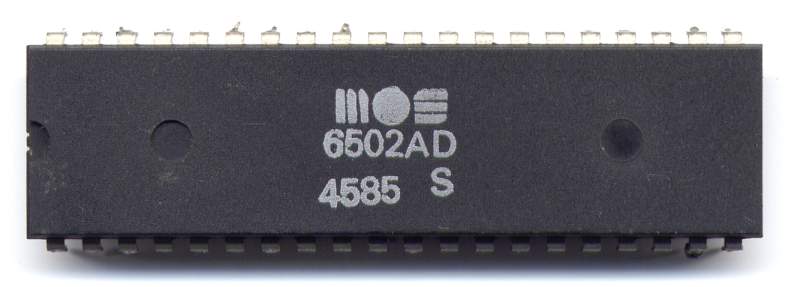 🇺🇸 United StatesMOS Technology 6502
An 8-bit microprocessor from 1975 that made cheap home computing possibleCPU · 8-bit · 1975
 🇺🇸 United StatesAMD Am9080
AMD's reverse-engineered clone of the Intel 8080, made from 1975CPU · 8-bit · 1975
🇺🇸 United StatesRockwell PPS-8
An early 8-bit microprocessor from Rockwell with unusual code-saving featuresCPU · 8-bit · 1974
More from National Semiconductor
All of them 🇺🇸 United States and 1 moreLM317
Adjustable positive linear voltage regulator integrated circuitAnalog · 1976
 🇺🇸 United States and 1 moreSignetics 8X300
A 1976 bipolar microcontroller and signal processor from SigneticsCPU · Other · 1976
 🇺🇸 United States and 1 moreMCP-1600
A 1975 multi-chip 16-bit microprocessor from Western DigitalCPU · Other · 1975
 🇺🇸 United StatesSignetics 2650
8-bit microprocessor from 1975 modelled on the IBM 1130 minicomputerCPU · 8-bit · 1975