
Signetics 2650
8-bit microprocessor from 1975 modelled on the IBM 1130 minicomputer
The Signetics 2650 is an 8-bit microprocessor that Signetics introduced in July 1975, designed from 1972 by John Kessler with layout by Kent Andreas. Built to resemble a minicomputer, it found use in hobbyist kits, arcade games, pinball machines and consoles, but its odd memory addressing limited wider adoption.
- Introduced July 1975 as an 8-bit microprocessor from Signetics
- Designed from 1972 by John Kessler, modelled on the IBM 1130
- Fully static NMOS part, halted simply by stopping the clock
- On-chip eight-level stack of 15-bit return addresses
- Used in arcade games, pinball machines and the Emerson Arcadia 2001
What it is
The Signetics 2650 is an 8-bit microprocessor that arrived in July 1975. Signetics built it as a single-chip CPU that could stand in for a minicomputer, and Adam Osborne called it the most minicomputer-like microprocessor of its day. It ran at 1.25 MHz in its base form and shipped in a 40-pin dual in-line package. The chip carried features rare for microprocessors of the era, such as vectored interrupts and an on-chip return stack. Those traits suited control work, and the part turned up in arcade games, pinball machines, home computers and consoles, though its memory addressing scheme kept it from selling widely.
How it came about
Signetics manager Jack Curtis hired John Kessler away from IBM in 1972 to lead a new single-chip CPU aimed at minicomputer work. Kessler modelled the design on the IBM 1130, a 16-bit machine from 1965. Kent Andreas drew the chip layout using a new ion implantation NMOS process. The design outclassed the Intel 4004 and 8008 of the day, but Signetics delayed production while it worked on Dolby noise-reduction chips, so the CPU did not appear until July 1975. Philips bought Signetics that year, and later parts carry either brand. Second-source deals with Advanced Memory Systems and National Semiconductor both fell through.
Inside the chip
Kessler drew heavily on the IBM 1130, giving the 2650 traits more common in 1960s minis than in 1970s microprocessors. Status bits tracked input and output devices, and vectored interrupts let a device place an address on the data bus so the CPU could jump straight to the right handler. Registers comprised a global accumulator R0 plus two banks of three index registers, switchable through a bit in the status word. Indirect addressing was built into most instructions, and a second arithmetic unit handled address maths. An eight-level return stack sat on the die itself. The trade-off was a 15-bit address space, cut to 13 bits for most instructions, so memory had to be split into 8 KB pages.
How it was made
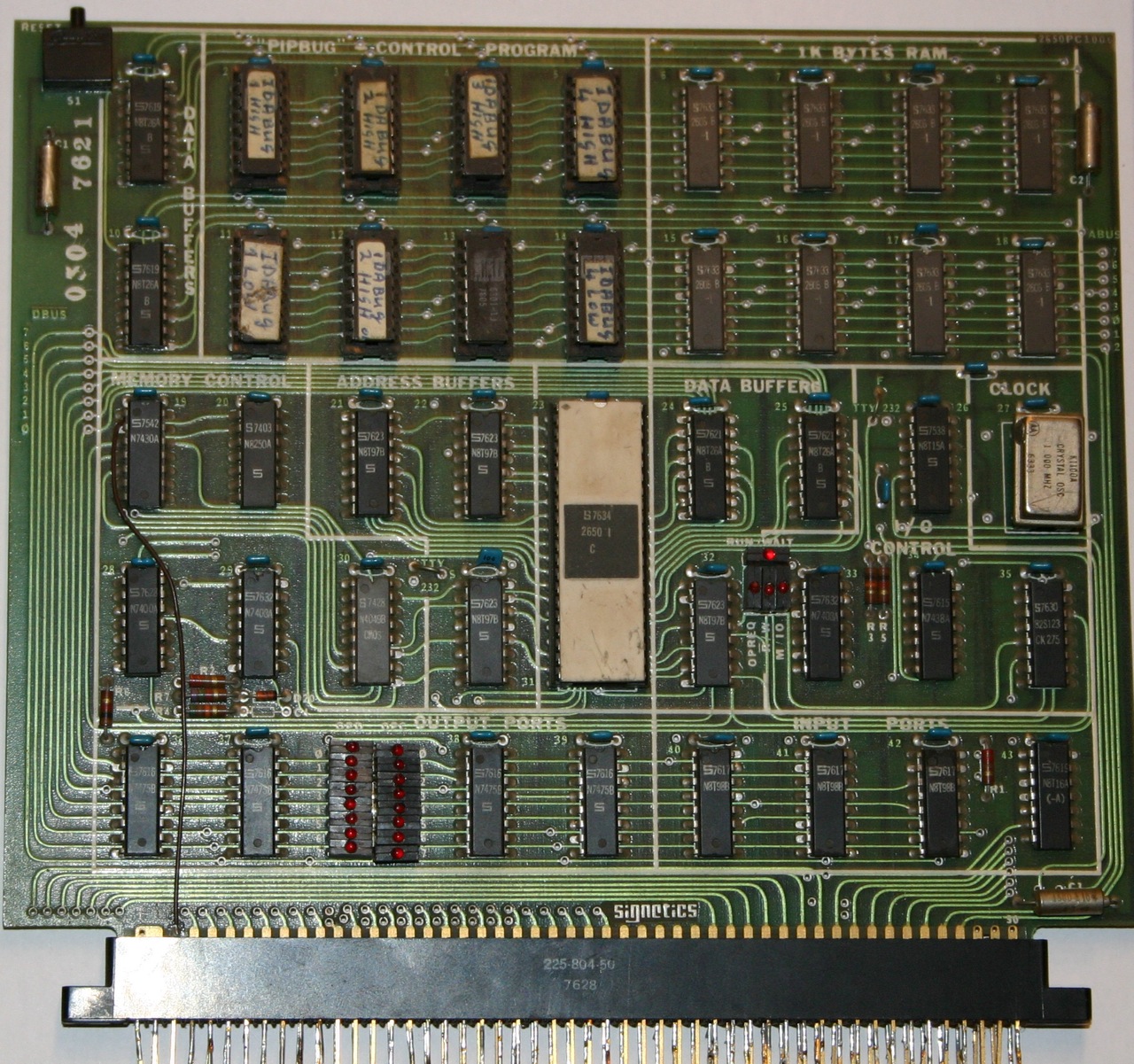
The chip used an ion implantation NMOS process, which drew less power and ran cooler than the PMOS parts common at the time. That let the first 2650s match the 1.25 MHz clock of contemporary IBM 1130 models. It was a fully static design, so stopping the clock halted the processor, a trick hobbyists used to single-step programs with a push button. The part came in a 40-pin plastic or ceramic dual in-line package, needing one 5 V supply and an external single-phase clock.
Where it went
Signetics sold development boards, the PC1001 and later the PC1500, and the bare chip cost around A$20. Magazines such as Electronics Australia and Elektor published projects and kits, drawing hobbyists in Australia, the USA, the UK, the Netherlands and Germany. Consoles using the 2650 or 2650A include the Interton Video Computer 4000, the 1292 Advanced Programmable Video System and the Emerson Arcadia 2001. Arcade titles ranged from Atari's Quiz Show to Zaccaria's The Invaders, and Zaccaria built 28 pinball machines on the chip. It also powered the Signetics Instructor 50 teaching computer and the Tektronix 8540 development system.
Versions and family
The 2650A, introduced in 1977, reworked the original layout to raise yield and cut cost, keeping 1.25 MHz for the base part and 2 MHz for the -1 grade. The 2650B built on the A, adding two instructions and speeding up several existing ones. Advanced Memory Systems agreed to second-source the part in March 1976 but was bought by Intersil that November, which dropped it. A planned National Semiconductor version from 1977 never reached production, and only one example from France has surfaced.
Why it matters
The 2650 showed that a single chip could carry minicomputer habits such as vectored interrupts and status bits for peripherals. Its I/O support, with single-bit pins and dedicated port instructions, made it a natural microcontroller, and Philips demonstrated it running an intelligent lift system and a small robot. It reached hobbyists, arcades, pinball and consoles across several countries. Its addressing limits, however, kept it out of the mainstream as memory sizes grew.
Problems and reception
Adam Osborne judged it the most minicomputer-like microprocessor available, and in 1972 it beat the Intel 4004 and 8008 on features. Reviewers and users noted that missing capabilities and unusual memory access restricted its appeal. The 15-bit address space, and the 13 bits left for most instructions, became a real handicap once dynamic RAM made 8 KB, 16 KB and 64 KB machines ordinary. The chip saw little use in the wider market.



Questions people ask about Signetics 2650
Who designed the Signetics 2650?
John Kessler, hired from IBM by Signetics' Jack Curtis in 1972, designed the architecture. Kent Andreas handled the chip layout. Kessler based the design on the IBM 1130 minicomputer, which dated from 1965.
Why did the 2650 have so little memory space?
The top bit of each 16-bit address flagged indirection, leaving 15 bits, so 32 KB in total. Two more bits selected indexing modes on arithmetic and logic instructions, leaving 13 bits and 8 KB pages. Reaching other pages needed an indirect address and an extra memory cycle.
What made it good for control work?
It had single-bit input and output pins, plus instructions that addressed two 8-bit ports directly and a further 256 ports with an 8-bit address. Vectored interrupts let a device supply its own handler address. Philips showed it running a lift system and a small robot.
What versions were made?
The 2650A of 1977 reworked the layout for better yield, at 1.25 MHz or 2 MHz in the -1 grade. The 2650B added two instructions and improved others. Planned second sources from Advanced Memory Systems and National Semiconductor never reached production.
What products used the chip?
Consoles such as the Interton Video Computer 4000 and Emerson Arcadia 2001, arcade games including Atari's Quiz Show and Zaccaria's The Invaders, 28 Zaccaria pinball machines, the Signetics Instructor 50 teaching computer and the Tektronix 8540 development system.
Good reading and sources
- Signetics 2650 on WikipediaEncyclopedia
- More photos on Wikimedia CommonsPhotos
- Wikidata recordOpen data
The facts on this page come from the Wikipedia article "Signetics 2650", written by its contributors and used under the CC BY-SA 4.0 licence, and from its Wikidata record (CC0). EveryChip rewrote the text in its own words, with AI assistance, and compares every page with the article to make sure no passage is copied. It may be reused under the same CC BY-SA 4.0 licence with a link back.
It may contain mistakes, and figures change over time. Nothing here is investment or buying advice. If something is wrong, tell us. Last refreshed 2026-11-14.
Like Signetics 2650
All CPUs and microprocessors 🇺🇸 United StatesMOS Technology 6502
Low-cost 8-bit microprocessor that powered the home computer revolutionCPU · Other · 1975
 🇺🇸 United StatesFairchild F8
An early 8-bit microprocessor family built for small controller jobsCPU · 8-bit · 1974
 🇺🇸 United StatesWDC 65C02
CMOS rework of the 6502 with lower power and extra instructionsCPU · 8-bit · 1983
 🇺🇸 United StatesMotorola 6800 family
An 8-bit microprocessor line from Motorola, starting with the 6800 CPUCPU · 8-bit
More from Signetics
All of them 🇺🇸 United States and 1 moreMCP-1600
A 1975 multi-chip 16-bit microprocessor from Western DigitalCPU · Other · 1975
 🇺🇸 United StatesNational Semiconductor SC/MP
Early 8-bit microprocessor built for low-cost systems and shared-bus multiprocessor useCPU · 8-bit · 1976
 🇺🇸 United States and 1 moreLM317
Adjustable positive linear voltage regulator integrated circuitAnalog · 1976
 🇺🇸 United StatesNational Semiconductor PACE
First commercial single-chip 16-bit microprocessor, from National Semiconductor in 1974CPU · Other · 1974