
Motorola 6800 family
An 8-bit microprocessor line from Motorola, starting with the 6800 CPU
The Motorola 6800 family is a series of 8-bit microprocessors and microcontrollers that began with the 6800 CPU. Later members folded RAM, ROM, timers and ports onto one chip, and the design stayed in production through Freescale and into NXP as an embedded controller.
- 8-bit microprocessor family from Motorola, starting with the 6800 CPU
- 6801 adds on-chip RAM, ROM, a multiplier and a 16-bit timer
- Cost work on the 6800 led to the MOS 6502
- Hitachi cloned it as the 6301 and 6309
- NXP still offers the design as an embedded controller
What it is
The M6800 Microcomputer System, later called the Motorola 6800 family or 68xx, is a line of 8-bit microprocessors and microcontrollers. It opened with the 6800 CPU, which faced Intel's 8080 and later the MOS 6502 and Zilog Z80. Early on, a designer had to attach RAM, ROM and support chips around the CPU. Over time Motorola folded those pieces onto the die, producing single-chip microcontrollers. Cost and package size limits shaped a spread of near-identical parts with different feature mixes. The line remained on sale into the 1990s and beyond, first through Freescale Semiconductor and then NXP, where it serves as an embedded controller inside larger chips.
How it came about
Motorola launched the 6800 as the heart of its M6800 Microcomputer System. Rivals soon pushed it aside in general use, but the design kept spawning variants. Efforts to cut its cost produced the MOS 6502, one of the era's best-selling processors. Hitachi copied the 6801 as the 6301 and later the 6809 as the 6309, adding features of its own. Motorola's chip division became Freescale Semiconductor, which NXP bought in 2015.
Inside the chip
The 6800 is a plain 8-bit CPU: it fetches instructions, moves data over an address bus and a data bus, and needs outside memory to work. Later parts shrink that burden. The 6801 carries 128 bytes of static RAM plus 2048 bytes of factory-programmed ROM, keeps 64 bytes alive during shutdown for a fast wake-up, speeds up many instructions, and adds an 8x8 unsigned multiplier and a 16-bit timer. With memory on-chip, the old bus pins can switch to parallel I/O, and the timer can drive a serial port. CMOS reworkings carry a C in the part number.
How it was made
Some 6805 versions came in 28- or 40-pin packages, with three CMOS variants prefixed 14. Hitachi and United Microelectronics Corporation also built versions of these parts.
Where it went
The 6800 competed in early microcomputer systems against the Intel 8080. Hitachi's 6301 went into the Psion Organiser I, while the HD6303 appeared in the Psion Organiser II, Yamaha's KX88 MIDI keyboard, the Yamaha DX7 synthesiser and Roland's TR-707 drum machine. Today NXP still supplies the design as an embedded controller within bigger chip systems.
Versions and family
The line grew by adding or trimming features. The 6801 pairs the CPU with RAM and ROM; the 68701 swaps in EPROM for development; the 6802 adds 128 bytes of RAM and an internal clock, with 32 bytes held in standby; the 6802NS drops that standby RAM. The 6803 removes the internal program memory. The 6805 and 146805 merge earlier features into a customisable family. The 6808 is a 6802 whose RAM failed test. The 6809 adds enough new capability to count as its own design. Later Freescale parts include the 68HC05, 68HC08, 68HC11, 16-bit 68HC12 and 68HC16.
Why it matters
The 6800 never matched the sales of some rivals, yet it shaped the market widely. Cost-cutting work on it led directly to the MOS 6502, a hugely popular design. Hitachi cloned two members, and Motorola's backward-compatible 6809 carried the idea forward. The family stayed in production for decades, moving from Motorola to Freescale and then NXP, which still offers it.
Problems and reception
Newer 8-bit rivals such as the MOS 6502 and Zilog Z80 pushed the original 6800 out of broad use. The design nonetheless kept selling through its many derivatives and remains available from NXP.
Questions people ask about Motorola 6800 family
What is the Motorola 6800 family?
It is a series of 8-bit microprocessors and microcontrollers from Motorola, beginning with the 6800 CPU. Later members put memory, timers and I/O on the same chip, turning them into single-chip microcontrollers for embedded work.
Why did it matter if it lost to rivals?
Although the 6800 sold less than some competitors, it influenced the market strongly. Attempts to simplify it and lower its cost produced the MOS 6502, and Hitachi cloned several members, spreading the design further.
How did later family members differ from the first 6800?
They integrated parts the original needed outside. The 6801, for example, carries 128 bytes of static RAM and 2048 bytes of ROM, plus a multiplier and timer, and lets the old bus pins act as parallel ports.
Is the design still available?
Yes. Motorola's chip division became Freescale Semiconductor, which NXP bought in 2015. NXP continues to supply the design as an embedded controller inside larger chip systems.
What is the difference between the 6800 and the 6809?
The 6809 is a pure CPU that adds many new features while staying backward compatible. It is generally treated as a separate design rather than a simple family member, and Hitachi cloned it as the 6309 with further additions.
Good reading and sources
The facts on this page come from the Wikipedia article "Motorola 6800 family", written by its contributors and used under the CC BY-SA 4.0 licence, and from its Wikidata record (CC0). EveryChip rewrote the text in its own words, with AI assistance, and compares every page with the article to make sure no passage is copied. It may be reused under the same CC BY-SA 4.0 licence with a link back.
It may contain mistakes, and figures change over time. Nothing here is investment or buying advice. If something is wrong, tell us. Last refreshed 2026-11-14.
Like Motorola 6800 family
All CPUs and microprocessors 🇺🇸 United StatesFairchild F8
An early 8-bit microprocessor family built for small controller jobsCPU · 8-bit · 1974
 🇺🇸 United StatesSignetics 2650
8-bit microprocessor from 1975 modelled on the IBM 1130 minicomputerCPU · 8-bit · 1975
 🇺🇸 United StatesWDC 65C02
CMOS rework of the 6502 with lower power and extra instructionsCPU · 8-bit · 1983
 WorldMOS Technology 6510
8-bit 6502-derived CPU with a built-in I/O port, used in the Commodore 64CPU · 8-bit
More from Motorola
All of them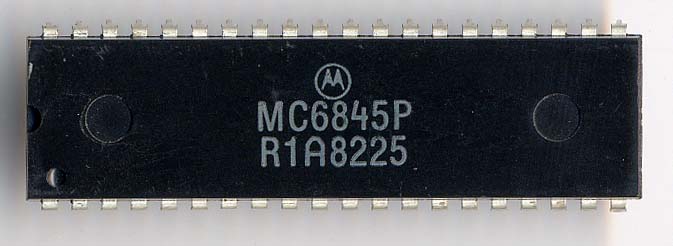 🇺🇸 United StatesMotorola 6845
Display controller for 1980s home computers and early PC graphics cardsGPU
🇺🇸 United StatesRAD5500
Radiation-hardened PowerPC processor for space systemsCPU · Power
 WorldMotorola 68851
External memory management unit for Motorola 68020 processorsAnalog · 68k
 🇺🇸 United StatesI.MX
ARM-based system-on-chip family for multimedia and embedded systems by NXP Semiconductors.SoC · Arm