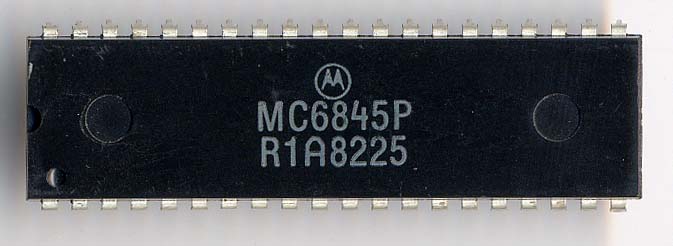
Motorola 6845
Display controller for 1980s home computers and early PC graphics cards
The Motorola 6845 is a display controller chip widely used in 1980s 8-bit computers and early IBM PC adapters. It manages video memory timing and address generation for raster displays, enabling text and basic graphics on machines like the BBC Micro and Amstrad CPC.
- Uses 14-bit character and 5-bit row addresses for memory access
- Supported light pen input via internal address latch
- Found in IBM PC CGA, MDA, and Hercules Graphics Cards
- Cloned by Hitachi, Fujitsu, UMC, and Bulgarian manufacturers
- Allows software switching between 50 Hz and 60 Hz refresh rates
What it is
The Motorola 6845, also known as the MC6845, is a cathode-ray tube controller designed for raster displays. It does not generate pixel data itself but provides precise timing signals and memory addresses for external circuits to fetch character or pixel patterns. This chip was central to video hardware in many 1980s home computers and early personal computer graphics adapters. Its flexible design allowed engineers to implement various display modes, from simple text to complex graphics, by managing how video memory was accessed during each screen refresh cycle.
How it came about
Originally intended for systems using the Motorola 6800 processor, the chip found broader adoption with Zilog Z80 and MOS 6502 based machines. Designers valued its programmability, which allowed software to switch between 50 Hz and 60 Hz refresh rates. The chip avoided internal character buffering to keep manufacturing costs low during an era when memory was expensive and chip yields were sensitive to die size. This design choice shifted the burden of memory bandwidth management to the system architect, influencing how video subsystems were built throughout the decade.
Inside the chip
The device features eighteen 8-bit registers that control all video timing aspects. It generates a 14-bit character address and a 5-bit row address, allowing it to access over half a million memory words. By splitting addresses this way, it supports character-based displays where ROM stores font patterns. Programmers could manipulate these addresses to create linear framebuffers or enable smooth scrolling tricks. The chip also includes a latch for light pen input, capturing the current beam position when triggered by external hardware.
How it was made
Specific manufacturing details such as process node or transistor count are not provided in the available records. The chip was produced by Motorola and later cloned by other manufacturers including Hitachi, Fujitsu, and United Microelectronics Corporation. These clones maintained pin compatibility, ensuring they could replace the original in various designs. The decision to exclude internal buffers was driven by the high cost of silicon area and memory at the time of its introduction.
Where it went
This controller powered video systems in notable machines like the BBC Micro, Amstrad CPC, and Videx VideoTerm for the Apple II. It was a key component in early IBM PC graphics standards, including the Monochrome Display Adapter, Color Graphics Adapter, and Hercules Graphics Card. Japanese computers from Sony, Sharp, and Panasonic also utilized Hitachi-built versions. The chip supported both interlaced and non-interlaced output modes, making it versatile for different monitor types and regional television standards.
Versions and family
MOS Technology and Rockwell produced the 6545, a closely related variant with minor differences such as optional address skew and sole bus access modes. Hitachi manufactured the HD46505, while Fujitsu created the MB89321A clone. During trade embargoes, Bulgaria produced the CM607 version. Later Motorola revisions incorporated some features from the 6545, such as address skew support. These variants ensured the architecture remained available across different markets and supply chains.
Why it matters
The 6845 established a standard for flexible video timing in microcomputers, influencing subsequent graphics hardware design. Its use in IBM PC adapters helped define early PC graphics capabilities, even as newer standards like EGA and VGA eventually extended its functionality. The chip demonstrated how minimal hardware could support diverse display configurations through clever software and external circuit design. Its legacy persists in the architecture of many retro computing systems and emulators today.
Questions people ask about Motorola 6845
Does the Motorola 6845 generate pixel images directly?
No, the chip does not generate actual pixels. It provides timing signals and memory addresses so external circuits can fetch character patterns or pixel data. The actual conversion of this data into video signals for the monitor is handled by other hardware components in the system.
Why was internal character buffering omitted from the design?
Internal buffering was excluded to keep the chip die small and cost-effective. In the 1980s, larger dies had lower production yields and higher costs. This design required the system to have sufficient memory bandwidth to re-read character data for every scan line during display refresh.
Which famous computers used the Motorola 6845 chip?
It was used in the BBC Micro, Amstrad CPC, and early IBM PC graphics adapters like the CGA and Hercules card. It also appeared in the Videx VideoTerm for the Apple II and various Japanese home computers from manufacturers such as Sony, Sharp, and Panasonic.
Good reading and sources
- Motorola 6845 on WikipediaEncyclopedia
- More photos on Wikimedia CommonsPhotos
- Wikidata recordOpen data
The facts on this page come from the Wikipedia article "Motorola 6845", written by its contributors and used under the CC BY-SA 4.0 licence, and from its Wikidata record (CC0). EveryChip rewrote the text in its own words, with AI assistance, and compares every page with the article to make sure no passage is copied. It may be reused under the same CC BY-SA 4.0 licence with a link back.
It may contain mistakes, and figures change over time. Nothing here is investment or buying advice. If something is wrong, tell us. Last refreshed 2026-11-14.
Like Motorola 6845
All graphics processors 🇫🇷 FranceThomson EF936x
Graphic Display Processor by Thomson-EFCIS from the late 1970sGPU · 1977
 🇺🇸 United StatesMotorola 6847
Simple video chip for 1980s home computersGPU · Other · 1978
 🇯🇵 JapanYamaha V9938
Video display processor for MSX2 home computersGPU · Other · 1985
More from Motorola
All of them WorldMotorola 68851
External memory management unit for Motorola 68020 processorsAnalog · 68k
 WorldMotorola 96000
32-bit floating point digital signal processor by MotorolaDSP · Other