
Motorola 6847
Simple video chip for 1980s home computers
The Motorola 6847 is a Video Display Generator released in 1978. It creates basic graphics and text for NTSC televisions. This chip powered many early home computers like the TRS-80 Color Computer and Dragon 32.
- Released by Motorola in 1978 for NTSC TVs
- Displays 256 by 192 pixel resolution
- Includes built-in 64-character ASCII ROM
- Supports twelve colors via YPbPr signals
- Used in TRS-80 Color Computer and Dragon 32
What it is
The MC6847 is a Video Display Generator introduced by Motorola in 1978. It produces video signals for standard NTSC television sets. The chip handles alphanumeric text, semigraphics, and simple raster images. Its output resolution is 256 pixels wide by 192 lines high. This square aspect ratio fits safely within the visible area of older TV screens. It avoids character cutoff caused by overscan. The device was widely used in early personal computers and game consoles.
How it came about
Motorola launched this chip to provide an affordable video solution for consumer electronics. Television sets were the most common display devices in homes during the late 1970s. High-resolution monitors were too expensive for mass-market computers. The design prioritizes compatibility with existing TV hardware over graphical fidelity. It became a standard component in machines like the Acorn Atom and NEC PC-6000 series. The chip allowed manufacturers to build low-cost systems without complex video circuitry.
Inside the chip
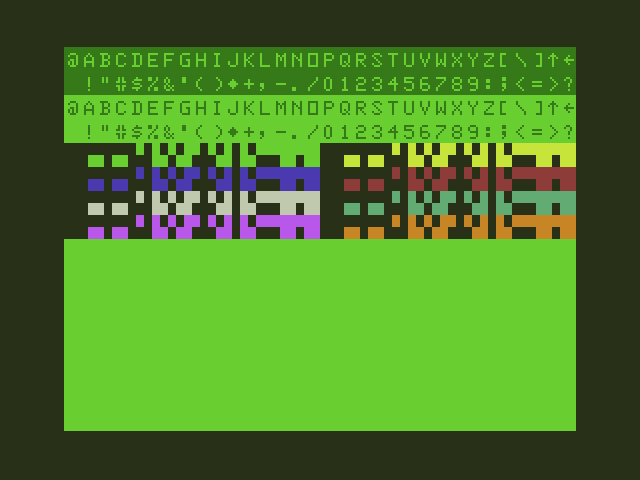
The chip generates a progressive scan signal with 262 lines at 60 Hz. It uses a built-in Read Only Memory to store character shapes. The default font contains 64 ASCII characters in a 5 by 7 pixel grid. Users could order custom ROM patterns for specialized symbols. Colors are created by combining luminance and chrominance signals. The palette includes twelve distinct hues such as green, orange, and cyan. Text modes support inverse video and colored backgrounds. An updated version, the 6847T1, added lowercase letters to the character set.
How it was made
Motorola manufactured the chip in several package types. These included ceramic cases with an L suffix, plastic with a P suffix, and CERDIP with an S suffix. The internal character memory is organized as a matrix of 2240 bits. Customers could supply their own ROM patterns on PROM chips or floppy disks. Motorola would then produce verification units for testing. Some systems used external memory chips to expand the character set beyond the internal limits.
Where it went
This video generator appeared in many notable home computers. The TRS-80 Color Computer and Dragon 32 relied on it for display output. Other systems include the Laser 200, Matra Alice, and Gakken Compact Vision TV Boy. The APF Imagination Machine also utilized this chip. It served as the primary video source for these machines, driving composite video outputs directly to television sets. The simplicity of the chip made it ideal for educational and entry-level computing devices.
Versions and family
Three main variants exist in the product line. The standard 6847 is non-interlaced. The 6847Y supports interlaced scanning for higher vertical resolution. The 6847T1 is a non-interlaced version with an expanded 96-character ROM. This update allowed for proper lowercase text display. Different packaging options catered to various manufacturing needs. Some regional computer models, like the Spanish Dragon 200-E, used daughterboards to modify the chip's behavior.
Why it matters
The MC6847 helped democratize home computing by lowering video costs. It enabled a generation of programmers to create games and applications on limited hardware. Its color palette and semigraphic modes influenced the visual style of early software. The chip remains a recognizable part of vintage computing history. It demonstrated how integrated circuits could simplify system design for consumer products.


Questions people ask about Motorola 6847
What resolution does the Motorola 6847 support?
The chip outputs a display matrix of 256 pixels wide by 192 lines high. This low resolution ensures compatibility with standard NTSC television sets and prevents image cutoff from overscan.
How many colors can the MC6847 display?
The hardware palette consists of twelve colors. These include black, green, yellow, blue, red, buff, cyan, magenta, and orange. Dark green and dark orange are used for text ink.
Can the character set be changed?
Yes. Motorola allowed customers to order chips with custom ROM patterns. Systems could also use external character ROMs, as seen in the Dragon 200-E variant.
Good reading and sources
- Motorola 6847 on WikipediaEncyclopedia
- More photos on Wikimedia CommonsPhotos
- Wikidata recordOpen data
The facts on this page come from the Wikipedia article "Motorola 6847", written by its contributors and used under the CC BY-SA 4.0 licence, and from its Wikidata record (CC0). EveryChip rewrote the text in its own words, with AI assistance, and compares every page with the article to make sure no passage is copied. It may be reused under the same CC BY-SA 4.0 licence with a link back.
It may contain mistakes, and figures change over time. Nothing here is investment or buying advice. If something is wrong, tell us. Last refreshed 2026-11-14.
Like Motorola 6847
All graphics processors 🇯🇵 JapanYamaha V9938
Video display processor for MSX2 home computersGPU · Other · 1985
 🇺🇸 United StatesOriginal Chip Set
Custom chipset for early Commodore Amiga computersGPU · Other · 1985
🇺🇸 United StatesIntel i750
Two-chip video processor for early digital video captureGPU · Other · 1991
🇺🇸 United StatesAmiga Advanced Graphics Architecture
Third-generation graphics chipset for Commodore Amiga computersGPU · Other · 1992
More from Motorola
All of them 🇺🇸 United StatesMC14500B
One-bit CMOS microprocessor for industrial control logicMicrocontroller · Other · 1977
 🇺🇸 United StatesMotorola 68000
A 16/32-bit CISC microprocessor introduced by Motorola in 1979CPU · 68k · 1979
🇺🇸 United StatesMotorola 68000 series
32-bit CISC microprocessor family from MotorolaCPU · 68k · 1979
 🇺🇸 United States and 1 moreMC10800
4-bit bit-sliced processor in ECL logic from 1979CPU · Other · 1979