
Transputer
A 1980s microprocessor series designed for parallel computing with integrated memory and serial links.
Inmos, a Bristol-based company, created the transputer in the 1980s to enable parallel processing. Each chip included on-chip memory and serial communication ports, allowing multiple units to form large computing networks without complex motherboards.
- Designed by David May and Robert Milne at Inmos.
- Featured integrated RAM and serial communication links.
- Operated at 20 MHz using a 5 MHz external clock.
- Primarily programmed using the Occam language.
- Supported booting software directly over network links.
What it is
The transputer was a family of microprocessors developed by Inmos during the 1980s. It was built specifically for parallel computing tasks. Unlike standard CPUs of the era, each unit contained its own random-access memory. It also featured serial communication links to connect directly with other chips. This design allowed engineers to build large computing systems by linking many simple processors together. The goal was to create a scalable architecture where performance increased by adding more nodes rather than speeding up a single core.
How it came about
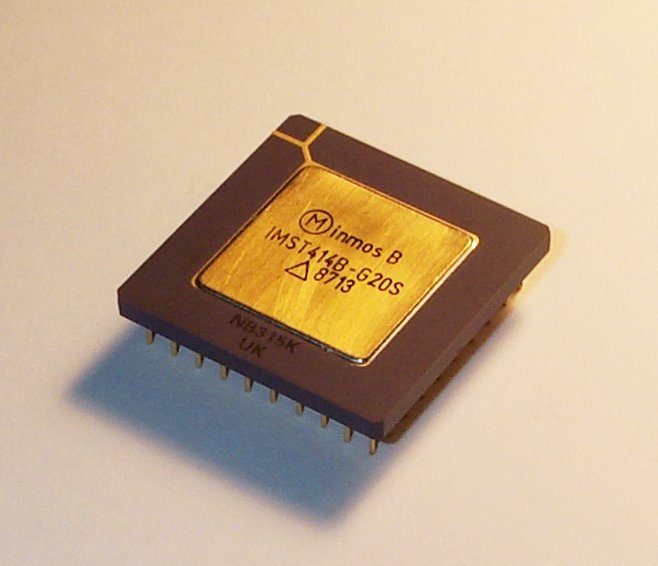
Computer scientist David May and telecommunications consultant Robert Milne led the initial design work. They aimed to overcome the performance limits of traditional complex instruction set computers. By the late 1980s, the technology was highly regarded as a potential future standard for computing. Tony Fuge, an engineer at Inmos, won the Prince Philip Designers Prize in 1987 for his work on the T414 model. Despite high expectations, the architecture did not become the dominant industry standard it was predicted to be.
Inside the chip
The architecture used microcode to control data paths efficiently. It operated at a high internal clock speed of 20 MHz, derived from a slower 5 MHz external signal via a phase-locked loop. The chip featured only three data registers that acted as a stack. Context switching was fast because the system used a workspace pointer to access memory stacks. It included hardware schedulers to manage traffic over its serial links. Processes waiting for communication would automatically pause, freeing the processor for other tasks without needing complex operating system intervention.
How it was made
Inmos manufactured the chips at their facility in Bristol, United Kingdom. The design integrated significant circuitry onto a single die, effectively creating a processor-in-memory. This approach reduced the need for external components like bus controllers or separate memory management units. The chips utilized dynamic logic in several areas to save space and improve speed. However, these techniques made automatic testing difficult, which influenced later design choices. The company also introduced the TRAM standard in 1987 to simplify building multi-chip systems.
Where it went
The primary use case was parallel computing clusters. Engineers could link transputers together to solve complex problems by dividing tasks across multiple units. The architecture supported booting code directly over the network links. One central chip could distribute software to others in the network. Occam was the main programming language used to exploit this concurrency. Implementations for C, FORTRAN, Ada, and Pascal were also released later to support broader development needs.
Versions and family
The series included various models ranging in power and cost. The T414 was a notable variant for which Tony Fuge received recognition. Inmos provided zero-delay switches to connect up to 32 transputers into larger networks. These switches helped reduce latency compared to direct point-to-point linking. The TRAM module standard allowed different sizes of daughterboards to be used. These modules could include external memory or peripheral devices alongside the core processor.
Why it matters
Although the transputer did not achieve mass market dominance, it influenced modern computer architecture. Many ideas re-emerged in later systems. The concept of integrating memory and communication on a single chip foreshadowed system-on-chip designs. The emphasis on concurrency and message passing impacted distributed computing research. The hardware scheduler demonstrated how low-level features could simplify software development for parallel tasks.
Problems and reception
The transputer faced challenges due to its unconventional nature. The required programming language, Occam, was unfamiliar to many developers. The initial development environment was also considered unorthodox. These factors limited early adoption despite the technical merits. The architecture struggled to compete with established x86 and RISC designs that offered easier migration paths for existing software.


Questions people ask about Transputer
What made the transputer different from other 1980s CPUs?
It integrated memory and serial communication links directly onto the chip. This allowed multiple processors to connect easily without complex motherboards or buses. It was designed specifically for parallel computing rather than sequential processing.
Which programming language was used for transputers?
The primary language was Occam, based on communicating sequential processes. It matched the hardware's concurrency features. Later versions supported C, FORTRAN, Ada, and Pascal through third-party compilers.
How did transputers communicate with each other?
They used serial links called os-links. Each chip could connect to four others at speeds of 5, 10, or 20 Mbit/s. Messages were relayed between chips to form larger networks.
Who designed the original transputer architecture?
Computer scientist David May and telecommunications consultant Robert Milne led the design team at Inmos. Their goal was to create a scalable parallel computing solution.
Good reading and sources
The facts on this page come from the Wikipedia article "Transputer", written by its contributors and used under the CC BY-SA 4.0 licence, and from its Wikidata record (CC0). EveryChip rewrote the text in its own words, with AI assistance, and compares every page with the article to make sure no passage is copied. It may be reused under the same CC BY-SA 4.0 licence with a link back.
It may contain mistakes, and figures change over time. Nothing here is investment or buying advice. If something is wrong, tell us. Last refreshed 2026-11-16.
Like Transputer
All CPUs and microprocessors 🇺🇸 United StatesSBP0400
4-bit slice microprocessor using I²L technologyCPU · Other · 1975
🇺🇸 United StatesBellmac 32
Bell Labs CMOS microprocessor, first to move 32 bits per clock cycleCPU · Other · 1980
WorldNCR/32
A 32-bit microprocessor set from NCR with custom microcode support.CPU · Other · 1982
 🇯🇵 JapanNEC V60
32-bit CISC microprocessor family from NEC for embedded and arcade useCPU · Other · 1986
