
Mali
A family of graphics processing unit cores licensed by Arm for mobile and embedded chips.
The Mali and Immortalis series are graphics processors created by Arm Holdings. They began as the Utgard architecture in 2005 after Arm acquired Falanx Microsystems. These cores power many smartphones and tablets worldwide.
- Acquired by Arm in 2006 from Falanx Microsystems.
- First architecture launched in 2005 as Utgard.
- Cores range from 1 to 32 per chip design.
- Immortalis series added hardware ray tracing in 2022.
- Open-source Linux drivers exist for most generations.
What it is
The Mali and Immortalis series are graphics processing units designed by Arm Holdings. They function as semiconductor intellectual property cores rather than standalone cards. Manufacturers license these designs to build system-on-chip devices for phones and tablets. The name comes from a Serbo-Croatian word meaning small, reflecting their target market. Arm also produces related video and image signal processors under the same brand.
How it came about
Development started at Falanx Microsystems A/S, a spin-off from the Norwegian University of Science and Technology. Arm acquired the company on 23 June 2006 and renamed it Arm Norway. The first architecture, Utgard, launched in 2005 with the Mali-200 chip. Subsequent generations included Midgard, Bifrost, and Valhall. In June 2022, Arm introduced the Immortalis series featuring hardware ray tracing.
Inside the chip
These GPUs use various microarchitectures like Utgard, Midgard, Bifrost, and Valhall. Early models used discrete pixel and vertex shaders. Later designs adopted unified shaders and scalar instruction sets. Cores range from one to thirty-two depending on the model. They render graphics into memory rather than driving displays directly. Display controllers are handled by separate Arm cores. Features include cache coherency and advanced compression techniques.
How it was made
Arm does not manufacture these chips itself. Instead, partners integrate the IP into their own ASICs using processes between four and forty nanometres. Transistor counts vary by implementation. The cores are packaged within larger system-on-chip solutions. Arm provides tools for shader development and user interface engines to assist designers.
Where it went
Mali GPUs appear in countless smartphones, tablets, and smart home devices. They handle 3D rendering for games and user interfaces. Video processors support codecs like H.264, HEVC, and VP9 for streaming and videotelephony. Image signal processors manage camera inputs for security cameras and drones. They are essential for mobile multimedia performance.
Versions and family
The lineup includes GPU, video, display, and image signal processor variants. GPU models range from Mali-T604 to Immortalis-G720. Video processors include V500, V550, V61, V52, V76, and V77. Display processors like D71 and D77 handle output. Image processors such as C71 and C55 manage camera data. Each generation improves efficiency and adds new features.
Why it matters
Mali cores dominate the mobile graphics market due to their licensing model. They enable efficient graphics in resource-constrained devices. Open-source drivers like Lima, Panfrost, and Panthor allow Linux support. This community effort ensures long-term software compatibility. The technology has shaped how mobile devices handle visual content.
Problems and reception
Reverse-engineering projects like Lima emerged early on to provide open-source support. Developers successfully implemented OpenGL ES and Vulkan drivers. The mainline Linux kernel now includes these drivers. This openness has been praised by the developer community. No major recalls or controversies are recorded.
Questions people ask about Mali
Who makes the Mali GPU?
Arm Holdings designs the Mali GPU architecture. They license the intellectual property to other companies who integrate it into their own chips. Arm does not manufacture the physical silicon itself.
What does the name Mali mean?
The name was originally Malaik but shortened to Mali. It is a Serbo-Croatian word meaning small. This reflected its intended use in compact mobile devices rather than large desktop computers.
Are there open-source drivers for Mali?
Yes. Projects like Lima, Panfrost, and Panthor provide open-source drivers for Linux. These allow Mali GPUs to work with standard operating systems without proprietary code from Arm.
What is the difference between Mali and Immortalis?
Immortalis is a newer series announced in 2022. It includes hardware-based ray tracing support. Standard Mali GPUs generally lack this specific feature found in the Immortalis line.
Good reading and sources
The facts on this page come from the Wikipedia article "Mali (processor)", written by its contributors and used under the CC BY-SA 4.0 licence, and from its Wikidata record (CC0). EveryChip rewrote the text in its own words, with AI assistance, and compares every page with the article to make sure no passage is copied. It may be reused under the same CC BY-SA 4.0 licence with a link back.
It may contain mistakes, and figures change over time. Nothing here is investment or buying advice. If something is wrong, tell us. Last refreshed 2026-11-17.
Like Mali
All graphics processors 🇬🇧 United KingdomVideoCore
Low-power mobile multimedia processor series by BroadcomGPU · Arm
🇯🇵 JapanPICA200
Low-power GPU core for embedded devices and handheld consolesGPU · GPU architecture · 2005
🇯🇵 JapanULTRAY2000
Concept GPU by DMP with MAESTRO lighting techGPU · GPU architecture · 2005
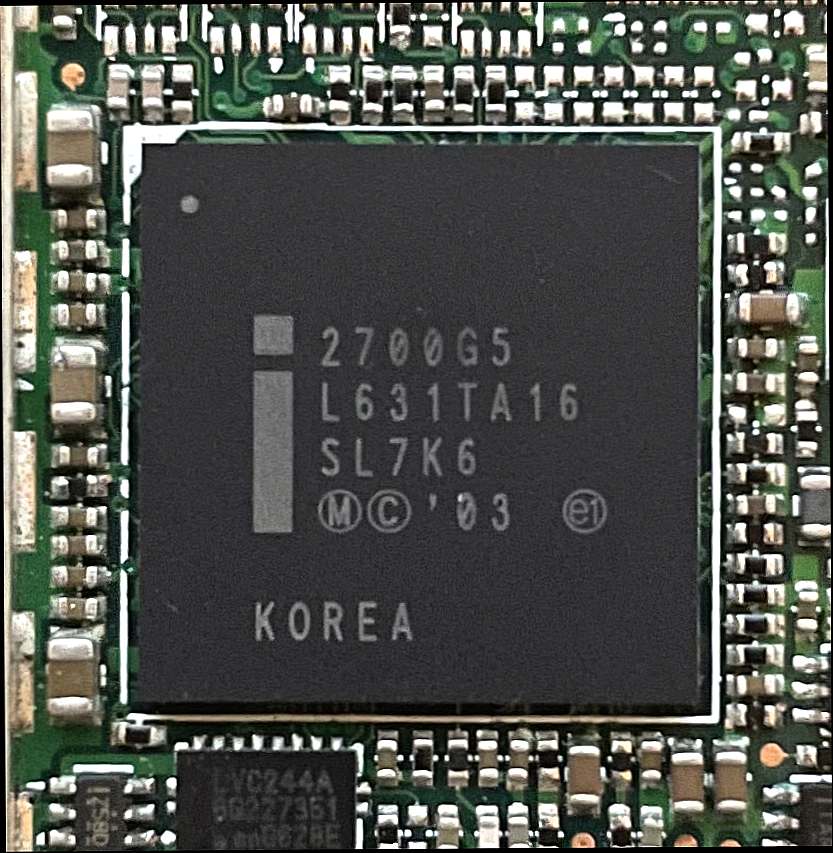 🇺🇸 United StatesIntel 2700G
Mobile graphics co-processor for XScale PXA27xGPU · GPU architecture · 2004
More from Arm Holdings
All of them WorldARM Cortex-A8
32-bit ARMv7-A processor core for mobile devicesCPU · Arm · 2005
 🇬🇧 United KingdomARM Cortex-A9
32-bit multi-core processor core for mobile and embedded systemsCPU · Arm · 2007
 🇺🇸 United StatesQualcomm Snapdragon
Qualcomm's brand of ARM-based systems on chip, modems and wireless controllersSoC · Arm · 2007
 EuropeSTM32
32-bit ARM microcontrollers and microprocessors from STMicroelectronicsMicrocontroller · Arm · 2007