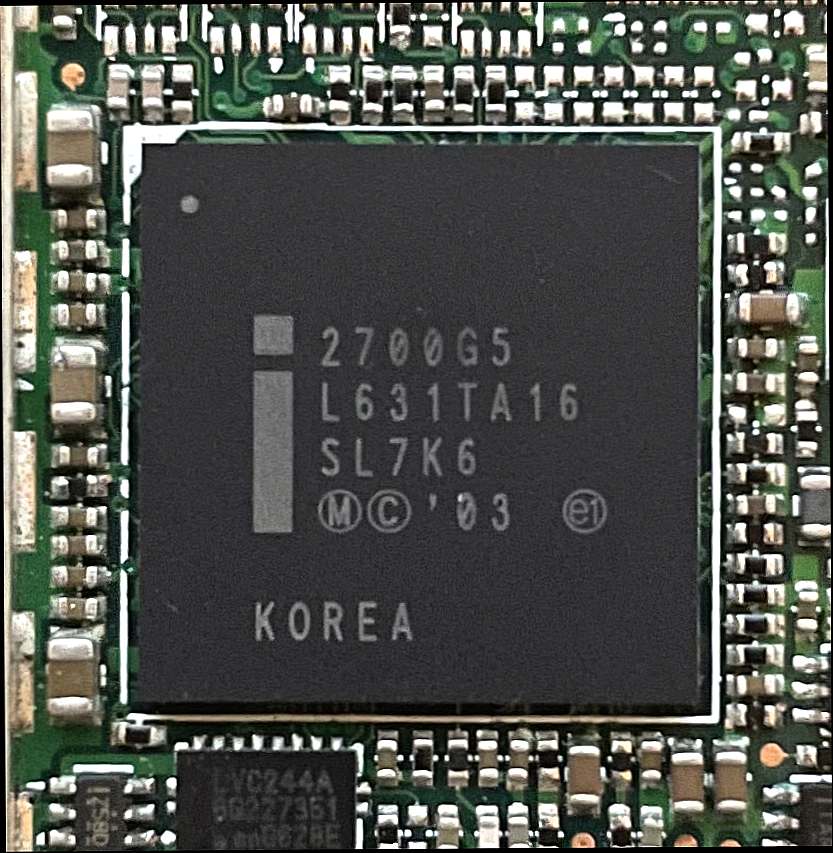
Intel 2700G
Mobile graphics co-processor for XScale PXA27x
Intel released the 2700G in April 2004 as a dedicated graphics chip for mobile devices. It paired with XScale processors to handle 2D, 3D and video tasks efficiently.
- Announced on April 12, 2004
- Maximum power draw of 70 mW
- Supports OpenGL ES 1.0 standard
- Decodes MPEG-4 video at VGA resolution
- Used in Dell Axim X50v and X51v
What it is
The Intel 2700G is a graphics co-processor designed for mobile systems. Announced in April 2004, it works alongside the XScale PXA27x application processor. The chip handles graphics rendering and video decoding to reduce the load on the main CPU. It uses technology licensed from PowerVR and includes specific video encoding features. This design allowed handheld devices to display complex interfaces and play video smoothly while keeping power consumption low. The maximum power draw is just 70 milliwatts.
How it came about
Intel developed this chip under the code name Marathon. It combined PowerVR MBX Lite graphics cores with MVED1 video technology. The goal was to enhance the multimedia capabilities of XScale-based devices. After Intel sold its XScale business unit to Marvell, the company discontinued the 2700G series. No direct successor was released by Intel for this specific mobile graphics role.
Inside the chip
The core runs at 75 MHz with a 32-bit interface. It supports OpenGL ES 1.0 for three-dimensional graphics, including texture compression and shading. Two-dimensional operations include alpha blending and anti-aliasing. The chip can drive two liquid crystal displays simultaneously. Video acceleration covers MPEG-1, MPEG-2, MPEG-4 and WMV formats. It processes inverse discrete cosine transforms and motion compensation in hardware. This allows DVD-resolution playback at thirty frames per second.
How it was made
The chip ships in a ball grid array package. Three variants exist with different memory configurations. The base model has 384 kilobytes of on-die memory. The performance version increases this to 704 kilobytes. The top tier stacks 16 megabytes of local memory in the same package. This stacked memory connects via a 100 MHz bus.
Where it went
This processor appeared in several personal digital assistants and smartphones. Devices included the Dell Axim X50v and X51v models. The Gigabyte GSmart t600 and Pepper Pad 2 also used it. Intel planned it for the cancelled Palm Foleo project. Beyond handhelds, it powered standalone signage kiosks and human-machine interfaces. Examples include the MediaStaff DS and various industrial touch screen controllers from Advantech and Clipsal.
Versions and family
The 2700G3 is the entry-level option with limited memory for smaller screens. The 2700G5 offers more memory for VGA resolution and better video support. The 2700G7 matches the G5 performance but adds substantial external memory bandwidth. All three share the same core architecture and clock speed. They differ primarily in how much graphics data they can store locally without accessing system RAM.
Why it matters
It brought desktop-class graphics features to early smartphones and PDAs. By offloading video and graphics tasks, it extended battery life for multimedia use. The integration of PowerVR technology helped establish standards for mobile 3D acceleration. Its discontinuation marked the end of Intel's direct involvement in this specific segment of mobile graphics hardware before the rise of modern integrated solutions.
Questions people ask about Intel 2700G
What devices used the Intel 2700G?
It was found in the Dell Axim X50v and X51v, Gigabyte GSmart t600, and Pepper Pad 2. It also powered industrial kiosks and touch screen controllers from companies like Advantech and Clipsal.
How much memory does the chip have?
Memory depends on the variant. The G3 has 384 kB, the G5 has 704 kB, and the G7 includes 16 MB of stacked local memory for higher bandwidth operations.
Can it play video files?
Yes, it accelerates decoding for MPEG-1, MPEG-2, MPEG-4 and WMV. It can handle DVD-resolution video at thirty frames per second using dedicated hardware blocks.
Is the Intel 2700G still available?
No, the product line is discontinued. This happened after Intel sold its XScale unit to Marvell, ending their production of these specific mobile graphics co-processors.
Good reading and sources
- Intel Delivers Next-Generation Processors Specifically Designed For Cell Phones And Wireless PDAsIntel, Article
- Sega Dreamcast spawned Intel PDA graphics techThe Register, Article
The facts on this page come from the Wikipedia article "Intel 2700G", written by its contributors and used under the CC BY-SA 4.0 licence, and from its Wikidata record (CC0). EveryChip rewrote the text in its own words, with AI assistance, and compares every page with the article to make sure no passage is copied. It may be reused under the same CC BY-SA 4.0 licence with a link back.
It may contain mistakes, and figures change over time. Nothing here is investment or buying advice. If something is wrong, tell us. Last refreshed 2026-11-14.
Like Intel 2700G
All graphics processors 🇺🇸 United StatesIntel Graphics Technology
Integrated graphics processors for Intel CPUsGPU · GPU architecture · 2010
🇺🇸 United StatesRadeon RX Vega
AMD graphics processors using the fifth generation GCN architectureGPU · GPU architecture · 2017
 🇺🇸 United StatesPowerVR
Graphics and AI accelerator IP for mobile and embedded systemsGPU · GPU architecture · 1985
 🇬🇧 United KingdomVideoCore
Low-power mobile multimedia processor series by BroadcomGPU · Arm
More from Intel
All of them 🇺🇸 United StatesIntel GMA
Integrated graphics series for low-cost PCs by IntelGPU · GPU architecture · 2004
 🇺🇸 United StatesTejas and Jayhawk
Cancelled Intel CPU cores planned as successors to Prescott Pentium 4 and XeonCPU · x86 · 2004
 🇺🇸 United StatesPentium D
Intel's first dual-core desktop Pentium, two NetBurst cores in one packageCPU · x86 · 2005
 🇺🇸 United States and 1 morePentium M
Intel's power-saving laptop CPU line, launched in 2003 on the P6 designCPU · x86 · 2003