
Pentium M
Intel's power-saving laptop CPU line, launched in 2003 on the P6 design
Pentium M is a line of single-core x86 processors that Intel built for notebook computers, starting in March 2003. It drew far less power than the mobile Pentium 4 it replaced while keeping comparable speed, and it became the heart of the Centrino laptop platform before the Core brand took over.
- Launched 12 March 2003 as part of the Centrino platform
- 900 MHz to 2.26 GHz, with TDP from 5 W to 27 W
- Banias at 130 nm with 77 million transistors
- Dothan at 90 nm with about 140 million transistors
- A 1.6 GHz part could match a 2.4 GHz mobile Pentium 4
What it is
Pentium M is a family of 32-bit single-core x86 microprocessors that Intel designed for laptops. The line arrived in March 2003 as part of the Centrino notebook platform and carried the mobile part of the Pentium name until 2009. It ran at modest clock speeds yet matched or beat the hotter mobile Pentium 4, which made thin, quiet notebooks practical. Chips spanned 900 MHz to 2.26 GHz with a thermal design power between 5 W and 27 W. The design grew out of the Pentium III core rather than the Pentium 4, and it added a faster bus, better instruction handling, stronger branch prediction, SSE2 and a much bigger cache.
How it came about
Intel's Haifa team in Israel had been working on the memory controller for Timna, and that job gave them deep knowledge of the P6 design. When Intel needed a backup mobile processor on a tight schedule, the same group took it on. The first chip, code-named Banias after an ancient site in the Golan Heights, reached market in March 2003. A second core called Dothan, named for an old town in Israel, was announced in September 2003 and formally launched on 10 May 2004. Intel dropped the Pentium M from its price lists in July 2009.
Inside the chip
The chip pairs a Pentium III execution core with a bus interface borrowed from the Pentium 4, plus a redesigned front end that decodes and issues instructions more efficiently. Branch prediction improved and SSE2 arrived. Level 1 cache is 64 KB, split evenly between data and instructions, while the shared Level 2 cache is 1 MB or 2 MB. Only the part of the L2 cache being read is powered up, which saves energy while leaving useful capacity available. SpeedStep 3 varies clock speed and core voltage on the fly; a 1.6 GHz part can step down through 600 MHz, 800 MHz, 1000 MHz, 1200 MHz, 1400 MHz and 1600 MHz. The address width is 36 bits and the data width 64 bits.
How it was made
Banias was built on Intel's 130 nm process and carries about 77 million transistors. Dothan moved to 90 nm and roughly 140 million transistors, most of them forming the 2 MB cache, yet the die stayed near 87 mm2. Both were made by Intel. Chips shipped in a micro pin grid array package and in a high performance ball grid array, using Socket 479 or H-PBGA479.
Where it went
Intel sold the Pentium M only as a mobile part, and it powered the Centrino notebook platform. Enthusiasts went further: AOpen, DFI and MSI built desktop boards for it, ASUS offered the CT-479 adapter so the chip could sit in certain Socket 478 boards, and Shuttle sold complete desktops tuned for low energy use and quiet cooling. Embedded makers also valued it, since its low heat allowed fanless and very small PCs. The chip tolerates undervolting well, using tools such as Notebook Hardware Control or RMClock.
Versions and family
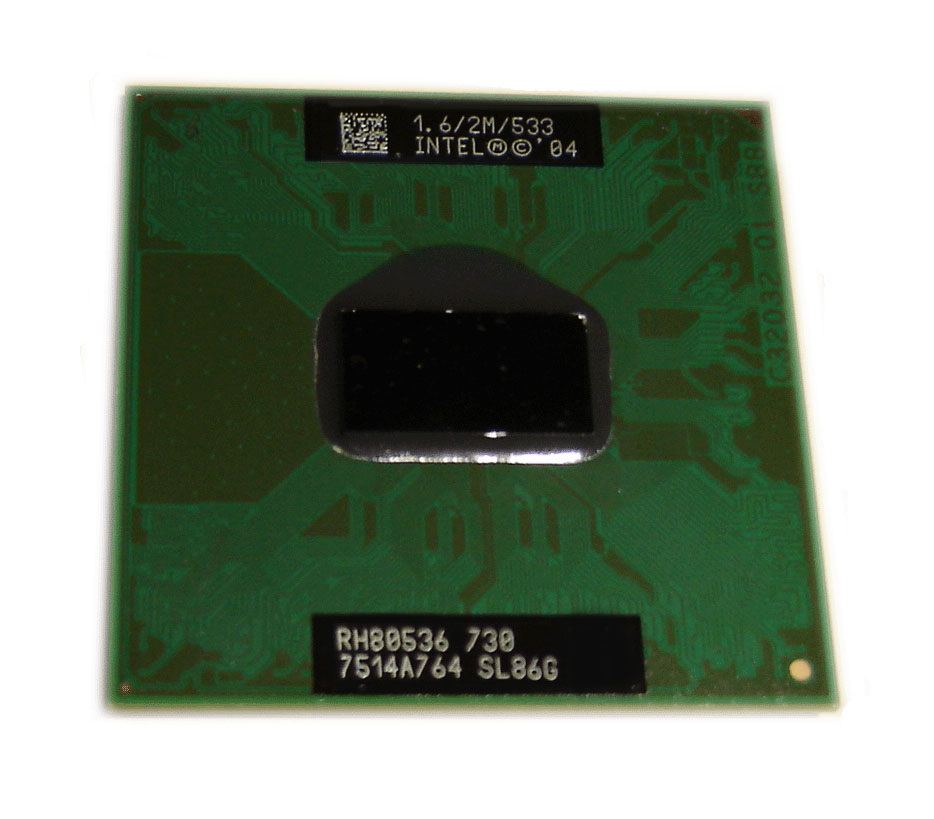
Banias, product code 80535, ran from 900 MHz to 1.7 GHz on a 400 MT/s front-side bus with 1 MB of L2 cache and a 24.5 W average TDP. Dothan, code 80536, kept the same basic shape but doubled the cache and moved to 90 nm. Early Dothan models covered 1.4 GHz to 2.1 GHz at 21 W. Revisions from early 2005 paired with Sonoma chipsets, raised the bus to 533 MT/s and added XD support, reaching 2.26 GHz at 27 W. Low-voltage and ultra-low-voltage versions ran as low as 5 W. A related ultra low-power part, the Intel A100 series, used a Dothan core with 512 KB of L2. Celeron M was a sibling line, and Yonah followed as Core Duo and Core Solo.
Why it matters
By proving that a laptop chip could match a much faster-clocked desktop design while sipping power, Pentium M reshaped Intel's mobile roadmap. A 1.6 GHz part could reach or pass the speed of a 2.4 GHz Pentium 4-M, and the 740 model has been measured near 7,400 MIPS and 3.9 GFLOPS using SSE2. The design became the base for the Core Solo and Core Duo processors, and later the mobile Pentium Dual-Core line carried the Pentium name forward after 2009.
Problems and reception
Third-party reviews found Dothan roughly 10 to 20 percent quicker than Banias in most tests, while notebooks using either core delivered about the same battery life. One snag concerned Banias and early Dothan chips: they support Physical Address Extension internally but do not set the PAE flag in CPUID. Linux kernels that require PAE can refuse to boot without the forcepae option, and Windows 8 or later crashes while loading ntoskrnl.exe with error 0xc0000260. Later Dothan revisions set the flag and removed the problem.



Questions people ask about Pentium M
What kind of chip is the Pentium M?
It is a single-core 32-bit x86 microprocessor built by Intel for notebook computers. The design descends from the Pentium III core rather than the Pentium 4, and it was tuned to run cool and save battery life while still delivering strong performance.
Why did Intel build it?
The mobile Pentium 4 ran hot and drained batteries quickly. Intel's Haifa team, already familiar with the P6 design from work on Timna's memory controller, was given a crash project to make a backup mobile CPU. The result replaced the Pentium 4-M in laptops.
What is the difference between Banias and Dothan?
Banias, code 80535, was the first core, made at 130 nm with 1 MB of L2 cache and 77 million transistors. Dothan, code 80536, moved to 90 nm, doubled the cache to 2 MB and reached about 140 million transistors, with later versions adding a faster bus and XD support.
What came after it?
The Yonah core arrived under the Intel Core brand as Core Duo and Core Solo, based on an enhanced version of the Pentium M design. The Pentium M name itself left Intel's price lists in July 2009, succeeded by mobile Pentium Dual-Core processors.
Can it run modern operating systems?
Banias and early Dothan chips do not report PAE in CPUID, so many Linux distributions need the forcepae boot option and Windows 8 or later fails with error 0xc0000260. Revised Dothan models enable the PAE flag and avoid those boot problems.
Good reading and sources
- Intel SupportIntel, Article
- A Look at Centrino's Core: The Pentium MArs Technica, Article
- Checking your browserAnandTech, Article
- Mooly Eden: A look into the origins of Core 2 DuoTom's Hardware, Article
The facts on this page come from the Wikipedia article "Pentium M", written by its contributors and used under the CC BY-SA 4.0 licence, and from its Wikidata record (CC0). EveryChip rewrote the text in its own words, with AI assistance, and compares every page with the article to make sure no passage is copied. It may be reused under the same CC BY-SA 4.0 licence with a link back.
It may contain mistakes, and figures change over time. Nothing here is investment or buying advice. If something is wrong, tell us. Last refreshed 2026-11-14.
Like Pentium M
All CPUs and microprocessors 🇺🇸 United StatesIntel Core
Intel's multi-core x86 CPU line for laptops, desktops and workstationsCPU · x86 · 2006
 🇮🇱 IsraelIntel Core microarchitecture
Intel's 2006 multi-core CPU design that replaced NetBurst across desktops, laptops and serversCPU · x86 · 2006
 🇺🇸 United States and 1 moreIntel Core 2
Intel's 2006 x86-64 desktop and laptop CPU family, from single-core to quad-core.CPU · x86 · 2006
 🇺🇸 United StatesIntel Core
Multi-core x86 CPUs for PCs and servers by Intel.CPU · x86 · 2006
More from Intel
All of them 🇺🇸 United StatesIntel GMA
Integrated graphics series for low-cost PCs by IntelGPU · GPU architecture · 2004
 🇺🇸 United StatesXScale
ARM-based microarchitecture for mobile and embedded systemsCPU · Arm · 2002
 🇺🇸 United StatesTejas and Jayhawk
Cancelled Intel CPU cores planned as successors to Prescott Pentium 4 and XeonCPU · x86 · 2004
 🇺🇸 United StatesIntel 2700G
Mobile graphics co-processor for XScale PXA27xGPU · GPU architecture · 2004