74181
4-bit slice ALU, the first complete arithmetic logic unit on one chip
The 74181 is a 4-bit slice arithmetic logic unit built as a 7400 series TTL chip. Texas Instruments introduced it in February 1970, and it became the arithmetic and logic core of many minicomputers, sitting between board-level CPUs and single-chip microprocessors.
- First complete ALU on a single chip, introduced February 1970
- 16 arithmetic and 16 logical operations on two 4-bit words
- Standard part: 22 ns per operation, about 45 MHz
- Sixteen 74S181 slices with 74S182 carry units do 64-bit work in 28 ns
- Used in the PDP-11, Xerox Alto, VAX-11/780 and Data General Nova
What it is
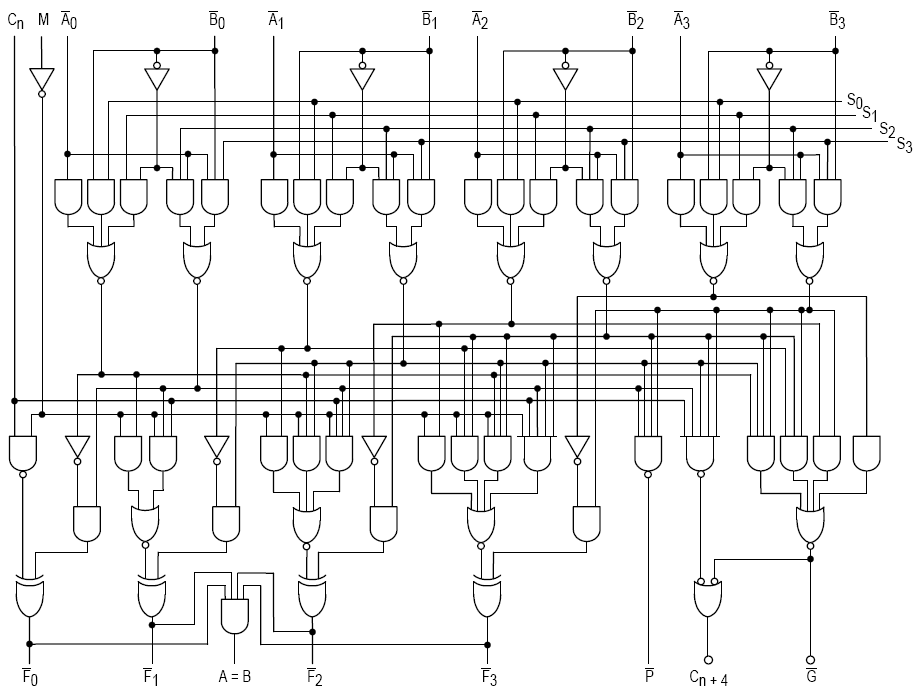
The 74181 is a 4-bit slice arithmetic logic unit, the part of a processor that does sums, comparisons and Boolean operations. Texas Instruments brought it out in February 1970 as the first complete ALU on a single chip. Built in the 7400 series TTL family at medium-scale integration, it packs the equivalent of about 75 logic gates into a 24-pin DIP. Designers chained several slices together to build wider CPUs, and it became the arithmetic core of many important minicomputers of the 1970s and early 1980s.
How it came about
Before this chip arrived, a processor's arithmetic unit was spread across several circuit boards made of small-scale logic, and even modest machines filled cabinets. The 74181 let a whole CPU, sometimes a whole computer, fit on one large printed circuit board. It eased both design and production of fast machines through the 1970s and into the early 1980s. Once single-chip microprocessors grew stronger and cheaper, building a CPU from separate parts lost its appeal, and the 74181 disappeared from new designs.
Inside the chip
Four selection lines, S0 to S3, choose the operation. A mode input M picks logical or arithmetic work, and Cn is the carry-in. Data arrives on two 4-bit buses, A and B, and the result leaves on F. The chip covers all 16 logical functions of two variables plus 16 arithmetic ones, including add and subtract with or without carry, and it works with active-high or active-low data. Propagate and generate outputs feed a carry-lookahead adder such as the 74182. Multiply and divide are absent but can be built from shifts and adds. A left shift comes from choosing A plus A with carry; right shifts are not supported.
How it was made
The device is a medium-scale integration TTL part holding roughly 75 gates worth of logic, normally in a 24-pin DIP. Speed grades vary: the standard part finishes a 4-bit operation with carry in 22 nanoseconds, the 74S181 in 11 nanoseconds and the 74F181 in 7 nanoseconds typical. Slices stack for wider words. Sixteen 74S181s with five 74S182 look-ahead carry generators handle 64-bit operands in 28 nanoseconds. PDIP and CERDIP versions of the 74181 and 74182 are still made for breadboarding.
Where it went
The chip powered Data General's Nova 1200, the first commercial 16-bit minicomputer built around it, plus later Nova models. Several PDP-11 variants, the Xerox Alto, the VAX-11/780, the Three Rivers PERQ and the HP 2100 series relied on it, as did Texas Instruments' own 16-bit machines and the Wang 2200. Datapoint used pairs of them. Outside computers, the Vectorbeam arcade platform ran three 25LS181 slices in its 12-bit processor for games such as Space Wars and Star Castle, and NorthStar's S-100 floating point board carried one 74LS181.
Versions and family
The family includes the standard 74181, the faster 74S181 Schottky version, the 74F181 and the 74LS181 low-power Schottky part, plus the 25LS181 used in arcade hardware. The 74182 is a companion look-ahead carry generator that speeds multi-slice builds. Word width grows by adding slices: the Nova 1200 ran one chip four times over, while the Nova 800 used four, and the Naked Mini LSI-2 used four as well.
Why it matters
The 74181 marks the step from CPUs assembled from discrete gates across boards to processors on one die. It cut computer construction down to a single large board in many cases and shaped a generation of minicomputers, including machines as varied as the PDP-11, the Xerox Alto and the Synclavier's ABLE processor. Textbooks and technical papers still cite it as a classic ALU design.
Problems and reception
By 1994 the chip was no longer commercially sensible for CPU design, since microprocessors offered more performance for less money. It kept a role in teaching, where students could wire it up and see a processor take shape. Course labs, simulators and homebrew projects such as APOLLO181 in 2012 still use it for hands-on work in computer organisation.

Questions people ask about 74181
What does the 74181 actually do?
It is a 4-bit arithmetic logic unit. Given two 4-bit inputs, A and B, it produces a 4-bit result on F, doing sums, subtractions and Boolean operations such as AND, OR and XOR. Selection lines S0 to S3 and the mode input M choose the operation, and Cn supplies carry-in.
Why does a 4-bit chip matter?
Slices can be chained. Several 74181s work together to handle wider words, with a 74182 look-ahead carry generator speeding the carry between them. Sixteen 74S181s plus five 74S182s perform 64-bit operations in 28 nanoseconds.
Can it multiply or divide?
No. Those functions are not built in. They can be carried out over several steps using the shift and add or subtract operations. A left shift is obtained by selecting A plus A with carry, though right shifts are not supported.
Which computers used it?
Many minicomputers and workstations, among them the Data General Nova 1200, several PDP-11 models, the Xerox Alto, the VAX-11/780, the Three Rivers PERQ, the HP 2100 series and Texas Instruments' 16-bit machines. Arcade platforms and floating-point boards used it too.
Is it still available?
It is no longer used in new commercial designs, but PDIP and CERDIP packages of the 74181 and 74182 are still manufactured and sold for breadboarding, and the part remains common in computer architecture courses.
Good reading and sources
The facts on this page come from the Wikipedia article "74181", written by its contributors and used under the CC BY-SA 4.0 licence, and from its Wikidata record (CC0). EveryChip rewrote the text in its own words, with AI assistance, and compares every page with the article to make sure no passage is copied. It may be reused under the same CC BY-SA 4.0 licence with a link back.
It may contain mistakes, and figures change over time. Nothing here is investment or buying advice. If something is wrong, tell us. Last refreshed 2026-11-14.
Like 74181
All CPUs and microprocessors 🇯🇵 JapanNEC μCOM series
NEC microprocessor and microcontroller family from the 1970s and 1980sCPU · x86 · 1973
 WorldMOS 6507
A low-cost 8-bit 6502 variant in a 28-pin package with an 8 KB address rangeCPU · Other · 1975
 🇺🇸 United StatesMOS Technology 6502
An 8-bit microprocessor from 1975 that made cheap home computing possibleCPU · 8-bit · 1975
More from Texas Instruments
All of them 🇺🇸 United StatesEPROM
Non-volatile memory chip erased by ultraviolet lightMemory · 1971
 🇺🇸 United States4000 series
Versatile CMOS logic chips for low-power digital circuitsAnalog · Other · 1968
 🇺🇸 United StatesIntel 8008
Early 8-bit microprocessor from Intel, launched April 1972CPU · 8-bit · 1972
 🇺🇸 United StatesTMS1000
A 4-bit microcontroller family with on-chip ROM, RAM and I/O from 1974.Microcontroller · Other · 1974