
GAL22V10
Programmable logic device with configurable inputs and outputs
The GAL22V10 is a programmable logic device from Lattice Semiconductor. It uses CMOS technology to implement generic array logic circuits. Engineers use it for digital design tasks in education and industry. The chip features configurable macrocells and EEPROM programming.
- Features 12 inputs and 10 configurable I/O pins
- Switching speeds range from 25 ns to 4 ns
- Uses E2PROM for storing logic configurations
- Discontinued by Lattice in June 2010
What it is
The GAL22V10 is a series of programmable logic devices made by Lattice Semiconductor. It implements generic array logic using CMOS integrated circuits. These chips come in dual inline packages or plastic leaded chip carriers. They serve as standard examples of general array logic devices. Students and engineers often use them in educational settings to learn basic programmable logic concepts. In combinatorial mode, the device acts like a group of programmable AND-OR-invert gates. This allows users to create custom digital circuits without designing new silicon.
How it came about
Lattice Semiconductor developed the GAL22V10 as part of its standard production line. The company discontinued the GAL22V10D variant in June 2010. The final shipments occurred in June 2011. Lattice did not offer pin-compatible replacements for this specific series. Other manufacturers like Microchip and Atmel produced compatible versions such as the ATF22V10. These alternatives remain available in various package types including PDIP and SOIC. The device shares conceptual roots with earlier parts like the GAL16V8 and GAL20V8.
Inside the chip
The chip has twelve input pins and ten pins that function as inputs or outputs. Each output uses an output-logic macrocell with an enable term. Product terms range from eight to sixteen per macrocell. Users can set each macrocell to inverting or non-inverting modes. Registered mode uses a D-flip-flop to store state on clock edges. Combinatorial mode bypasses the flip-flop for direct logic driving. Configuration data is stored in E2PROM memory. The device includes latch-up protection via charge pumps and pull-ups. A security cell prevents logic retrieval once programmed.
How it was made
Lattice Semiconductor manufactured these devices using CMOS technology. The chips are available in dual inline packages and plastic leaded chip carriers. Switching speeds vary from 25 nanoseconds down to 4 nanoseconds. The manufacturing process includes active pull-ups on inputs and outputs. High-impedance buffers ensure compatibility with transistor-transistor logic levels. Official units include a user electronic signature section for identification. Static sections maintain compatibility with non-Lattice variants of the same part number.
Where it went
Engineers use the GAL22V10 in educational environments to teach programmable logic. It serves as a basic device for learning digital circuit design. The chip supports both registered and combinatorial logic operations. This flexibility allows it to replace multiple fixed-function logic gates. Designers can reprogram the E2PROM to change circuit behavior without new hardware. The device fits into systems requiring custom glue logic or simple state machines. Its TTL compatibility makes it easy to integrate with older digital systems.
Versions and family
The GAL22V10D was a specific variant discontinued by Lattice. Similar devices include the GAL16V8 and GAL20V8 which have fewer pins. Microchip and Atmel produce the ATF22V10 series as pin-compatible replacements. These modern variants come in PDIP, SOIC, PLCC, and TSSOP packages. The ATF22V10B and ATF22V10C are examples of these compatible parts. They offer lower power consumption while maintaining the same logical structure. No direct replacement was recommended by Lattice after discontinuation.
Why it matters
The GAL22V10 established a standard for generic array logic devices. Its use in education helped many students understand programmable logic fundamentals. The architecture influenced later complex programmable logic devices. Open source tools like GALasm and Galette support assembly for these chips. Hardware programmers such as Afterburner allow users to configure the devices. The inclusion of security cells set a precedent for protecting intellectual property in programmable hardware.

Questions people ask about GAL22V10
What is the GAL22V10 used for?
It is a programmable logic device used to create custom digital circuits. Engineers and students use it for educational purposes and simple logic tasks. It replaces multiple fixed logic gates with one reconfigurable chip.
Is the GAL22V10 still being made by Lattice?
No, Lattice Semiconductor discontinued the GAL22V10D in June 2010. The last shipments were sent in June 2011. Compatible replacements are available from other manufacturers like Microchip.
How is the logic configured on this chip?
The logic is stored in E2PROM memory inside the device. Users program the combinations using a GAL programmer. The configuration can define registered or combinatorial modes for each output macrocell.
Good reading and sources
The facts on this page come from the Wikipedia article "GAL22V10", written by its contributors and used under the CC BY-SA 4.0 licence, and from its Wikidata record (CC0). EveryChip rewrote the text in its own words, with AI assistance, and compares every page with the article to make sure no passage is copied. It may be reused under the same CC BY-SA 4.0 licence with a link back.
It may contain mistakes, and figures change over time. Nothing here is investment or buying advice. If something is wrong, tell us. Last refreshed 2026-11-14.
Like GAL22V10
All FPGAs and programmable logic 🇺🇸 United StatesProgrammable Array Logic
Early programmable logic chips for digital circuitsFPGA · Other · 1978
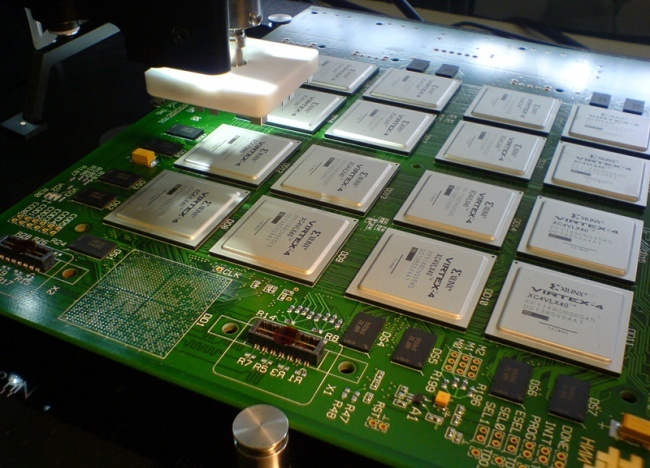 🇺🇸 United StatesVirtex
High-performance FPGA family by AMD and XilinxFPGA · Other · 1999
🇺🇸 United StatesField-programmable object array
Programmable logic device bridging FPGA and ASIC gapsFPGA · Other · 2006
 WorldGeneric Array Logic
Reprogrammable digital logic device by Lattice SemiconductorFPGA · Other