
Programmable Array Logic
Early programmable logic chips for digital circuits
Monolithic Memories introduced Programmable Array Logic (PAL) chips in March 1978. These semiconductors allowed engineers to implement custom logic functions in a single package, replacing many discrete components and simplifying digital circuit design.
- Introduced by Monolithic Memories in March 1978
- Replaced dozens of discrete logic components
- Used fixed-OR and programmable-AND logic planes
- Led to development of early hardware description languages
- Available in one-time programmable and erasable variants
What it is
Programmable Array Logic (PAL) is a family of semiconductor devices used to build digital logic circuits. Monolithic Memories launched the first units in March 1978. These chips contain a programmable read-only memory core and output logic. Engineers use them to create specific logic functions without needing many separate components. The devices are field-programmable, meaning users can set their behaviour after manufacturing. This approach simplified circuit board design and reduced the number of parts required for complex systems.
How it came about
Before PALs arrived, designers relied on small-scale integration components like the 7400 series. These discrete logic gates required significant board space. Signetics had sold Field Programmable Logic Arrays since 1975, but they were slow and expensive. John Birkner managed the PAL project, with H. T. Chua designing the circuit. They aimed for low cost and standard package sizes. Initial manufacturing yields were poor, forcing high prices until production improved. National Semiconductor and other firms later licensed the technology to meet demand.
Inside the chip
The architecture features a fixed-OR and programmable-AND plane. This structure implements sum-of-products binary logic equations. Signals from input pins route through this array to output macrocells. Early models offered ten inputs and eight outputs. The output structures were fixed at manufacture, limiting flexibility. Later variable series allowed users to configure outputs as combinational or registered. This change let one chip replace several earlier fixed-function variants, improving utility for diverse applications.
How it was made
Early devices used bipolar transistor technology with titanium-tungsten fuses. They came in 20-pin dual in-line packages. Manufacturers produced one-time programmable versions that could not be changed after writing. Later iterations used CMOS technology for lower power consumption. Some variants included quartz windows for ultraviolet erasure, similar to EPROMs. Flash erasable versions appeared subsequently. Companies like Cypress and Lattice Semiconductor eventually manufactured these chips using more advanced processes.
Where it went
These chips replaced dozens of discrete logic packages in many products. Minicomputers frequently employed PALs to manage control logic. The reduction in component count helped shrink circuit boards and improve reliability. Designers used them in various industrial and consumer electronics where custom logic was needed. As programmable logic evolved, these devices served as building blocks for more complex systems before being largely superseded by generic array logic and field-programmable gate arrays.
Versions and family
One-time programmable units were common initially. Ultraviolet erasable types allowed re-use via light exposure. Flash erasable models offered electrical rewriting. The V series introduced variable output macrocells, solving rigidity issues. Generic Array Logic chips later provided electrically erasable alternatives that were pin-compatible. Complex programmable logic devices extended the concept with multiple logic planes. Field-programmable gate arrays eventually offered even greater flexibility for large-scale designs.
Why it matters
PALs transformed digital design by consolidating many logic gates into single chips. They spurred the decline of the small-scale integration business. The need to program these devices drove the creation of early hardware description languages like PALASM and CUPL. These tools automated the conversion of logic equations into fuse maps. The industry shifted towards computer-assisted design, laying groundwork for modern electronic design automation workflows used in semiconductor development today.
Problems and reception
Initial high prices due to yield problems threatened commercial viability. However, the convenience of replacing many discrete parts won over designers. The fixed output structure of early models frustrated some engineers who needed mixed output types. The introduction of variable macrocells addressed these complaints. Second sourcing by major manufacturers like Texas Instruments ensured supply stability. The devices gained a reputation for reliability and ease of use compared to earlier programmable logic arrays.
Questions people ask about Programmable Array Logic
What is a PAL chip used for?
PAL chips implement custom logic functions in digital circuits. They replace multiple discrete logic gates, reducing component count and simplifying board design for engineers building embedded systems or computers.
Can you reprogram a PAL device?
It depends on the variant. One-time programmable PALs cannot be changed after initial programming. Ultraviolet erasable and flash erasable versions allow re-use and reprogramming by the user.
Who designed the first PAL circuit?
H. T. Chua designed the actual PAL circuit. John Birkner managed the project at Monolithic Memories. They aimed to create a user-programmable device that could replace standard logic components efficiently.
Good reading and sources
- Programmable Array Logic on WikipediaEncyclopedia
- More photos on Wikimedia CommonsPhotos
- Wikidata recordOpen data
The facts on this page come from the Wikipedia article "Programmable Array Logic", written by its contributors and used under the CC BY-SA 4.0 licence, and from its Wikidata record (CC0). EveryChip rewrote the text in its own words, with AI assistance, and compares every page with the article to make sure no passage is copied. It may be reused under the same CC BY-SA 4.0 licence with a link back.
It may contain mistakes, and figures change over time. Nothing here is investment or buying advice. If something is wrong, tell us. Last refreshed 2026-11-14.
Like Programmable Array Logic
All FPGAs and programmable logic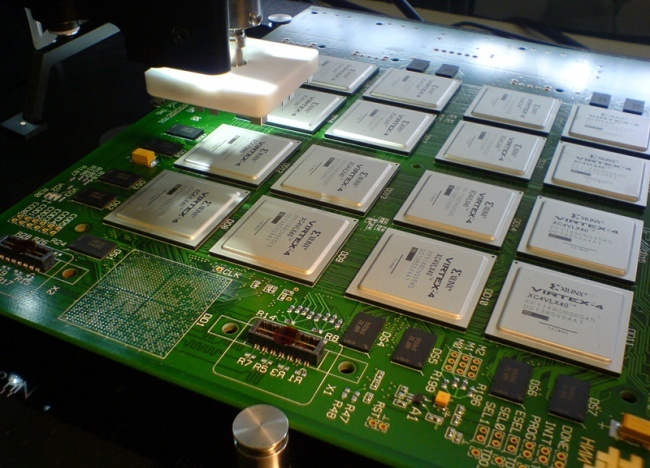 🇺🇸 United StatesVirtex
High-performance FPGA family by AMD and XilinxFPGA · Other · 1999
 WorldGAL22V10
Programmable logic device with configurable inputs and outputsFPGA · Other
🇺🇸 United StatesMicroBlaze
Soft microprocessor core for Xilinx FPGAsFPGA · RISC · 2002