Virtex
High-performance FPGA family by AMD and Xilinx
Virtex is a flagship series of field-programmable gate arrays developed by Xilinx, now part of AMD. Launched in 1999, these chips offer high logic density and speed for complex electronic systems. They are used in scientific research, communications, and aerospace applications.
- First launched in September 1999 on 180 nm process
- Virtex-7 2000T packs 6.8 billion transistors via 3D stacking
- Used in CERN ALICE experiment for particle tracking
- Radiation-hardened versions available for space applications
- Supports up to 4.4 million logic cells in UltraScale family
What it is
Virtex is a premium line of field-programmable gate arrays (FPGAs). These chips contain reconfigurable hardware that engineers can program after manufacturing. Xilinx introduced the first Virtex devices in 1999. AMD now owns the brand following its acquisition of Xilinx. The series targets applications requiring high performance and large logic capacity. It sits above the mid-range Kintex and low-cost Artix families in the product portfolio. Users configure the chips using hardware description languages like VHDL or Verilog.
How it came about
The original Virtex family launched in September 1999 using 180 nm process technology. It offered double the gate density of previous Xilinx parts. Subsequent generations arrived regularly. Virtex-II followed in 2001 on a 150 nm node. The Virtex-4 debuted in 2004, and Virtex-5 arrived in 2006 on a 65 nm process. Each iteration increased performance and reduced power consumption. The line evolved to include system-on-chip features with embedded processor cores. AMD continues to develop the series today as its flagship FPGA offering.
Inside the chip
Virtex chips use configurable logic blocks as their basic building units. Each block contains slices that perform logical operations. Early models used four-input look-up tables, while later versions switched to six-input tables for better efficiency. The devices include fixed-function hardware for digital signal processing and memory. Input and output pins are grouped into banks that support different voltage levels. Some families integrate microprocessor cores, such as IBM PowerPC units. High-speed serial transceivers and Ethernet controllers are also built into the silicon.
How it was made
Manufacturing processes have shrunk over time, from 180 nm down to 16 nm. The Virtex-7 2000T model uses a unique three-dimensional packaging technique. It stacks four separate FPGA dies on a silicon interposer. This approach allows 6.8 billion transistors to fit in one package. The interposer provides thousands of data pathways between the dies. This method increases capacity beyond what a single flat chip could achieve. The fabrication involves triple-oxide process technology for certain voltage requirements.
Where it went
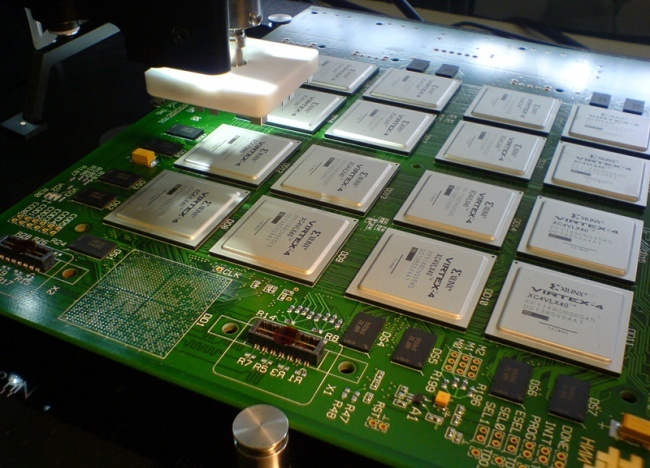
These FPGAs appear in demanding electronic systems. Scientists at CERN used Virtex-4 chips in the ALICE experiment. The hardware helps track subatomic particle trajectories. Some variants, like the Virtex-5QX, are radiation-hardened for space missions. Communications infrastructure relies on them for high-speed data handling. They serve compute-intensive tasks in data centres and industrial equipment. Designers choose Virtex when they need maximum logic resources and input-output performance.
Versions and family
The family includes many sub-series. Virtex-E improved I/O performance over the original. Virtex-II Pro added embedded processor cores. Virtex-5 split into LX for logic and SXT for signal processing. Virtex-6 focused on compute intensity. The UltraScale and UltraScale+ generations brought further power savings. The 3D variants, such as the H580T, combine different types of dies. Older families like Virtex-II and Virtex-4 are now considered legacy but remain in production for existing customers.
Why it matters
Virtex established Xilinx as a leader in high-end programmable logic. The introduction of 3D stacking influenced packaging trends in the industry. The complexity of these devices forced a redesign of development software. This led to the creation of the Vivado Design Suite. The tools aim to speed up system integration for large chips. Industry publications have recognized the series for innovation and market impact. It remains a standard choice for high-performance prototyping and deployment.

Questions people ask about Virtex
Who currently owns the Virtex brand?
AMD owns the Virtex brand. It acquired Xilinx, the original developer of the FPGA series. AMD continues to develop and sell Virtex products as part of its adaptive computing portfolio.
What makes the Virtex-7 2000T different from other FPGAs?
It uses 3D stacking technology. Four smaller FPGA dies are placed on a silicon interposer within a single package. This allows for 6.8 billion transistors and high connectivity between the dies.
Can Virtex FPGAs be used in space?
Yes, specific members of the family are available in radiation-hardened packages. For example, the Virtex-5QX is designed to withstand the harsh radiation environment found in outer space applications.
How do engineers program Virtex chips?
Engineers use hardware description languages such as VHDL or Verilog. They write code to define the circuit behavior and use software tools like Xilinx ISE or Vivado to compile and load the design onto the chip.
Good reading and sources
- Virtex (FPGA) on WikipediaEncyclopedia
- More photos on Wikimedia CommonsPhotos
- Wikidata recordOpen data
The facts on this page come from the Wikipedia article "Virtex (FPGA)", written by its contributors and used under the CC BY-SA 4.0 licence, and from its Wikidata record (CC0). EveryChip rewrote the text in its own words, with AI assistance, and compares every page with the article to make sure no passage is copied. It may be reused under the same CC BY-SA 4.0 licence with a link back.
It may contain mistakes, and figures change over time. Nothing here is investment or buying advice. If something is wrong, tell us. Last refreshed 2026-11-14.
Like Virtex
All FPGAs and programmable logic 🇺🇸 United StatesProgrammable Array Logic
Early programmable logic chips for digital circuitsFPGA · Other · 1978
 WorldGAL22V10
Programmable logic device with configurable inputs and outputsFPGA · Other
WorldStratix
A high-performance FPGA brand developed by Altera for data processing and imaging.FPGA · Other
More from AMD
All of them 🇺🇸 United StatesAthlon
AMD's x86 desktop processor brand, from the first 1 GHz chip to entry-level Zen APUsCPU · x86 · 1999
 🇺🇸 United StatesGeode
Low-power x86 system-on-chip for embedded devicesSoC · x86 · 1999
 🇺🇸 United StatesAMD K6-III
x86 desktop processor with on-die L2 cacheCPU · x86 · 1999
🇺🇸 United StatesAlchemy
Ultra low power MIPS embedded microprocessor familySoC · MIPS · 2000