
Athlon
AMD's x86 desktop processor brand, from the first 1 GHz chip to entry-level Zen APUs
Athlon is the brand name AMD has used for x86-compatible microprocessors since June 1999. The original Athlon was the first seventh-generation x86 processor and the first desktop chip to reach 1 GHz, and the name has since covered K7, Athlon 64, Athlon II and Zen-based APU designs.
- First seventh-generation x86 processor, launched 23 June 1999
- First desktop CPU to reach 1 GHz
- First commercial processor built with copper fabrication
- First x86 chip with a 128 KB split L1 cache
- Held the x86 speed crown from August 1999 to January 2002
What it is
Athlon is the brand name AMD applies to a family of x86-compatible microprocessors. The first Athlon arrived in June 1999 as AMD's high-end desktop part and was the first seventh-generation x86 processor. It also became the first desktop CPU to pass 1 GHz. AMD has since reused the Athlon name for the 64-bit Athlon 64, the Athlon II, and APU-style chips for Socket AM1 and Socket AM4. The 2019 Zen-based Athlon with Radeon graphics serves as AMD's fastest entry-level option.
How it came about
The original Athlon came out of AMD's K7 work in the 1990s. Founder and CEO Jerry Sanders pushed partnerships and hiring to build on the K6 line, and in 1998 announced a tie-up with Motorola on copper semiconductor technology. That made K7 the first commercial processor built with copper fabrication. The K7 team grew from the NexGen group AMD had acquired, which included engineer Vinod Dham. The chip launched on 23 June 1999 and reached general availability by August.
Inside the chip
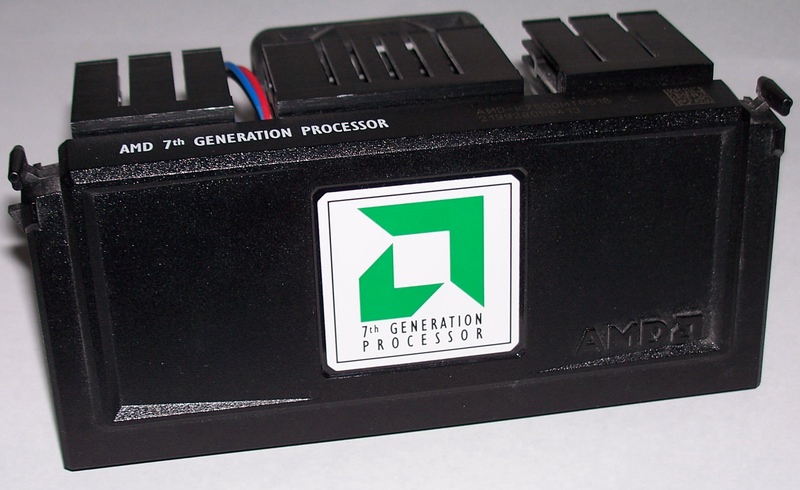
The Athlon Classic shipped as a Slot A cartridge, using the same 242-pin connector as Intel's Slot 1 but rotated 180 degrees. It carried 512 KB of L2 cache on the cartridge, run at a fraction of CPU clock over its own 64-bit back-side bus, so cache and front-side traffic could happen together. It was the first x86 chip with a 128 KB split L1 cache, 64 KB each for data and instructions. The out-of-order core decoded x86 into buffered micro-instructions, used an improved branch predictor over the K6, and had a deeper pipeline. A triple-issue out-of-order FPU fixed AMD's old floating-point weakness, and Enhanced 3DNow! added DSP and SSE-subset instructions. The system bus was DEC's EV6 with DDR signalling.
How it was made
The Argon-based Athlon held 22 million transistors over 184 mm2 and was built by AMD on its CS44E process, a 250 nm CMOS flow with six aluminium interconnect layers. Pluto and Orion versions moved to 180 nm. Working with Motorola, AMD refined copper interconnect about a year ahead of Intel, and the die shrink cut power use enough to push clocks toward 1 GHz. Thunderbird chips were made at AMD's Dresden fab, which raised output and used copper interconnects.
Where it went
From August 1999 to January 2002 the first Athlon was the fastest x86 chip available. Compaq, IBM and other makers put it in their most powerful PCs, and by mid-2000 Gateway, Hewlett-Packard and Fujitsu Siemens Computers were shipping Athlon systems in volume. Later Athlons moved into mid-range desktops after Phenom arrived in 2007, and the 2018 Athlon 200GE and 2019 Athlon 3000G targeted low-cost desktops with built-in Radeon graphics.
Versions and family
Thunderbird (2000) put 256 KB of full-speed L2 on the die as exclusive cache and shipped in Slot A or Socket A form. Athlon XP followed in 2001 across the Palomino, Thoroughbred, Thorton and Barton cores, plus mobile Corvette and Dublin parts. Athlon 64 arrived in 2003 on AMD64, Athlon 64 X2 in 2005 as AMD's first native dual-core desktop CPU, and Athlon II in 2009 as a dual-core family. The 2018 Athlon 200GE used the Zen-based Raven Ridge core.
Why it matters
The Athlon broke Intel's speed lead and made AMD a genuine rival at the top of the desktop market. It was the first x86 processor to reach 1 GHz and held the performance crown from August 1999 to January 2002. The Thunderbird became AMD's biggest seller since the Am386DX-40, and the brand later covered everything from high-end K7 parts to budget Zen APUs.
Problems and reception
The Los Angeles Times reported in October 1999 that AMD had overtaken Intel's fastest processors, with the Athlon clearly ahead of the 600 MHz Pentium III. The Thunderbird was widely liked for its overclocking headroom. Slot A Athlons were AMD's first multiplier-locked CPUs, a step against remarking and reseller overclocking, though a Goldfingers device later bypassed the lock. Palomino added a thermal diode, but it was only quick enough to handle slow overheating such as a failed fan.



Questions people ask about Athlon
What is the Athlon?
Athlon is the brand name AMD has used since 1999 for a line of x86-compatible microprocessors. It began as AMD's high-end desktop chip and later covered 64-bit, dual-core and APU designs, ending up as an entry-level brand alongside Ryzen.
Why was the first Athlon important?
It was the first seventh-generation x86 processor and the first desktop CPU to reach 1 GHz. From August 1999 to January 2002 it was the fastest x86 chip in the world, beating Intel's Pentium III in both business and gaming work.
What was Slot A?
Slot A was the cartridge format used by the first Athlons. It used the same 242-pin connector as Intel's Slot 1, rotated 180 degrees, and let AMD attach fast cache memory chips to the processor module rather than relying on slower motherboard cache.
How did Athlon chips get made?
AMD built them in its own fabs. The first parts used a 250 nm process with aluminium wiring, then moved to 180 nm and later 130 nm. A partnership with Motorola brought copper interconnect to the K7 line ahead of Intel, cutting power use and allowing higher clocks.
What came after the original Athlon?
Thunderbird followed in 2000 with on-die cache, then Athlon XP in 2001, Athlon 64 in 2003, Athlon 64 X2 in 2005 and Athlon II in 2009. From 2018 the name covered low-cost Zen-based APUs with Radeon graphics.
Good reading and sources
The facts on this page come from the Wikipedia article "Athlon", written by its contributors and used under the CC BY-SA 4.0 licence, and from its Wikidata record (CC0). EveryChip rewrote the text in its own words, with AI assistance, and compares every page with the article to make sure no passage is copied. It may be reused under the same CC BY-SA 4.0 licence with a link back.
It may contain mistakes, and figures change over time. Nothing here is investment or buying advice. If something is wrong, tell us. Last refreshed 2026-11-14.
Like Athlon
All CPUs and microprocessors 🇺🇸 United StatesGeode
Low-power x86 system-on-chip for embedded devicesSoC · x86 · 1999
 🇺🇸 United StatesCeleron
Intel's budget x86 desktop and mobile CPU line, sold from 1998 to 2023CPU · x86 · 1998
 WorldRise mP6
Low-cost x86 microprocessor for Super Socket 7 systemsCPU · x86 · 1998
More from AMD
All of them 🇺🇸 United StatesPowerPC G4
32-bit PowerPC microprocessor family with AltiVec vector processingCPU · Power · 1999
 🇺🇸 United StatesAMD K6-III
x86 desktop processor with on-die L2 cacheCPU · x86 · 1999
 🇺🇸 United StatesVirtex
High-performance FPGA family by AMD and XilinxFPGA · Other · 1999
 🇺🇸 United StatesK6-2
x86 microprocessor with 3DNow! instructions for budget PCsCPU · x86 · 1998