
K6-2
x86 microprocessor with 3DNow! instructions for budget PCs
The K6-2 is an x86 microprocessor launched by AMD in May 1998. It introduced the 3DNow! instruction set and Super Socket 7 support, offering strong price-to-performance value against Intel rivals.
- Introduced 3DNow! SIMD instruction set
- Used Super Socket 7 with 100 MHz bus
- Built on 250 nm process with 9.3M transistors
- Competed effectively against Intel Celeron
- Ran at speeds up to 550 MHz officially
What it is
The K6-2 is a single-core x86 microprocessor developed by AMD. Released in May 1998, it served as a cost-effective alternative to Intel’s Pentium II and Celeron lines. The chip featured the new 3DNow! instruction set, which improved floating-point performance for multimedia tasks. It operated on Super Socket 7 motherboards, allowing faster data transfer rates than previous designs. This processor helped AMD gain market share in the budget personal computer segment during the late 1990s.
How it came about
AMD designed the K6-2 to challenge Intel’s dominance in the mid-range market. While the earlier K6 excelled at integer calculations, it lagged in floating-point operations. The K6-2 addressed this weakness by adding 3DNow!, a SIMD instruction set that boosted graphics and media performance. Although software adoption for 3DNow! was limited, the chip offered excellent value. Its success provided the financial stability AMD needed to develop the subsequent Athlon processor line.
Inside the chip
The processor uses the K6 microarchitecture with a single core. It includes 64 KiB of level one cache, split evenly between data and instructions. The design supports MMX and the proprietary 3DNow! extensions. A key feature is the Super Socket 7 interface, which raised the front-side bus speed from 66 MHz to 100 MHz. This upgrade allowed the system memory to keep pace with higher clock frequencies. The chip contains 9.3 million transistors built on a 250 nanometer process.
How it was made
AMD manufactured the K6-2 using a 250 nanometer production process. The initial version, codenamed Chomper, ran at 2.2 volts. A later revision, Chomper Extended, supported various voltages including lower settings for mobile use. Clock speeds ranged from 200 MHz to 550 MHz for standard desktop models. The transistor count remained at 9.3 million across these variants. Production continued until the end of 2003, covering a significant period of PC evolution.
Where it went
This chip powered many budget-friendly desktop computers in the late 1990s. It competed directly with Intel’s Celeron processors, often offering better system memory access speeds. Gamers and home users benefited from the 3DNow! enhancements in compatible titles. The K6-2+ variant targeted low-power mobile applications, featuring integrated level two cache. Some enthusiasts used unofficial BIOS updates to run these mobile chips on desktop boards at higher speeds.
Versions and family
The family includes the original Chomper core and the updated Chomper Extended. Speeds expanded from 233 MHz up to 550 MHz over time. The K6-2+ is a distinct variant based on the K6-III+ design but with reduced cache. It was intended for notebooks but found use in desktops via community hacks. A hidden feature allowed users to override multiplier limits, pushing some models to 600 MHz. The K6-2 was eventually succeeded by the K6-III and the Duron.
Why it matters
The K6-2 established AMD as a serious competitor in the consumer CPU market. Its aggressive pricing forced Intel to respond with more affordable options. The introduction of Super Socket 7 extended the life of existing motherboard investments for users. While 3DNow! did not become an industry standard like SSE, it demonstrated AMD’s ability to innovate. The revenue generated by this successful product line funded the development of future high-performance architectures.
Problems and reception
Reviewers praised the K6-2 for its strong price-to-performance ratio. It was seen as a viable alternative to the more expensive Pentium II. The chip performed well in general computing tasks, though it trailed Intel in some floating-point benchmarks without 3DNow! optimization. The Super Socket 7 platform was welcomed for its backward compatibility. Enthusiasts appreciated the overclocking potential, particularly with the later K6-2+ models.


Questions people ask about K6-2
What is the main difference between K6 and K6-2?
The K6-2 added the 3DNow! instruction set for better multimedia performance and supported Super Socket 7 with a faster 100 MHz front-side bus, whereas the original K6 used slower 66 MHz buses.
Can I use a K6-2 in an old Socket 7 motherboard?
Standard K6-2 chips require Super Socket 7 for full performance, but the interface is backward compatible with older Socket 7 motherboards, though they may be limited to 66 MHz bus speeds.
What was the fastest official speed of the K6-2?
The fastest officially released desktop model ran at 550 MHz. The K6-2+ mobile variant also topped out at 550 MHz, though users could sometimes overclock it to 600 MHz.
Good reading and sources
The facts on this page come from the Wikipedia article "AMD K6-2", written by its contributors and used under the CC BY-SA 4.0 licence, and from its Wikidata record (CC0). EveryChip rewrote the text in its own words, with AI assistance, and compares every page with the article to make sure no passage is copied. It may be reused under the same CC BY-SA 4.0 licence with a link back.
It may contain mistakes, and figures change over time. Nothing here is investment or buying advice. If something is wrong, tell us. Last refreshed 2026-11-14.
Like K6-2
All CPUs and microprocessors 🇺🇸 United StatesCeleron
Intel's budget x86 desktop and mobile CPU line, sold from 1998 to 2023CPU · x86 · 1998
 🇺🇸 United StatesXeon
Intel's x86 processor brand for servers, workstations and embedded systems since 1998CPU · x86 · 1998
 WorldRise mP6
Low-cost x86 microprocessor for Super Socket 7 systemsCPU · x86 · 1998
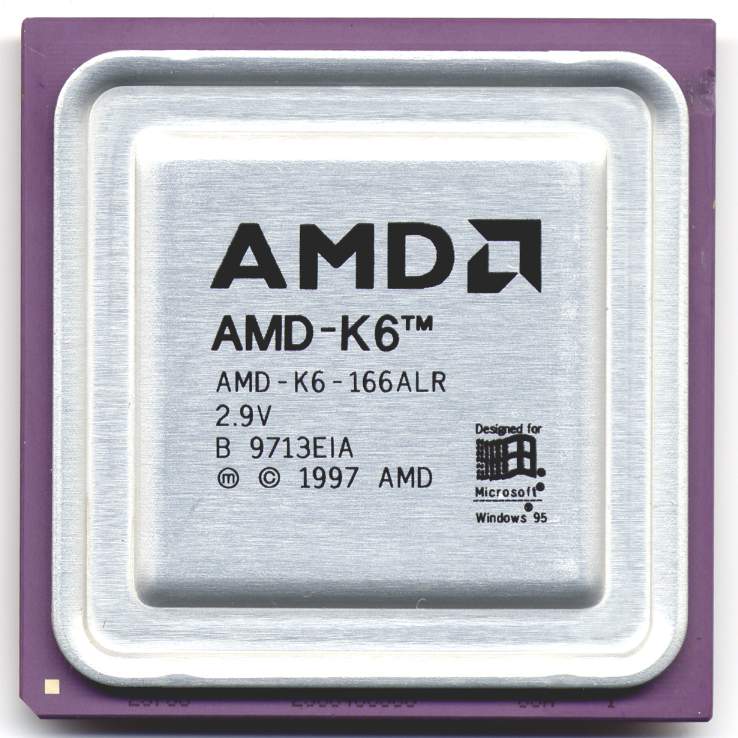 🇺🇸 United StatesAMD K6
x86 microprocessor for Socket 7 desktopsCPU · x86 · 1997
More from AMD
All of them 🇺🇸 United StatesVirtex
High-performance FPGA family by AMD and XilinxFPGA · Other · 1999
 🇺🇸 United StatesAMD K6-III
x86 desktop processor with on-die L2 cacheCPU · x86 · 1999
 🇺🇸 United StatesAthlon
AMD's x86 desktop processor brand, from the first 1 GHz chip to entry-level Zen APUsCPU · x86 · 1999
 🇺🇸 United StatesGeode
Low-power x86 system-on-chip for embedded devicesSoC · x86 · 1999