
Xeon
Intel's x86 processor brand for servers, workstations and embedded systems since 1998
Xeon is Intel's brand of x86 processors for high-end workstations, servers and embedded systems, introduced on 29 June 1998. Xeon chips share desktop designs but add ECC memory, more cores, more cache and reliability features that let servers keep running when hardware faults occur.
- Introduced on 29 June 1998 as the Pentium II Xeon, replacing the Pentium Pro
- Supports ECC memory and enterprise RAS features for fault tolerance
- Multi-socket systems of 2, 4 or 8 CPUs use the Ultra Path Interconnect bus
- Xeon Scalable tiers ran Bronze, Silver, Gold and Platinum from May 2017
- Xeon 6 replaced the Scalable branding from the 6th generation onwards
What it is
Xeon is Intel's family of x86 processors aimed at workstations, servers and embedded equipment. The first chip arrived on 29 June 1998 as the Pentium II Xeon, and the brand has continued through many generations since. A Xeon is built on the same core design as the matching desktop chip, but adds features that matter to businesses: error correcting code (ECC) memory that catches and fixes data errors, more cores and cache, more PCI Express lanes, more memory channels, and reliability, availability and serviceability (RAS) features that help a machine survive hardware faults instead of crashing.
How it came about
The brand began in 1998, when the Pentium II Xeon replaced the Pentium Pro at the top of Intel's server range. Early chips carried the desktop name plus Xeon, but from 2001 the name Xeon stood alone with the NetBurst-based Foster. In May 2017 Intel launched the Xeon Scalable brand with Bronze, Silver, Gold and Platinum tiers. In April 2024 Intel said the Scalable name would retire, and the 6th generation chips, codenamed Sierra Forest and Granite Rapids, became Xeon 6 instead.
Inside the chip
Xeon chips share their core design with desktop processors but differ in the extras around it. ECC memory corrects single-bit errors, important for machines that run for months without rebooting. Larger caches, up to 320 MB of L3 per socket, and up to 64 GB of on-package HBM2e memory keep data close to the cores. Multi-socket systems with two, four or eight processors are linked by the Ultra Path Interconnect (UPI) bus, which replaced the older QuickPath Interconnect (QPI). Most Xeons lack an integrated GPU and older models cannot be overclocked, with the Xeon W-3175X an early exception.
How it was made
Xeon production has spanned every Intel process from 250 nm to today's Intel 3, with some recent chips made at TSMC on its N5 node. The very first Pentium II Xeon carried its large second-level cache on a separate board using custom 512 kB SRAM chips, each a 222.21 mm2 die made on a 0.35 µm four-layer metal CMOS process, which is why it needed the bigger Slot 2 connector.
Where it went
Xeon processors are aimed at servers, workstations and embedded systems. Xeon D targets microservers and edge computing with integrated networking, letting it work as a system on a chip without a separate southbridge chip. Xeon W serves workstations, with tiers w3, w5, w7 and w9 mirroring the Core i3 to i9 names. Despite their server focus, video editors and other power users have long favoured Xeons on the desktop for their high core counts.
Versions and family
The brand has many lines. The Pentium II and III Xeons used the P6 design; Foster, Prestonia, Gallatin and others used NetBurst; later generations moved through Core, Nehalem, Sandy Bridge, Skylake and newer designs. Xeon Scalable added Bronze, Silver, Gold and Platinum levels from 2017. Xeon D, launched in 2015 in a soldered BGA package, competed with ARM server chips, and early in 2025 Intel announced the Xeon 6 SoC line as a follow-on for part of that range. Xeon Phi is a separate product, originally a coprocessor card.
Why it matters
Xeon has been Intel's server flagship for over 25 years and shaped how enterprise computing is built. Its addition of Intel 64 in the 2004 Nocona chip followed AMD's x86-64 move, and chips such as Prestonia became top sellers in their day. The Scalable naming of 2017 set a template that the industry recognised, and the move to Xeon 6 in 2024 shows the brand still anchors Intel's data centre strategy.
Problems and reception
Reception has varied by generation. Foster underperformed older Xeons and AMD's Athlon MP in servers and needed costly Rambus memory. Nocona and Irwindale lost consistently to AMD's Opteron. Prestonia, by contrast, beat the Athlon MP and became a top-selling server chip, and Dempsey finally offered real competition, though its successor Woodcrest claimed the clear lead.


Questions people ask about Xeon
How is a Xeon different from a regular Intel desktop processor?
It shares the same core design but adds ECC memory support, more cores and cache, more PCI Express lanes, more memory channels, and reliability features that let the machine keep running through some hardware faults.
Why do many Xeon systems need a separate graphics card?
Most Xeon processors lack an integrated GPU, so a computer using one needs a discrete graphics card or separate GPU to produce a picture on the monitor.
What is Xeon D for?
Xeon D targets microservers and edge computing with lower power use and integrated input-output blocks such as network controllers. It ships soldered in a BGA package and works without a separate southbridge chip.
What happened to the Xeon Scalable name?
Intel announced in April 2024 that the Scalable brand would retire. From the 6th generation, chips such as Sierra Forest and Granite Rapids are simply called Xeon 6, split into E-core and P-core series.
Is Xeon Phi the same as Xeon?
No. The first-generation Xeon Phi was a coprocessor card for a PCI Express slot, comparable to a graphics card, built around many cores with high memory bandwidth. It is a distinct product line from Xeon.
Good reading and sources
- Intel InsideIntel, Article
- Checking your browserAnandTech, Article
- Intel bares TigertonThe Register, Article
- Intel’s Xeon brand makes its first foray into SoC space with Xeon DArs Technica, Article
The facts on this page come from the Wikipedia article "Xeon", written by its contributors and used under the CC BY-SA 4.0 licence, and from its Wikidata record (CC0). EveryChip rewrote the text in its own words, with AI assistance, and compares every page with the article to make sure no passage is copied. It may be reused under the same CC BY-SA 4.0 licence with a link back.
It may contain mistakes, and figures change over time. Nothing here is investment or buying advice. If something is wrong, tell us. Last refreshed 2026-11-16.
Like Xeon
All CPUs and microprocessors 🇺🇸 United StatesIntel Core
Intel's multi-core x86 CPU line for laptops, desktops and workstationsCPU · x86 · 2006
 🇺🇸 United StatesIntel Core
Multi-core x86 CPUs for PCs and servers by Intel.CPU · x86 · 2006
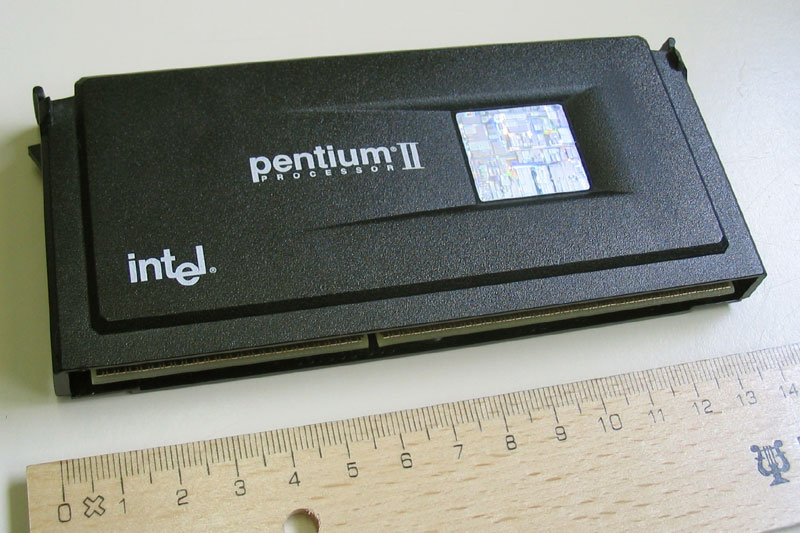 🇺🇸 United StatesPentium II
Intel's 1997 P6 desktop CPU line with MMX, sold in a slot cartridgeCPU · x86 · 1997
 🇺🇸 United StatesP6
Intel's sixth x86 design, first with out-of-order executionCPU · x86 · 1995
More from Intel
All of them 🇺🇸 United StatesIntel740
1998 AGP graphics chip by Intel using system RAM for texturesGPU · 1998
 🇺🇸 United StatesCeleron
Intel's budget x86 desktop and mobile CPU line, sold from 1998 to 2023CPU · x86 · 1998
 🇺🇸 United StatesPentium III
Intel's 32-bit P6 desktop and server CPU line, launched in 1999 with SSE.CPU · x86 · 1999
 WorldIntel 810
Budget chipset with integrated graphics for Socket 370 CPUsSoC · x86 · 1999