
Intel740
1998 AGP graphics chip by Intel using system RAM for textures
The Intel740 is a 350 nm graphics processing unit released by Intel in February 1998. It aimed to promote the Accelerated Graphics Port interface but suffered from poor performance due to its reliance on system memory for texture storage.
- Released on 12 February 1998 by Intel
- Used 350 nm manufacturing process
- Stored textures in system RAM via AGP
- Withdrawn from market in August 1999
- Predecessor to Intel integrated graphics
What it is
The Intel740, also known as the i740, is a discrete graphics processing unit manufactured by Intel. Launched on 12 February 1998, it was built using a 350 nanometre process. The chip was designed to accelerate three-dimensional graphics on personal computers. Its primary goal was to encourage adoption of the Accelerated Graphics Port interface, which offered higher bandwidth than the older PCI standard. Despite strong initial marketing, the product failed to meet performance expectations in real-world applications.
How it came about
The technology originated at GE Aerospace, where it powered flight simulators including the Apollo Visual Docking Simulator. After GE sold its aerospace division, the team became part of Lockheed Martin. In 1995, Lockheed formed Real3D to bring this expertise to the consumer market. Real3D partnered with Intel and Chips and Technologies on a project codenamed Auburn. This collaboration produced the i740. Intel hoped to dominate the market using its manufacturing scale, but the chip was withdrawn in August 1999 after less than eighteen months.
Inside the chip
The i740 operated at a clock speed of 66 MHz. It featured between two and eight megabytes of video random access memory. Unlike competitors, it used this small onboard memory only for the display frame buffer. Textures were stored in the computer main system memory. The chip accessed these textures via the AGP link. This design intended to lower costs by reducing onboard memory needs. However, the AGP channel proved significantly slower than local video memory for texture data. This bottleneck severely limited performance compared to cards that stored all data locally.
How it was made
Intel manufactured the i740 using a 350 nanometre production process. The company leveraged its own fabrication facilities to produce the chips at a low cost. This allowed the processor to be sold at a competitive price point of roughly thirty-five dollars in bulk. Some third-party manufacturers produced versions of the card using the PCI interface. These variants included an AGP-to-PCI bridge and added more onboard memory. These PCI models often performed better than the native AGP cards because they avoided the slow texture streaming bottleneck.
Where it went
The i740 was intended for use in desktop personal computers. It targeted the mainstream PC market where users wanted affordable three-dimensional acceleration. Several hardware partners released cards based on the chip at launch. However, gamers and enthusiasts found it slower than existing solutions like the 3dfx Voodoo2. It could only compete with entry-level accelerators such as the Nvidia RIVA 128. As newer chips like the RIVA TNT arrived, the i740 quickly became obsolete for gaming purposes.
Versions and family
Intel planned two successors, the i752 and i754, which supported advanced features like multitexturing. The i754 was cancelled, and the i752 saw limited release before being withdrawn. The core technology from these chips was repurposed for integrated graphics in the Intel 810 and 815 chipsets. Intel later attempted discrete graphics with projects like Larrabee, which was cancelled in 2010. The company eventually returned to the discrete market with the Intel Arc series in 2022, ending a twenty-four year gap.
Why it matters
The i740 failed to displace established graphics vendors. Its poor performance demonstrated the limitations of relying on system memory for textures over early AGP links. The failure led Intel to abandon discrete graphics for many years, focusing instead on integrated solutions. Real3D was closed in October 1999, and Intel acquired its intellectual property. Many former Real3D employees joined ATI. The i740 remains a notable example of a major manufacturer misjudging market technical requirements.
Problems and reception
Press coverage before launch predicted the i740 would drive smaller competitors out of business. Rumours of poor performance circulated before release, but many pundits still expected success. Upon launch, reviews highlighted disappointing real-world speeds. The card was significantly slower than high-end rivals and struggled against mid-range options. It vanished from benchmarks within months. Intel withdrew the product from the market in August 1999, acknowledging its commercial failure.


Questions people ask about Intel740
Why did the Intel740 perform poorly?
The chip stored textures in the main system memory instead of onboard video memory. Accessing this data through the AGP interface was much slower than using local memory. This bottleneck reduced performance significantly compared to competitors that kept all data on the card.
What was the codename for the Intel740?
The project was codenamed Auburn. It was developed through a joint effort between Intel and Real3D. Real3D had previously provided graphics technology for Sega arcade systems before merging their efforts with Intel for the PC market.
Did Intel make any other discrete GPUs after the i740?
Intel did not release another discrete GPU until the Intel Arc series in 2022. Between 1999 and 2022, the company focused on integrated graphics within its chipsets. Projects like Larrabee were developed but cancelled before reaching the market.
Good reading and sources
The facts on this page come from the Wikipedia article "Intel740", written by its contributors and used under the CC BY-SA 4.0 licence, and from its Wikidata record (CC0). EveryChip rewrote the text in its own words, with AI assistance, and compares every page with the article to make sure no passage is copied. It may be reused under the same CC BY-SA 4.0 licence with a link back.
It may contain mistakes, and figures change over time. Nothing here is investment or buying advice. If something is wrong, tell us. Last refreshed 2026-11-14.
Like Intel740
All graphics processors 🇺🇸 United StatesIntel GMA
Integrated graphics series for low-cost PCs by IntelGPU · GPU architecture · 2004
🇺🇸 United StatesIntel i750
Two-chip video processor for early digital video captureGPU · Other · 1991
 🇺🇸 United StatesIntel Graphics Technology
Integrated graphics processors for Intel CPUsGPU · GPU architecture · 2010
 🇺🇸 United States and 1 moreSkylake
Intel's 2015 sixth-generation Core microarchitecture, built on 14 nmCPU · x86 · 2015
More from Intel
All of them 🇺🇸 United StatesCeleron
Intel's budget x86 desktop and mobile CPU line, sold from 1998 to 2023CPU · x86 · 1998
 🇺🇸 United StatesXeon
Intel's x86 processor brand for servers, workstations and embedded systems since 1998CPU · x86 · 1998
 🇺🇸 United StatesPentium III
Intel's 32-bit P6 desktop and server CPU line, launched in 1999 with SSE.CPU · x86 · 1999
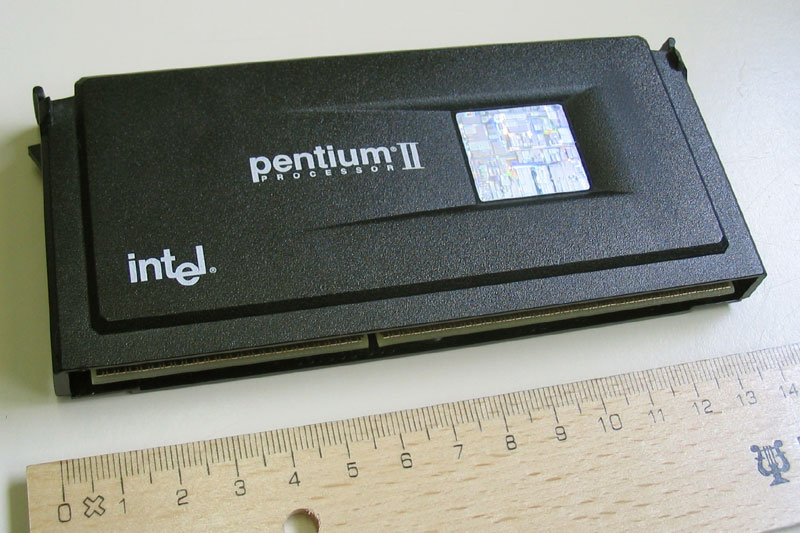 🇺🇸 United StatesPentium II
Intel's 1997 P6 desktop CPU line with MMX, sold in a slot cartridgeCPU · x86 · 1997