
Generic Array Logic
Reprogrammable digital logic device by Lattice Semiconductor
Lattice Semiconductor created the Generic Array Logic (GAL) as an upgrade to Programmable Array Logic. It offered erasable and reprogrammable features, allowing engineers to prototype designs more easily with a single device type replacing many older variants.
- Invented by Lattice Semiconductor as a PAL improvement
- Erasable and reprogrammable for easier prototyping
- One device can replace many PAL types
- Similar to PEEL devices by ICT
What it is
The Generic Array Logic, often called GAL, is a type of digital circuit developed by Lattice Semiconductor. It serves as an advanced version of the Programmable Array Logic (PAL). The key distinction is its ability to be erased and reprogrammed. This feature allows engineers to adjust designs without replacing physical components. One GAL unit can substitute for multiple PAL types, offering greater flexibility in electronic design and prototyping workflows.
How it came about
Lattice Semiconductor invented the GAL to improve upon existing PAL technology. The goal was to create a device that could handle functions beyond the original PAL range. By making the logic erasable, the company addressed the difficulties engineers faced during prototyping. A similar concept, known as PEEL, was later introduced by International CMOS Technology, showing industry interest in reprogrammable logic solutions.
Inside the chip
As a programmable logic device, the GAL uses an array structure to implement digital functions. Its architecture supports reprogramming, which means the internal connections can be changed after manufacturing. This contrasts with fixed logic devices. The design allows a single chip to mimic various PAL configurations. Engineers can modify the logic behaviour electrically, facilitating rapid design iterations and corrections without needing new hardware for each change.
How it was made
Specific details regarding the manufacturing process, transistor count, or fabrication facilities are not provided in the available records.
Where it went
The primary application for GAL devices is in engineering prototyping and design development. Because they are reprogrammable, they allow for easy testing and modification of digital circuits. They replace multiple fixed PAL devices, simplifying inventory and design processes. These chips are suitable for embedded systems where logic requirements might change during the development phase.
Versions and family
The GAL22V10 is a specific model mentioned in relation to this technology. International CMOS Technology produced a comparable device called PEEL, which stands for programmable electrically erasable logic. These variants share the core benefit of being electrically erasable, distinguishing them from earlier one-time programmable logic arrays.
Why it matters
The introduction of GAL simplified the workflow for digital design engineers. By enabling reprogramming, it reduced the time and cost associated with prototyping. It expanded the functional capabilities available compared to the original PAL range. This innovation paved the way for more complex programmable logic devices, such as CPLDs, by demonstrating the value of reconfigurable hardware.

Questions people ask about Generic Array Logic
What is the main advantage of GAL over PAL?
The primary benefit is that GAL devices are erasable and reprogrammable. This allows engineers to make design changes easily during prototyping, whereas PAL devices are typically programmed only once.
Who invented the Generic Array Logic?
Lattice Semiconductor invented the Generic Array Logic. It was developed as an innovation on the earlier Programmable Array Logic technology to provide more flexibility.
Can one GAL replace multiple PAL devices?
Yes, one GAL device type can take the place of many different PAL device types. It can also perform functions that were not covered by the original range of PAL devices.
Good reading and sources
- Generic Array Logic on WikipediaEncyclopedia
- More photos on Wikimedia CommonsPhotos
- Wikidata recordOpen data
The facts on this page come from the Wikipedia article "Generic Array Logic", written by its contributors and used under the CC BY-SA 4.0 licence, and from its Wikidata record (CC0). EveryChip rewrote the text in its own words, with AI assistance, and compares every page with the article to make sure no passage is copied. It may be reused under the same CC BY-SA 4.0 licence with a link back.
It may contain mistakes, and figures change over time. Nothing here is investment or buying advice. If something is wrong, tell us. Last refreshed 2026-11-14.
Like Generic Array Logic
All FPGAs and programmable logic WorldGAL22V10
Programmable logic device with configurable inputs and outputsFPGA · Other
WorldStratix
A high-performance FPGA brand developed by Altera for data processing and imaging.FPGA · Other
 🇺🇸 United StatesProgrammable Array Logic
Early programmable logic chips for digital circuitsFPGA · Other · 1978
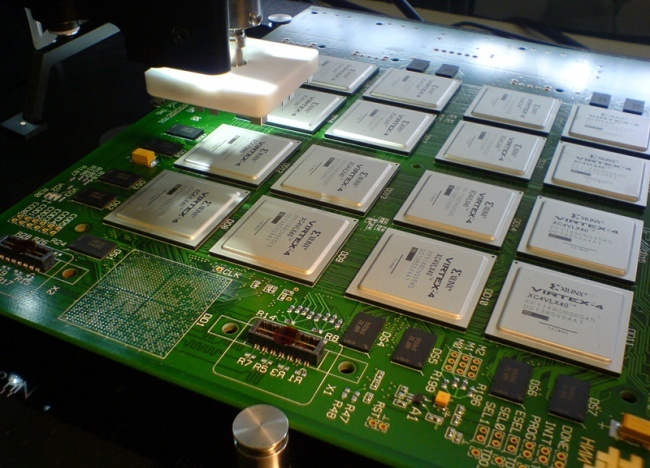 🇺🇸 United StatesVirtex
High-performance FPGA family by AMD and XilinxFPGA · Other · 1999