TMS6100
Serial mask ROM for speech synthesis data storage
The TMS6100 is a serial read-only memory chip designed by Texas Instruments to store voice data. It works with speech synthesizer chips like the TMS5100 by holding linear predictive coding information. The device uses local addressing to output bits sequentially and supports custom mask programming for specific products.
- Stores 128 kilobits of voice synthesis data
- First used in the 1978 Speak and Spell toy
- Uses local addressing for sequential bit reading
- Mask-programmed for specific product requirements
- Supports 1-bit or 4-bit serial output modes
What it is
The TMS6100 is a specialized memory integrated circuit created by Texas Instruments. It functions as a companion chip for speech synthesizers such as the TMS5100 and CD2802. This device stores voice data in a format called linear predictive coding. It is a mask-programmed read-only memory, meaning its content is fixed during manufacturing for a specific product. The chip holds 128 kilobits of data, which equals 16 kilobytes. It outputs data serially, either one bit or four bits at a time, depending on how it was programmed.
How it came about
Texas Instruments developed this memory type for use in consumer electronics requiring voice output. The first versions appeared in 1978 inside the Speak and Spell toy. These early units carried the markings TMC0351 and TMC0352. Later models adopted the CDxxxxx numbering scheme for consumer goods. The company also produced these chips for non-consumer industrial uses under the VMxxxxx label. Third-party products used the CMxxxxx identifier. The design allowed manufacturers to swap voice data without changing the main controller code.
Inside the chip
This chip uses a system called local addressing. Once an address is loaded, the internal pointer tracks the position automatically. This allows sequential reading of every bit stored in the device. The memory organizes data in eight-bit bytes internally but shifts them out serially. Four basic commands control the chip via two input pins. These commands include idle, load address, read bit, and read and branch. The load address command accepts twenty bits in sequence to set the starting point. A read bit command outputs data and moves the pointer forward. If the address is outside the valid range, the chip enters a high impedance state.
How it was made
Texas Instruments manufactured the TMS6100 using mask programming techniques. This process defines the data content and certain operational features during fabrication. Engineers could program the chip to require a high or low signal on the chip enable line. They also defined whether the device would output one bit or four bits per cycle. The total addressable space spans eighteen bits due to internal configuration options. The chip supports parallel wiring, allowing multiple units to share a data bus if their address ranges do not overlap.
Where it went
The primary application for this memory was in voice-enabled consumer toys and devices. It served as the data source for the Speak and Spell educational toy. Expansion cartridges for this toy, such as Vowel Power, also utilized these chips. Beyond toys, the technology appeared in measurement devices and other computer peripherals that required spoken feedback. The chip provided a cost-effective way to store fixed vocabulary sets for embedded systems. Its serial interface simplified connections to the main speech synthesis processor.
Versions and family
The TMS6125 is a smaller variant of the same design. It holds 32 kilobits, or 4 kilobytes, of data. The address loading command differs slightly to accommodate the reduced size, requiring only four executions instead of five. Both chips are referred to as Voice Synthesis Memory in technical documents. The part numbers vary by market segment. Consumer products use CD codes, while industrial items use VM codes. Third-party integrations use CM codes. The numeric suffixes ensure no two chips share the same identifier across different series.
Why it matters
This memory architecture enabled affordable voice synthesis in mass-market products during the late twentieth century. By separating data storage from the synthesis engine, Texas Instruments allowed flexible product development. Manufacturers could change the spoken words by ordering new mask sets without redesigning the hardware. The local addressing feature reduced the computational load on the host microcontroller. This approach influenced later designs for embedded audio storage where simple serial access was preferred over complex parallel memory interfaces.
Questions people ask about TMS6100
What is the TMS6100 used for?
It stores voice data for speech synthesizer chips. The memory holds linear predictive coding information that allows devices like the Speak and Spell to produce spoken words. It acts as a companion chip to processors such as the TMS5100.
How much data can the TMS6100 hold?
The chip contains 128 kilobits of storage, which is equivalent to 16 kilobytes. A smaller version called the TMS6125 holds 32 kilobits or 4 kilobytes. The data is fixed during manufacturing via mask programming.
How does the chip manage memory addresses?
It uses local addressing, meaning the chip maintains its own internal address pointer. Once an address is loaded, it can read bits sequentially without external intervention. This simplifies the interface with the main speech synthesis controller.
Good reading and sources
The facts on this page come from the Wikipedia article "TMS6100", written by its contributors and used under the CC BY-SA 4.0 licence, and from its Wikidata record (CC0). EveryChip rewrote the text in its own words, with AI assistance, and compares every page with the article to make sure no passage is copied. It may be reused under the same CC BY-SA 4.0 licence with a link back.
It may contain mistakes, and figures change over time. Nothing here is investment or buying advice. If something is wrong, tell us. Last refreshed 2026-11-14.
Like TMS6100
All memory chips 🇺🇸 United States and 2 moreEEPROM
Byte-erasable non-volatile memory for small data storageMemory · 1978
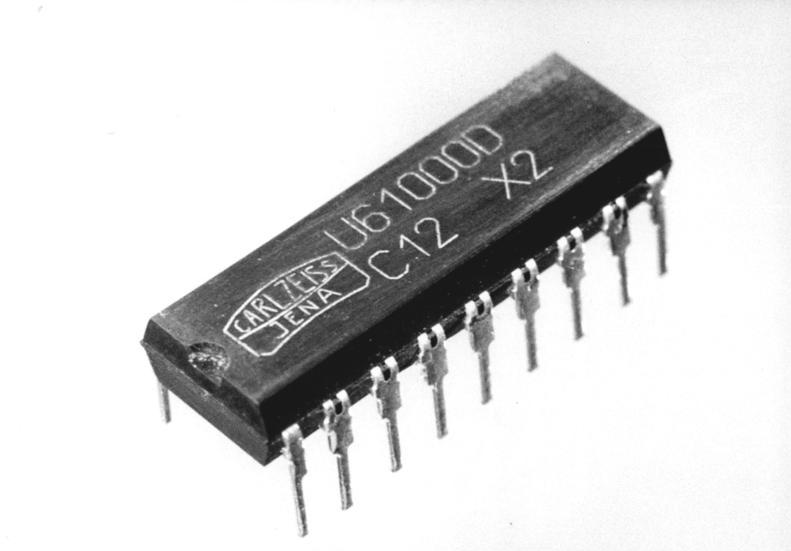 🇩🇪 GermanyU61000
First 1-Mbit DRAM chip from the German Democratic RepublicMemory · 1988
 🇺🇸 United States1T-SRAM
High-density pseudo-static memory technology for embedded systemsMemory · 1998
 WorldDataFlash
Serial interface flash memory with SPI compatibilityMemory
More from Texas Instruments
All of them 🇺🇸 United StatesTexas Instruments LPC Speech Chips
Digital signal processors for speech synthesis in toys and arcades.DSP · Other · 1978
 🇺🇸 United StatesSN76477
Analog sound chip for arcade games and toysAnalog · Other · 1978
🇺🇸 United StatesSN76477
Analog sound chip for arcade games and toysAnalog · Other · 1978
🇺🇸 United StatesSN76489
Programmable sound generator chip for 1980s computers and consolesAnalog · 1979