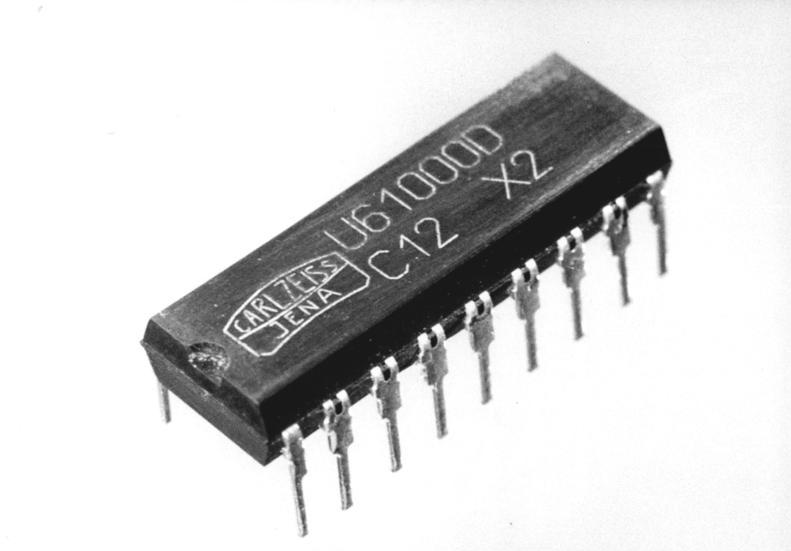
U61000
First 1-Mbit DRAM chip from the German Democratic Republic
The U61000 is a 1-megabit dynamic random-access memory chip developed in the German Democratic Republic. Zentrum Mikroelektronik Dresden produced it in September 1988 using CMOS technology, marking a local milestone in semiconductor manufacturing.
- First 1-Mbit DRAM made in the German Democratic Republic
- Produced by Zentrum Mikroelektronik Dresden in September 1988
- Uses CMOS technology with 100 ns to 120 ns access time
- Final production version designated as U61000-2.2
What it is
The U61000 is a dynamic random-access memory integrated circuit with a capacity of one megabit. It was the first chip of this density manufactured in the German Democratic Republic. The device uses complementary metal-oxide-semiconductor technology, which helps reduce power consumption compared to older designs. Zentrum Mikroelektronik Dresden completed the initial production in September 1988. This component stores data as bits in a grid structure, allowing computers to access information quickly for temporary tasks.
How it came about
Development began with an initial prototype designated U61000-1. Engineers at Zentrum Mikroelektronik Dresden worked to refine the design and improve the manufacturing technology. After optimizing these elements, they created an intermediate version called U61000-2.1. The team continued to adjust the process until they achieved a stable final variant known as U61000-2.2. This iterative approach allowed them to resolve technical challenges before full-scale production started in late 1988.
Inside the chip
The chip organizes its memory as 1024 kilobits by one bit. This configuration means it stores data in a single-bit wide format across a large array. Access times range from 100 nanoseconds to 120 nanoseconds, indicating how long the system waits to read or write data. The physical die measures 12.60 millimetres by 4.53 millimetres. Using CMOS technology, the design balances speed with energy efficiency, which was critical for the electronics available in that region during the late 1980s.
How it was made
Zentrum Mikroelektronik Dresden fabricated the U61000 using CMOS processes. The facility in Dresden was responsible for both the design and the physical production of the microchip. The final production model, U61000-2.2, represented the matured manufacturing capability of the plant. The small physical footprint of 12.60 mm by 4.53 mm reflects the integration levels achievable with the technology of that era in Eastern Europe.
Where it went
As a 1-Mbit DRAM module, this chip served as main memory or video memory in computing systems available in the German Democratic Republic. It supported applications requiring moderate data storage and retrieval speeds. Given its access time of up to 120 ns, it was suitable for personal computers and embedded controllers of the late 1980s. The component enabled local manufacturers to build systems without relying entirely on imported memory chips from Western markets.
Versions and family
The project evolved through three distinct stages. The initial development unit was named U61000-1. Once the team improved the underlying technology, they released the U61000-2.1. The final mass-production version carried the designation U61000-2.2. These variants show a clear progression from prototype to optimized product, with each step addressing specific design or manufacturing constraints identified during the earlier phases.
Why it matters
The U61000 marked a significant achievement for the semiconductor industry in the German Democratic Republic. It demonstrated that local facilities could produce high-density memory chips using CMOS technology. This milestone reduced dependence on foreign suppliers for critical computer components. The success of the U61000-2.2 version proved that the design and production methods at Zentrum Mikroelektronik Dresden had reached a competitive level for 1-Mbit capacity devices in 1988.


Questions people ask about U61000
What is the storage capacity of the U61000?
The U61000 has a capacity of 1 megabit. It is organized as 1024 kilobits by 1 bit. This allows it to store over one million individual binary digits for use in computer memory systems.
Who manufactured the U61000 chip?
Zentrum Mikroelektronik Dresden designed and produced the U61000. This facility was located in the German Democratic Republic and was responsible for the entire development process from prototype to final production.
How fast is the U61000 memory chip?
The access time for the U61000 ranges between 100 nanoseconds and 120 nanoseconds. This speed determines how quickly the chip can retrieve or store data when requested by the processor.
Good reading and sources
The facts on this page come from the Wikipedia article "U61000", written by its contributors and used under the CC BY-SA 4.0 licence, and from its Wikidata record (CC0). EveryChip rewrote the text in its own words, with AI assistance, and compares every page with the article to make sure no passage is copied. It may be reused under the same CC BY-SA 4.0 licence with a link back.
It may contain mistakes, and figures change over time. Nothing here is investment or buying advice. If something is wrong, tell us. Last refreshed 2026-11-14.
Like U61000
All memory chips 🇺🇸 United States and 2 moreEEPROM
Byte-erasable non-volatile memory for small data storageMemory · 1978
 World6264
JEDEC-standard 64 Kbit static RAM chipMemory
🇺🇸 United StatesTMS6100
Serial mask ROM for speech synthesis data storageMemory · Other · 1978
 🇺🇸 United States1T-SRAM
High-density pseudo-static memory technology for embedded systemsMemory · 1998