
EEPROM
Byte-erasable non-volatile memory for small data storage
EEPROM is a type of non-volatile memory that allows individual bytes to be erased and reprogrammed electrically. Developed from the 1970s by firms like Intel and Siemens, it stores small amounts of data in devices such as smart cards and microcontrollers.
- Allows individual bytes to be erased and reprogrammed
- Uses Fowler-Nordheim tunnelling for electrical erasure
- Typical endurance of one million write cycles
- Invented in late 1970s by Intel and Hughes Aircraft
- Requires two transistors per bit compared to one for flash
What it is
EEPROM is a form of non-volatile memory that retains data without power. Unlike earlier read-only memories, it can be erased and rewritten electrically. The key feature is the ability to modify individual bytes rather than large blocks. This makes it suitable for storing configuration settings and small datasets. It is often found inside microcontrollers or as a standalone chip. The technology relies on floating-gate transistors to trap electrons.
How it came about
Research into electrically reprogrammable memory began in the early 1970s. Yasuo Tarui and colleagues in Japan presented early work in 1971. IBM and NEC filed patents in 1972 and 1974 respectively. NEC secured the EEPROM trademark in 1978. A major breakthrough came in 1977 when Eliyahou Harari at Hughes Aircraft patented a method using Fowler-Nordheim tunnelling. Intel later developed the FLOTOX structure in 1978, improving reliability and cycle endurance.
Inside the chip
The chip uses an array of floating-gate transistors. Data is stored by trapping electrons on a gate isolated by silicon dioxide. Erasing involves removing these electrons via quantum tunnelling. Modern versions allow multi-byte page operations, though early devices were limited to single bytes. Each bit typically requires two transistors, one for reading and one for control. This design occupies more space than flash memory but offers finer control over data changes.
How it was made
Early manufacturing involved creating a thin silicon dioxide layer, less than 200 angstroms thick. Intel introduced this FLOTOX process in 1978. Later innovations included on-device charge pumps to generate the high voltages needed for programming. This removed the need for external high-voltage supplies. Fabrication was carried out by companies such as Intel, Siemens, and Hughes Aircraft. The process focuses on reliability of the tunnel oxide layer.
Where it went
These chips store small amounts of critical data. Common applications include smart cards, remote keyless systems, and SIM cards. They hold calibration data in sensors and real-time clocks. Video game cartridges used them to save progress before flash became common. Serial presence detect modules in computer memory also rely on EEPROM. It is preferred where only frequent small updates are needed.
Versions and family
Flash memory is a related type designed for higher density and speed. It erases data in large blocks rather than single bytes. EAROM is another variant that allows very slow, infrequent bit modifications. Parallel interface EEPROMs offer faster access but use more pins. Serial versions use fewer pins and are more common in modern compact devices. Some microcontrollers now emulate EEPROM using flash memory instead.
Why it matters
EEPROM enabled reliable storage of settings in embedded systems. It solved the problem of needing ultraviolet light to erase previous EPROM chips. The development of Fowler-Nordheim tunnelling laid the groundwork for flash memory. It remains essential for security applications requiring byte-level access. Although flash is cheaper for large storage, EEPROM persists for small, frequent writes.


Questions people ask about EEPROM
How does EEPROM differ from flash memory?
EEPROM allows erasing and rewriting individual bytes, while flash memory erases data in large blocks. Flash is faster and cheaper for large storage, but EEPROM offers better precision for small, frequent updates.
What is the typical lifespan of an EEPROM chip?
Modern EEPROMs are rated for approximately one million erase and write cycles. Data retention is usually guaranteed for ten years or more, depending on temperature and usage conditions.
Why do EEPROMs require high voltage for programming?
Writing and erasing data involves moving electrons through an insulating layer via quantum tunnelling. This process requires a strong electric field, often generated by internal charge pumps or external high-voltage supplies.
Good reading and sources
The facts on this page come from the Wikipedia article "EEPROM", written by its contributors and used under the CC BY-SA 4.0 licence, and from its Wikidata record (CC0). EveryChip rewrote the text in its own words, with AI assistance, and compares every page with the article to make sure no passage is copied. It may be reused under the same CC BY-SA 4.0 licence with a link back.
It may contain mistakes, and figures change over time. Nothing here is investment or buying advice. If something is wrong, tell us. Last refreshed 2026-11-14.
Like EEPROM
All memory chips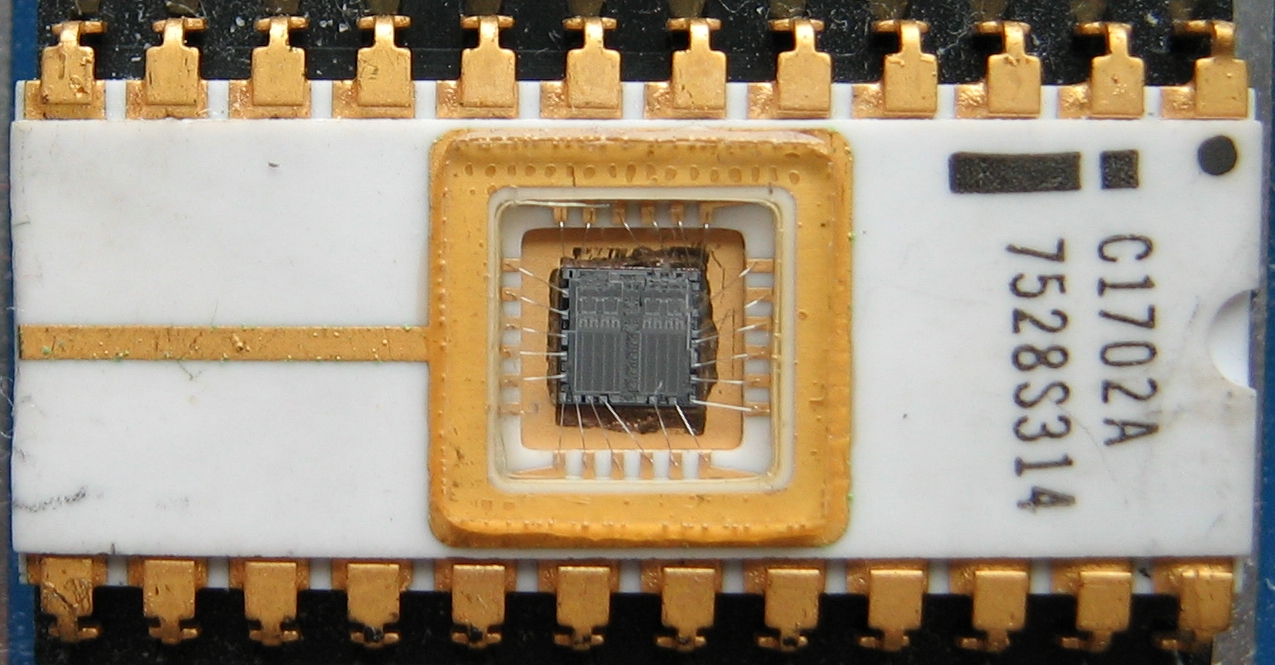 🇺🇸 United StatesEPROM
Non-volatile memory chip erased by ultraviolet lightMemory · 1971
 🇩🇪 GermanyU61000
First 1-Mbit DRAM chip from the German Democratic RepublicMemory · 1988
 World6264
JEDEC-standard 64 Kbit static RAM chipMemory
🇺🇸 United StatesTMS6100
Serial mask ROM for speech synthesis data storageMemory · Other · 1978
More from Intel
All of them 🇺🇸 United StatesIntel 8086
16-bit microprocessor that introduced the x86 instruction set in 1978CPU · x86 · 1978
 🇺🇸 United StatesIntel 8089
An I/O coprocessor that moved data for 8086 and 8088 systemsCPU · x86 · 1979
 🇮🇱 IsraelIntel 8088
A 16-bit Intel microprocessor with an 8-bit external data bus, used in the original IBM PC.CPU · x86 · 1979
 🇺🇸 United StatesIntel 8231/8232
Early single-chip floating-point coprocessors for microcomputers.Analog · Other · 1977