
Intel 8086
16-bit microprocessor that introduced the x86 instruction set in 1978
The Intel 8086 is a 16-bit microprocessor that Intel introduced in June 1978 and produced until 1998. It established the x86 instruction set architecture, which later processors extended while keeping binary compatibility with 8086 software.
- Introduced 8 June 1978; production ran until 1998
- First chip to implement the x86 instruction set architecture
- 29,277 transistors on a 33 mm² die at 3 μm
- 20-bit address bus gives a 1 MiB physical address space
- Second-sourced by AMD, NEC, Fujitsu, Siemens, Texas Instruments and others
What it is
The Intel 8086 is a 16-bit microprocessor, launched by Intel on 8 June 1978 and kept in production until 1998. It was the first chip to implement the x86 instruction set architecture, and later x86 processors kept binary compatibility with software written for it. All of its internal registers and its data buses are 16 bits wide, while a 20-bit address bus gives access to 1 MiB of memory. Clock speeds ranged from 5 MHz to 10 MHz. The chip carried 29,277 transistors and was built in a 3 μm process. Its last two digits gave the x86 family its name.
How it came about
Work on the 8086 began in May 1976 as a stopgap while Intel's ambitious iAPX 432 project slipped behind schedule. The goal was to answer 16-bit and 32-bit parts arriving from Motorola, Zilog and National Semiconductor. Principal architect Stephen P. Morse, helped by Bruce Ravenel, defined the instruction set; Jim McKevitt and John Bayliss led hardware development under manager Bill Pohlman. The first instruction set revision took about three months, and the whole design reached a working product in a little over two years, quick for a complex 1970s chip. Almost no CAD tools were used, with four engineers and 12 layout staff working at once.
Inside the chip
The 8086 keeps the shape of Intel's earlier 8-bit chips, so 8008, 8080 and 8085 assembly code could move across easily. It adds signed integers, base-plus-offset addressing and repeating string operations, plus microcoded multiply and divide. Eight general 16-bit registers are available, four of which can also be read as 8-bit pairs. Memory is reached through segmentation: a segment value is shifted left four bits and added to a 16-bit offset, forming a 20-bit address. A 6-byte instruction queue feeds the execution unit. Control pins change function between min mode for single-processor systems and max mode, needed with the 8087 or 8089 coprocessors.
How it was made
The first chips used depletion-load nMOS with roughly 20,000 active transistors, or 29,000 counting ROM and PLA sites, on a 33 mm² die with a 3.2 μm minimum feature size. Intel soon moved production to its HMOS process, developed for fast static RAM, then to HMOS-II, HMOS-III and finally a fully static CHMOS CMOS version for battery-powered devices. A 2 μm shrink arrived in 1981 and fixed a stack register bug found in the original 3.5 μm parts. Later 1.5 μm and CMOS variants were outsourced. The package is a 40-pin DIP, with address and data lines multiplexed to fit.
Where it went
The 8086 went into personal computers and other systems built by many manufacturers, and it was second-sourced by AMD, NEC, Fujitsu, Harris, Oki, Siemens, Texas Instruments, Mitsubishi Electric and Panasonic. Small programs could ignore segmentation and use plain 16-bit addressing, which made porting 8-bit software straightforward. Larger programs used near, far and huge pointers and standard memory models such as tiny, small, compact, medium, large and huge. The 8087 floating-point and 8089 I/O coprocessors plugged into the same bus in maximum mode.
Versions and family
The Intel 8088, released in 1979, is a close derivative whose external data bus is 8 bits wide instead of 16, so it works with cheaper and fewer support chips. The 80186 and 80286 followed, and the 80286 is named as the direct successor. The 8086 itself replaced the 8085, which in turn followed the 8080. Later parts in the line, including the 286 and 386, kept the last two digits of the 8086 name.
Why it matters
The 8086 set out the x86 instruction set, and every later x86 processor has kept binary compatibility with software written for it. That architecture became the basis for x86-64, still the instruction set of most desktop and server processors, and it also influenced IA-64. The x86 line grew into one of Intel's most successful product families and is widely used in personal computers today. Intel's PCI vendor ID for system devices is 8086, a nod to the part.
Problems and reception
The MUL and DIV instructions ran very slowly because they were microcoded, so programmers usually multiplied and divided with bit shift instructions instead. The original 3.5 μm chips had a stack register bug, corrected in the 2 μm version of 1981. Segmentation was widely seen by programmers as awkward to work with. The chip is now listed as unsupported.


Questions people ask about Intel 8086
What is the Intel 8086?
It is a 16-bit microprocessor that Intel launched in June 1978 and produced until 1998. It was the first chip to carry the x86 instruction set, and later x86 processors still run software written for it through binary compatibility.
How much memory could it use?
A 20-bit external address bus gives 1 MiB of physical memory. Addresses are formed by shifting a 16-bit segment value left four bits and adding a 16-bit offset. There is also a separate 64 KB I/O address space.
Who made the 8086?
Intel designed and built it, and it was also second-sourced by AMD, NEC, Fujitsu, Harris, Oki, Siemens, Texas Instruments, Mitsubishi Electric and Panasonic. Later 1.5 μm and CMOS variants were outsourced rather than developed in-house.
How does it differ from the 8088?
The 8088, released in 1979, is a close derivative with the external data bus cut from 16 bits to 8. That change let it work with cheaper and fewer supporting chips, while keeping the same instruction set.
What came before and after it?
It followed the Intel 8085, itself a successor to the 8080 and 8008. The 80186 and 80286 came after, with the 80286 named as its direct successor.
Good reading and sources
- Innovation starts hereIntel, Article
- For Parts, NASA Boldly Goes . . . on eBay (Published 2002)The New York Times, Article
- Birth of a standard: The Intel 8086 microprocessorPCWorld, Article
The facts on this page come from the Wikipedia article "Intel 8086", written by its contributors and used under the CC BY-SA 4.0 licence, and from its Wikidata record (CC0). EveryChip rewrote the text in its own words, with AI assistance, and compares every page with the article to make sure no passage is copied. It may be reused under the same CC BY-SA 4.0 licence with a link back.
It may contain mistakes, and figures change over time. Nothing here is investment or buying advice. If something is wrong, tell us. Last refreshed 2026-11-14.
Like Intel 8086
All CPUs and microprocessors 🇮🇱 IsraelIntel 8088
A 16-bit Intel microprocessor with an 8-bit external data bus, used in the original IBM PC.CPU · x86 · 1979
 🇺🇸 United States and 1 moreIntel 8087
A 1980 floating-point companion chip for the 8086 and 8088 CPUsCPU · x86 · 1980
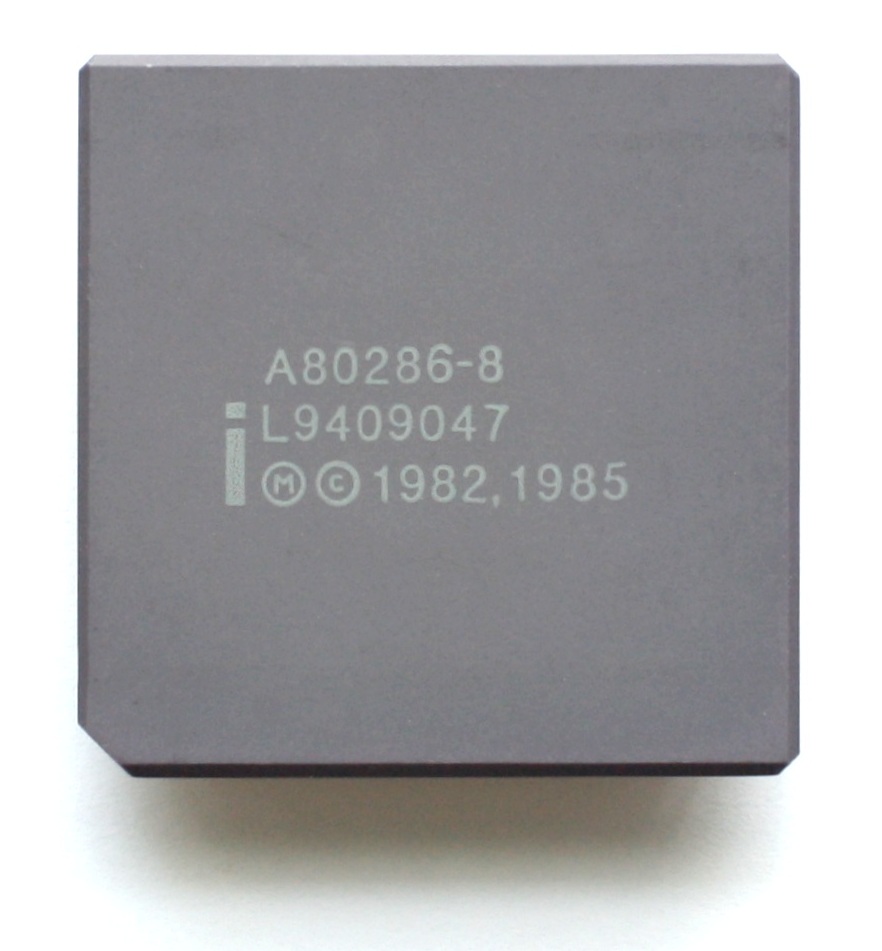 🇺🇸 United StatesIntel 80286
16-bit x86 CPU with protected mode and 24-bit addressing, launched in 1982CPU · x86 · 1982
 🇺🇸 United StatesIntel 8080
An 8-bit microprocessor released in 1974 that launched the personal computer era.CPU · x86 · 1974
More from Intel
All of them 🇺🇸 United States and 2 moreEEPROM
Byte-erasable non-volatile memory for small data storageMemory · 1978
 🇺🇸 United StatesIntel 8231/8232
Early single-chip floating-point coprocessors for microcomputers.Analog · Other · 1977
 🇺🇸 United StatesIntel 8089
An I/O coprocessor that moved data for 8086 and 8088 systemsCPU · x86 · 1979
 🇺🇸 United StatesIntel 8085
An 8-bit Intel microprocessor from 1976, the last of its lineCPU · 8-bit · 1976