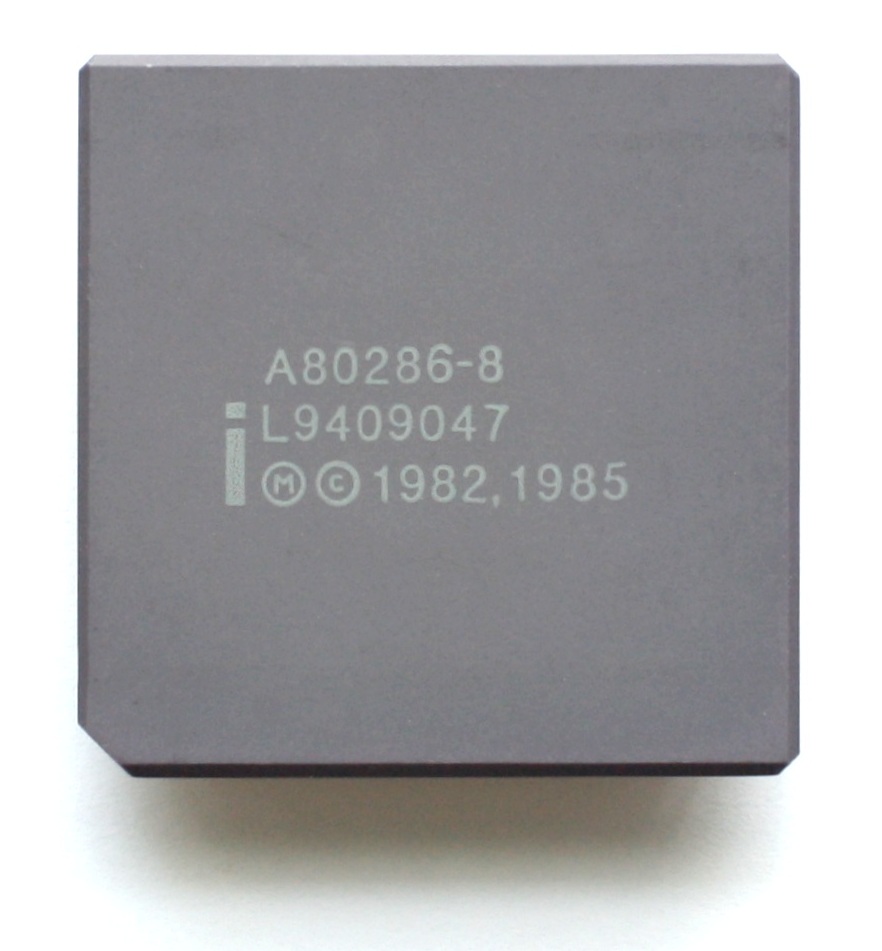
Intel 80286
16-bit x86 CPU with protected mode and 24-bit addressing, launched in 1982
The Intel 80286 is a 16-bit microprocessor that Intel introduced on 1 February 1982 as the second generation of the x86 family. It added protected mode and 24-bit physical addressing while keeping object-code compatibility with the 8086, 8088 and 80186, and it powered the IBM PC/AT and most PC/AT compatibles into the early 1990s.
- Introduced 1 February 1982 as the second x86 generation
- First x86 chip with an on-chip memory management unit
- 24-bit address bus reaches 16 MB, against 1 MB for the 8086
- About 134,000 transistors in the original nMOS design
- Intel shipped its five-millionth 80286 in 1987
What it is
The Intel 80286 is a 16-bit microprocessor, the second generation of the x86 line, launched by Intel on 1 February 1982. It kept object-code compatibility with earlier x86 chips such as the 8086, 8088 and 80186, so existing software could still run. Its new features were protected mode and a 24-bit address bus, which let a system reach 16 MB of memory instead of the 1 MB ceiling of earlier parts. It was also the first 8086-based CPU with separate address and data buses rather than multiplexed ones, and the first with on-chip memory management and protection. Around 134,000 transistors made up the original nMOS design. Production ran until 1991.
How it came about
Intel designed the 286 mainly for industrial automation, transaction processing and telecommunications rather than for personal computers. It was aimed at multi-user systems running several tasks at once, including automated telephone exchanges and real-time process control. The chip reached the mass market anyway through the IBM PC/AT, which arrived in 1984, and PC/AT clones followed. Intel second-sourced the part to Fujitsu around 1985. By 1987 Intel had shipped its five-millionth 80286.
Inside the chip
Inside, the 286 has four separate units: an address unit, a bus unit, an instruction unit and an execution unit, joined into a loosely coupled buffered pipeline much like the 8086. A dedicated unit works out addresses such as base plus index, which the older 8086 had to do with its general arithmetic unit, so many programs ran more than twice as fast at the same clock. The chip carries every 8086 instruction plus the 80186 additions, and adds protected-mode instructions for segment checks and descriptor tables. Registers stay 16-bit and memory is still mapped in 64 kB segments.
How it was made
The first parts were built on a 1.5 µm nMOS process, also described as HMOS, with about 134,000 transistors. Intel, Intersil and Fujitsu also made fully static CMOS versions aimed at battery-powered equipment; Intel's CMOS part was the 80C286. Chips were sold in 68-pin packages: plastic leaded chip carrier, leadless chip carrier and pin grid array. Manufacturing was shared across Intel, IBM, AMD, Harris, Siemens and Fujitsu.
Where it went
The best-known machine built around the 286 was the IBM PC/AT of 1984, and the chip stayed common in PC/AT compatible computers until the early 1990s. Intel had expected it in industrial control, transaction systems and telecoms gear such as automated PBXs. Protected-mode operating systems that used it included Microsoft Xenix, Coherent and Minix. Digital Research built Concurrent DOS 286 and later FlexOS 286 for it, and IBM based its 4680 and 4690 systems on that software. Static CMOS versions served battery-powered devices.
Versions and family
Intel's first 286 parts were rated at 5, 6 or 8 MHz, later 12.5 MHz. AMD and Harris went on to build 16, 20 and 25 MHz versions. The CMOS line was called 80C286. Early B-step and C-step silicon carried errata that troubled programmers; the later E-stepping cleared the documented faults, with an E-2 part possibly available in late 1986. The 80186 is listed as a variant, and the 80386 replaced the 286.
Why it matters
The 286 brought memory management and protection onto a single chip for IBM-compatible machines, letting them take on multitasking operating systems and compete in the server and workstation space that Unix held. Intel shipped its five-millionth unit in 1987. Its protected mode shaped the design of the 80386, whose engineers agreed with the criticism of the 286 and added virtual 8086 mode to fix the compatibility gap.
Problems and reception
Protected mode saw little use for years, partly because extended memory was costly and partly because DOS programs reached outside their own segments. The 286 could not return to real mode without a reset, so IBM added circuitry and BIOS code in the PC/AT to fake it, at a heavy speed cost. Bill Gates called the chip "brain-damaged" for its lack of virtual machine support for 8086 software. Digital Research hit emulation problems on the C-1 step and delayed Concurrent DOS 286 until Intel revised the microcode.


Questions people ask about Intel 80286
What did the 80286 add over the 8086?
It kept the same object code but added protected mode and a 24-bit address bus, so a machine could reach 16 MB of memory rather than 1 MB. It also had separate address and data buses and an on-chip memory management unit, and it ran many programs more than twice as fast at the same clock speed.
Why was protected mode hard to use?
Older DOS programs assumed they could touch any segment, which protected mode forbids, and they could not run there without rewrites. Registers stayed 16-bit and memory was still split into 64 kB segments. The chip also could not drop back to real mode without a hardware reset, which IBM worked around with extra circuitry at a large speed cost.
Which computers used it?
The main one was the IBM PC/AT of 1984, and the chip stayed standard in PC/AT compatible machines until the early 1990s. Intel also expected it in industrial automation, transaction processing and telephone systems. Protected-mode operating systems for it included Xenix, Coherent, Minix and Digital Research's Concurrent DOS 286.
How fast were the parts?
Intel's first chips were rated at 5, 6 or 8 MHz, later 12.5 MHz, while AMD and Harris built 16, 20 and 25 MHz versions. Reported figures were 0.9 MIPS at 6 MHz, 1.5 MIPS at 10 MHz and 2.66 MIPS at 12 MHz, with about 0.21 instructions per clock on typical code.
Good reading and sources
The facts on this page come from the Wikipedia article "Intel 80286", written by its contributors and used under the CC BY-SA 4.0 licence, and from its Wikidata record (CC0). EveryChip rewrote the text in its own words, with AI assistance, and compares every page with the article to make sure no passage is copied. It may be reused under the same CC BY-SA 4.0 licence with a link back.
It may contain mistakes, and figures change over time. Nothing here is investment or buying advice. If something is wrong, tell us. Last refreshed 2026-11-14.
Like Intel 80286
All CPUs and microprocessors 🇺🇸 United StatesIntel 80186
16-bit microprocessor with integrated peripherals for embedded systemsCPU · x86 · 1982
🇺🇸 United StatesIntel 80286
16-bit microprocessor with protected mode and 16 MB memory supportCPU · x86 · 1982
🇺🇸 United StatesIntel 80286
16-bit microprocessor with protected mode and 16 MB memory supportCPU · x86 · 1982
 🇺🇸 United States and 1 moreIntel 8087
A 1980 floating-point companion chip for the 8086 and 8088 CPUsCPU · x86 · 1980
More from Intel
All of them 🇺🇸 United StatesIntel iAPX 432
Intel's first 32-bit processor, a two-chip stack machine built for AdaCPU · Other · 1981
🇺🇸 United StatesIntel 8061
Automotive microcontroller for Ford engine control unitsMicrocontroller · Other · 1983
 🇺🇸 United StatesIntel MCS-51
An 8-bit microcontroller series for embedded systems.Microcontroller · Other · 1980
 WorldMagnetoresistive RAM
Non-volatile memory storing data in magnetic domainsMemory · 1980