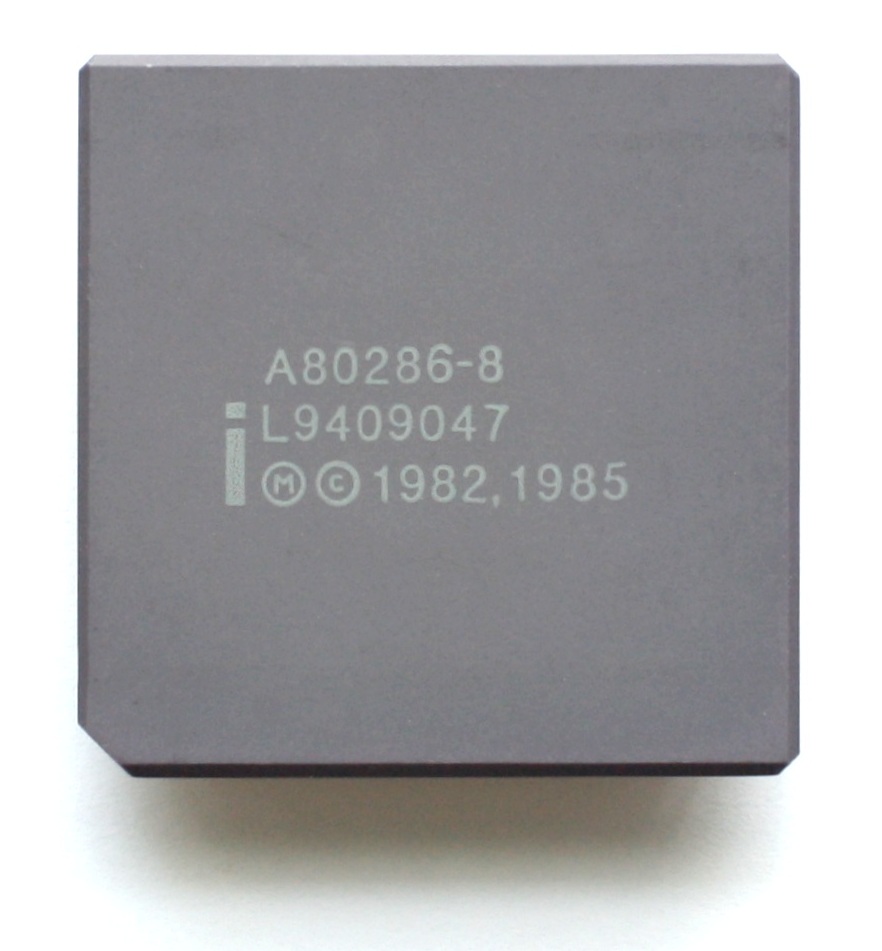
Intel 80286
16-bit microprocessor with protected mode and 16 MB memory support
Intel launched the 80286 in February 1982 as the second generation of x86 chips. It introduced protected mode for memory management and addressed up to 16 MB of RAM. This processor powered the IBM PC/AT and defined personal computing standards through the early 1990s.
- Introduced protected mode for memory management and security
- Addressed up to 16 MB of physical memory via 24-bit bus
- Powered the IBM PC/AT and compatible systems until the 1990s
- Contained 134,000 transistors in a 1.5 µm process
- First x86 CPU with separate non-multiplexed address and data buses
What it is
The Intel 80286 is a 16-bit microprocessor that marked the second generation of the x86 family. Released in early 1982, it brought significant architectural improvements over its predecessor, the 8086. The chip featured separate address and data buses, which eliminated the multiplexing bottleneck of earlier designs. It supported up to 16 MB of physical memory through a 24-bit address bus. This capacity was a major leap from the 1 MB limit of previous processors. The 80286 also introduced protected mode, enabling hardware-level memory protection and multitasking capabilities. These features made it suitable for multi-user systems and industrial applications. It retained compatibility with software written for the 8086 and 8088, ensuring a smooth transition for developers. The processor became the heart of the IBM PC/AT and dominated the compatible market for nearly a decade.
How it came about
Intel initially targeted the 286 at industrial automation and telecommunications rather than personal computers. The first chips operated at clock speeds of 5, 6, or 8 MHz. Later releases reached 12.5 MHz, while partners like AMD and Harris pushed speeds to 25 MHz. Intel shipped its five-millionth unit in 1987, highlighting its commercial success. Early production steps, such as B-step and C-step, contained errata that troubled programmers. Intel resolved these issues in the E-stepping level available by late 1986. The company also licensed production to Fujitsu in 1985 to meet demand. Despite its technical advances, the chip faced criticism for its inability to switch easily from protected mode back to real mode. This limitation frustrated operating system developers, including Microsoft, who found it difficult to multitask legacy DOS applications effectively.
Inside the chip
The processor contains approximately 134,000 transistors built using 1.5 µm nMOS technology. Its architecture divides work into four independent units: address, bus, instruction, and execution. These units operate in a loosely coupled pipeline, similar to the 8086 but with greater efficiency. A dedicated unit handles address calculations, which previously consumed extra cycles on the general ALU. This change, along with better instruction prefetching, doubled performance per clock cycle compared to the 8086. The chip supports a 16-bit data width and a 24-bit address width. It includes new instructions for protected mode, such as segment management and privilege checks. Protected mode prevents unauthorized memory access by assigning privilege levels to segments. However, returning to real mode requires a hardware reset, a design choice that complicated software development for multitasking environments.
How it was made
Manufacturers produced the 80286 using a 1.5 µm process node. The original implementation used depletion-load nMOS logic, known as HMOS. Later, Intel, Intersil, and Fujitsu developed fully static CMOS versions for battery-powered devices. The chip comes in several 68-pin packages, including plastic leaded chip carrier, leadless chip carrier, and pin grid array. Second sourcing allowed companies like AMD, Harris, Siemens, and Fujitsu to manufacture compatible versions. This broad manufacturing base helped keep supply steady as demand grew. The CMOS variants offered lower power consumption, making them suitable for portable equipment. The physical design supported clock speeds ranging from 4 MHz to 25 MHz, depending on the manufacturer and specific model variant.
Where it went
The most famous application of the 80286 was in the IBM PC/AT, launched in 1984. It became the standard for PC/AT compatible computers throughout the late 1980s. Beyond personal computing, Intel intended the chip for transaction processing and real-time control systems. It powered automated private branch exchanges and industrial automation equipment. Operating systems like Microsoft Xenix, Coherent, and Minix utilized its protected mode for multitasking. IBM also adopted a derivative of Concurrent DOS 286 for its 4680 point-of-sale terminals. Despite the potential for advanced operating systems, most users ran MS-DOS in real mode due to software compatibility issues. The chip remained in widespread use until the early 1990s, when 32-bit processors began to replace it.
Versions and family
Several companies produced variants of the original Intel design. AMD and Harris offered faster models running at 16, 20, and 25 MHz. Intel itself released the 80C286, a CMOS version designed for lower power consumption. The E-stepping revision corrected significant bugs found in earlier B and C stepping parts. Digital Research worked closely with Intel to address emulation problems in the E-1 and E-2 steps for their Concurrent DOS 286 operating system. The chip succeeded the 8086 and 8088 processors and was eventually replaced by the 32-bit 80386. The 80386 addressed many of the 286's limitations, particularly regarding virtual machine support and mode switching. The 80186 served as a contemporary variant with integrated peripherals but lacked the protected mode features of the 286.
Why it matters
The 80286 established the foundation for modern PC architecture by introducing protected mode and expanded memory addressing. It enabled the development of multitasking operating systems on Intel hardware, competing with Unix workstations. The chip's success cemented the x86 family's dominance in the personal computer market. However, its design flaws regarding mode switching influenced future processor development. Intel engineers acknowledged these issues when designing the 80386, adding virtual 8086 mode to improve compatibility. The tension between IBM and Microsoft over OS/2 development on the 286 highlighted the software challenges it presented. Despite these hurdles, the 80286 sold millions of units and remained relevant for over a decade. It bridged the gap between early 8-bit computing and the 32-bit era.
Problems and reception
Programmers and operating system writers faced difficulties with early errata in B-step and C-step chips. Bill Gates famously criticized the processor as brain-damaged due to its poor support for virtual machines. The inability to multitask MS-DOS applications efficiently in protected mode was a major complaint. Digital Research encountered undocumented performance problems while developing Concurrent DOS 286. These issues delayed the release of their operating system and required microcode changes in later silicon steppings. Despite the criticism, the chip was widely adopted because of its performance gains and compatibility. The E-stepping revisions largely resolved the technical bugs, improving stability for developers. The industry ultimately moved past these limitations with the introduction of the 80386.


Questions people ask about Intel 80286
What is protected mode on the 80286?
Protected mode is a feature that enables hardware-level memory protection and multitasking. It prevents programs from accessing memory segments they do not own by assigning privilege levels. This allows multiple users or tasks to run safely without interfering with each other, a key step toward modern operating systems.
Why was the 80286 criticized by software developers?
The chip could not switch from protected mode back to real mode without a hardware reset. This made it difficult to run legacy MS-DOS applications in a multitasking environment. Developers had to use complex workarounds involving the keyboard controller, which caused significant performance penalties.
How much memory could the 80286 address?
The processor featured a 24-bit address bus, allowing it to address up to 16 MB of physical memory. This was a substantial increase from the 1 MB limit of the earlier 8086 and 8088 processors, though cost and software limitations often restricted actual usage to 1 MB.
Which companies manufactured the 80286 besides Intel?
Several companies produced second-source versions of the chip, including AMD, Harris Corporation, Fujitsu, Siemens, and IBM. AMD and Harris notably offered faster variants running at up to 25 MHz, while Fujitsu and others produced CMOS versions for lower power applications.
Good reading and sources
The facts on this page come from the Wikipedia article "Intel 80286", written by its contributors and used under the CC BY-SA 4.0 licence, and from its Wikidata record (CC0). EveryChip rewrote the text in its own words, with AI assistance, and compares every page with the article to make sure no passage is copied. It may be reused under the same CC BY-SA 4.0 licence with a link back.
It may contain mistakes, and figures change over time. Nothing here is investment or buying advice. If something is wrong, tell us. Last refreshed 2026-11-14.
Like Intel 80286
All CPUs and microprocessors
🇺🇸 United StatesIntel 80286
16-bit x86 CPU with protected mode and 24-bit addressing, launched in 1982CPU · x86 · 1982
 🇺🇸 United StatesIntel 80186
16-bit microprocessor with integrated peripherals for embedded systemsCPU · x86 · 1982
🇺🇸 United StatesIntel 80286
16-bit microprocessor with protected mode and 16 MB memory supportCPU · x86 · 1982
 🇺🇸 United States and 1 moreIntel 8087
A 1980 floating-point companion chip for the 8086 and 8088 CPUsCPU · x86 · 1980
More from Intel
All of them 🇺🇸 United StatesIntel iAPX 432
Intel's first 32-bit processor, a two-chip stack machine built for AdaCPU · Other · 1981
🇺🇸 United StatesIntel 8061
Automotive microcontroller for Ford engine control unitsMicrocontroller · Other · 1983
 🇺🇸 United StatesIntel MCS-51
An 8-bit microcontroller series for embedded systems.Microcontroller · Other · 1980
🇺🇸 United StatesIntel 8237
Four-channel DMA controller for early IBM PCsAnalog · Other · 1980