
Intel iAPX 432
Intel's first 32-bit processor, a two-chip stack machine built for Ada
The iAPX 432 was Intel's first 32-bit processor design, a stack machine introduced in 1981 and sold until 1985. Built as two chips for the main processor, it pushed object support and protection into hardware but ran slowly and cost too much, so Intel dropped it in 1986.
- Intel's first 32-bit processor design, introduced in 1981
- Main processor split across two chips, 43201 and 43202, about 97,000 transistors
- Instructions ranged from 6 to 321 bits and were not byte-aligned
- Ran about a quarter of the 80286's speed at the same clock in early 1982
- Discontinued in 1986 after very low sales
What it is
The iAPX 432 was Intel's first 32-bit microprocessor, a computer architecture that reached customers in late 1981 and stayed in production until 1985. Intel called it a micromainframe and meant it to be programmed in high-level languages, with Ada as the main choice. It was a stack machine, so programs saw no general-purpose registers, and it handled object-oriented programming, garbage collection, multitasking and memory protection in hardware and microcode. The design was far more complex than other processors of its day, yet its buses were mostly 16 bits wide and 32-bit arithmetic ran through a 16-bit ALU. Very few systems used it and Intel ended the line in 1986.
How it came about
Work started in 1975 under the name 8800, chosen to follow the 8008 and 8080. Bill Lattin managed the team, with Justin Rattner as lead engineer; the group moved from Santa Clara to Portland in March 1977 with 17 engineers. The goal was a complete system in a few large-scale integration chips matching the best minicomputers, with multiprocessors, fault tolerance and strong security. Because that would take years, Intel rushed out the 8086 in 1978 as a stop-gap against Motorola, Zilog and National Semiconductor. The 432 arrived in 1981 but sold poorly and was discontinued in 1986.
Inside the chip
The main processor, called the General Data Processor, was split across two integrated circuits: the 43201 fetched and decoded instructions while the 43202 executed them. Instructions were variable length, from 6 to 321 bits, and not byte-aligned, so decoding needed a large barrel shifter and extra transistors. Memory was segmented, with up to 224 segments of 64 KB each. Programs could not use raw addresses; they named a segment and an offset, and an access descriptor carried an index plus a set of rights. Hardware kept access segments, which hold descriptors, separate from data segments, and checked object types in microcode.
How it was made
The two GDP chips together held roughly 97,000 transistors, and the single-chip Interface Processor about 49,000, against roughly 68,000 for the Motorola 68000. Intel made the parts itself. The fabrication methods of the time could not fit the design into one efficient chip, which pushed up cost and held down clock speed. Sold parts ran at 4, 5, 7 or 8 MHz, reaching about 2 million instructions per second at 8 MHz.
Where it went
Most systems paired the two GDP chips with a 43203 Interface Processor for input and output and an 8086 as an Attached Processor. Intel also sold the SBC 432/100 board. The iMAX 432 operating system was written entirely in Ada for the machine. In 1983 Intel added the 43204 Bus Interface Unit and 43205 Memory Control Unit, which let builders assemble multiprocessor systems of up to 63 nodes with almost no glue logic. Very few customers bought these systems.
Versions and family
The General Data Processor came as the 43201 instruction unit and the 43202 execution unit. Around them sat the 43203 Interface Processor and, in 1983, the 43204 Bus Interface Unit and 43205 Memory Control Unit. The architecture moved from Release 1 to Release 3, which changed how system objects were laid out. The 8086 line, though it briefly borrowed the iAPX prefix in marketing, was a separate design with a different instruction set. After the 432 failed, Intel hired Glenford Myers for a fresh architecture, done with Siemens as BiiN, which became the i960 family.
Why it matters
The 432 was among the first systems to implement the IEEE-754 floating-point standard. Its failure led many designers to conclude that object support in silicon makes a chip complex and slow, and RISC supporters often cited it as the cautionary case. Others argue the Ada compiler and the two-chip split were the real culprits. Only the Rekursiv tried a similar idea afterwards, though the INMOS Transputer handled processes in a related but fast way. Intel's later high-end effort with HP, Merced, became Itanium.
Problems and reception
Performance was the main complaint. On typical benchmarks in early 1982 the 432 ran at about a quarter of the speed of the 80286 at the same clock rate, and the New York Times reported it was 5 to 10 times slower than the Motorola 68000. The untuned Ada compiler chose costly object instructions for every call, ran protection setup for each variable, and always passed parameters by value-return, so on Dhrystone parameter passing took ten times longer than the rest of the work. Fault-tolerant bus design also burned up to 40% of bus time in wait states.


Questions people ask about Intel iAPX 432
What kind of processor was the iAPX 432?
It was a 32-bit stack machine with no visible general-purpose registers. Intel designed it to be programmed in high-level languages, mainly Ada, and put object support, garbage collection, multitasking and memory protection into hardware and microcode.
Why was it built from more than one chip?
The design was too large and advanced for the fabrication methods of the time, so the General Data Processor had to be split. The 43201 fetched and decoded instructions while the 43202 executed them, and the wiring between them limited the clock speed.
Why did it fail?
It was expensive and slow. Typical benchmarks in early 1982 ran at about a quarter of the 80286's speed at the same clock, and the New York Times put it at 5 to 10 times slower than the Motorola 68000. An immature Ada compiler and a fault-tolerant bus that wasted up to 40% of bus time made things worse.
Was it related to the 8086?
No. The 8086 was a separate stop-gap design started in 1977 while the 432 was still maturing, and the two have completely different instruction sets. Some early 8086, 80186 and 80286 products borrowed the iAPX prefix for marketing only.
What came after it?
Intel brought in Glenford Myers for a new architecture built with Siemens in the BiiN project, which produced the i960 family. The i960 RISC subset sold well in embedded systems for a time, while the high-end 960MC and 960MX were aimed at military use.
Good reading and sources
- Intel iAPX 432 on WikipediaEncyclopedia
- More photos on Wikimedia CommonsPhotos
- Wikidata recordOpen data
The facts on this page come from the Wikipedia article "Intel iAPX 432", written by its contributors and used under the CC BY-SA 4.0 licence, and from its Wikidata record (CC0). EveryChip rewrote the text in its own words, with AI assistance, and compares every page with the article to make sure no passage is copied. It may be reused under the same CC BY-SA 4.0 licence with a link back.
It may contain mistakes, and figures change over time. Nothing here is investment or buying advice. If something is wrong, tell us. Last refreshed 2026-11-14.
Like Intel iAPX 432
All CPUs and microprocessors 🇺🇸 United StatesIntel 4004
The first commercial microprocessor, a 4-bit chip released by Intel in 1971.CPU · Other · 1971
WorldIAPX
A short-lived Intel marketing prefix for 8086-family and iAPX 432 chips.CPU · x86
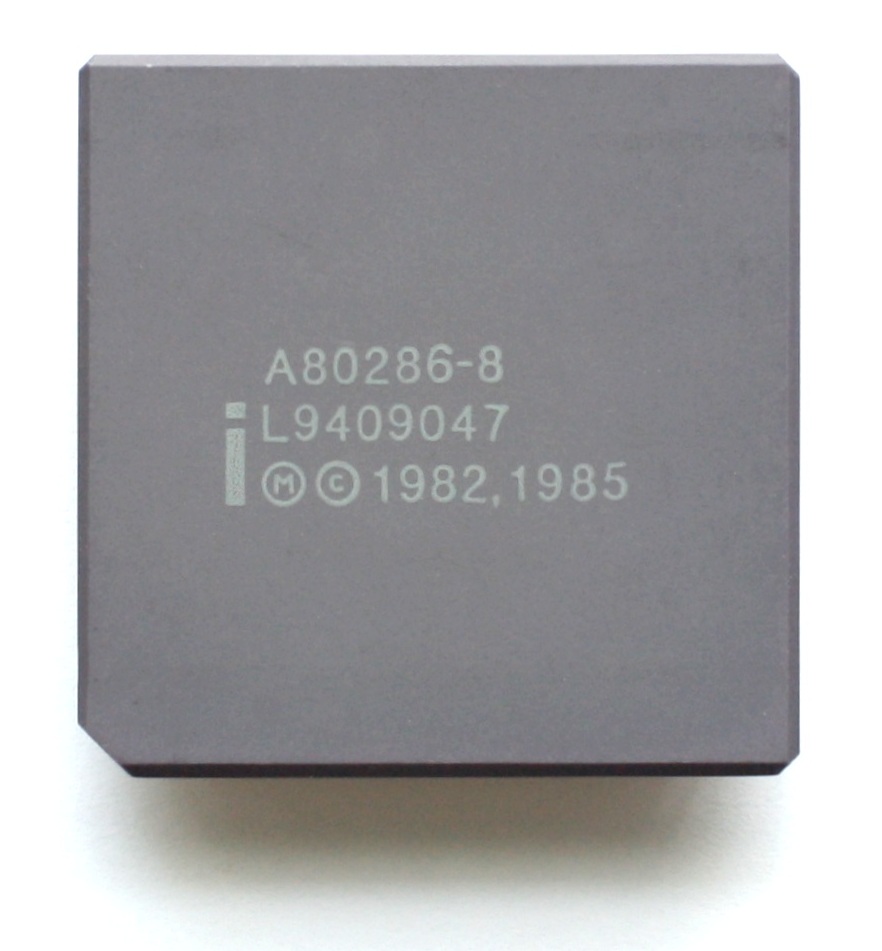 🇺🇸 United StatesIntel 80286
16-bit x86 CPU with protected mode and 24-bit addressing, launched in 1982CPU · x86 · 1982
 🇺🇸 United States and 1 moreDEC T-11
DEC's first single-chip PDP-11 microprocessor, built for embedded control workCPU · Other · 1982
More from Intel
All of them 🇺🇸 United StatesIntel MCS-51
An 8-bit microcontroller series for embedded systems.Microcontroller · Other · 1980
 🇺🇸 United States and 1 moreIntel 8087
A 1980 floating-point companion chip for the 8086 and 8088 CPUsCPU · x86 · 1980
 🇺🇸 United StatesIntel 8253
Programmable interval timer for early microcomputers and PCsAnalog · 1980