
Intel 4004
The first commercial microprocessor, a 4-bit chip released by Intel in 1971.
Released on November 15, 1971, the Intel 4004 was the first single-chip central processing unit. It used silicon gate technology to pack 2,300 transistors into a 16-pin package, launching the modern computing era.
- First commercial single-chip microprocessor released by Intel in 1971.
- Used self-aligned gate silicon technology for higher density and speed.
- Contained 2,300 transistors in a 16-pin dual in-line package.
- Designed originally for Busicom electronic calculators.
- Operated at speeds between 740 kHz and 750 kHz.
What it is
The Intel 4004 stands as the inaugural commercial microprocessor, marking a pivotal shift in electronics history. Unveiled by Intel Corporation on November 15, 1971, this four-bit central processing unit integrated previously separate logic components onto a single silicon die. Priced at sixty dollars upon release, it represented a significant economic and technological breakthrough. The chip served as the computational heart for early electronic calculators, demonstrating that complex arithmetic could be handled by a compact, programmable device rather than discrete circuit boards.
How it came about
The project began in April 1969 when Japanese firm Busicom commissioned Intel to create a custom chipset for their advanced calculators. Initial plans involved seven distinct chips, but Intel engineer Marcian Hoff proposed consolidating the central processing functions into one unit. This idea gained traction after Stanley Mazor joined the team to refine the architecture. Federico Faggin subsequently took over hardware design in April 1970, implementing critical manufacturing innovations. The first operational units were delivered to Busicom in March 1971 for their 141-PF printing calculator prototype.
Inside the chip
Architecturally, the 4004 operated on a four-bit binary-coded decimal system, ideal for direct numerical manipulation in calculating devices. It featured a twelve-bit address bus that utilized multiplexing to fit within a sixteen-pin dual in-line package. This pin limitation required three clock cycles to specify an address and two additional cycles to retrieve data from memory. The instruction set supported subroutine calls, allowing for more flexible program structures compared to earlier fixed-function logic designs. Shima modified key instructions to manage accumulator states efficiently during these operations.
How it was made
Manufacturing relied on self-aligned gate silicon gate technology, a process developed by Federico Faggin at Fairchild before joining Intel. This method replaced traditional aluminum wiring with polysilicon, drastically reducing parasitic capacitance and leakage current. The introduction of buried contacts allowed gates to connect directly to transistor sources without metal interposers. These advancements doubled component density and increased operating speed fivefold compared to previous metal-gate designs. The resulting chip contained 2,300 transistors fabricated on a ten-micrometre process node.
Where it went
Primary applications included electronic calculators, specifically the Busicom 141-PF model. Beyond consumer devices, the architecture enabled general-purpose embedded systems such as billing machines, automatic teller machines, and cash registers. NCR sold approximately one hundred thousand units based on this OEM partnership. The chip demonstrated that a single processor could replace entire banks of discrete logic circuits, paving the way for widespread adoption in industrial control and personal computing equipment.
Versions and family
The 4004 formed part of the MCS-4 chipset family, which included dedicated read-only memory, random-access memory, and input-output shift registers. Its immediate successor was the Intel 4040, released in 1974 with improved performance and expanded capabilities. The architectural lineage continued with the eight-bit Intel 8008 and subsequently the Intel 8080 processors. These later designs built upon the foundational concepts established by the original four-bit architecture, evolving into the extensive x86 processor families.
Why it matters
The 4004 proved that large-scale integration could produce affordable, versatile processors. It accelerated industry-wide adoption of silicon gate technology across the semiconductor sector. By demonstrating the viability of single-chip CPUs, it laid the groundwork for the microcomputer revolution. The success of this project validated Intel's business model and established the foundation for future processor development. It shifted computing power from room-sized mainframes to desktop-sized devices, fundamentally altering the trajectory of information technology.
Problems and reception
The chip was recognized immediately as a major milestone in engineering and commerce. It faced no significant recalls or controversies during its production run, which lasted until 1981. Industry observers viewed the reduction in component count and cost as a transformative achievement. The successful collaboration between Intel and Busicom showcased the potential of outsourcing complex semiconductor design. Historical records now preserve prototypes in institutions like the Computer History Museum, cementing its status as a landmark invention.


Questions people ask about Intel 4004
What made the Intel 4004 different from previous computers?
Unlike earlier systems using multiple discrete chips or vacuum tubes, the 4004 integrated the entire central processing unit onto a single silicon die. This consolidation reduced size, cost, and power consumption while increasing reliability. It allowed complex logic to fit into small devices like calculators.
Who designed the Intel 4004 architecture?
Marcian Hoff proposed the initial single-chip concept. Stanley Mazor refined the instruction set and addressing schemes. Masatoshi Shima from Busicom contributed significantly to the architectural design and subroutines. Federico Faggin led the physical implementation and manufacturing process.
How did silicon gate technology improve the chip?
Silicon gate technology replaced aluminum wiring with polysilicon gates. This eliminated parasitic capacitance, allowing faster operation and lower leakage currents. Buried contacts enabled denser packing of components. These changes doubled circuit density and reduced manufacturing costs significantly.
What was the primary application of the 4004?
It was primarily designed for electronic calculators, starting with the Busicom 141-PF. The architecture also supported other embedded systems like cash registers, billing machines, and automatic teller machines. Its general-purpose nature allowed it to handle various arithmetic tasks efficiently.
What came after the Intel 4004?
The Intel 4040 succeeded the 4004 in 1974, offering enhanced performance. The architectural lineage continued with the eight-bit Intel 8008 and Intel 8080 processors. These developments eventually evolved into the broader x86 processor family used in modern computing.
Good reading and sources
- Announcing a New Era of Integrated ElectronicsIntel, Article
- For Texas Instruments, Some Bragging Rights (Published 1996)The New York Times, Article
- Chip Hall of Fame: Intel 4004 MicroprocessorIEEE Spectrum, Article
The facts on this page come from the Wikipedia article "Intel 4004", written by its contributors and used under the CC BY-SA 4.0 licence, and from its Wikidata record (CC0). EveryChip rewrote the text in its own words, with AI assistance, and compares every page with the article to make sure no passage is copied. It may be reused under the same CC BY-SA 4.0 licence with a link back.
It may contain mistakes, and figures change over time. Nothing here is investment or buying advice. If something is wrong, tell us. Last refreshed 2026-11-17.
Like Intel 4004
All CPUs and microprocessors 🇯🇵 JapanNEC μCOM series
NEC microprocessor and microcontroller family from the 1970s and 1980sCPU · x86 · 1973
🇯🇵 JapanΜCOM-4
NEC original 4-bit single-chip microprocessor from 1973Microcontroller · Other · 1973
 🇺🇸 United StatesMotorola 6800
An 8-bit microprocessor from Motorola, launched in 1974 as the core of the M6800 family.CPU · Other · 1974
More from Intel
All of them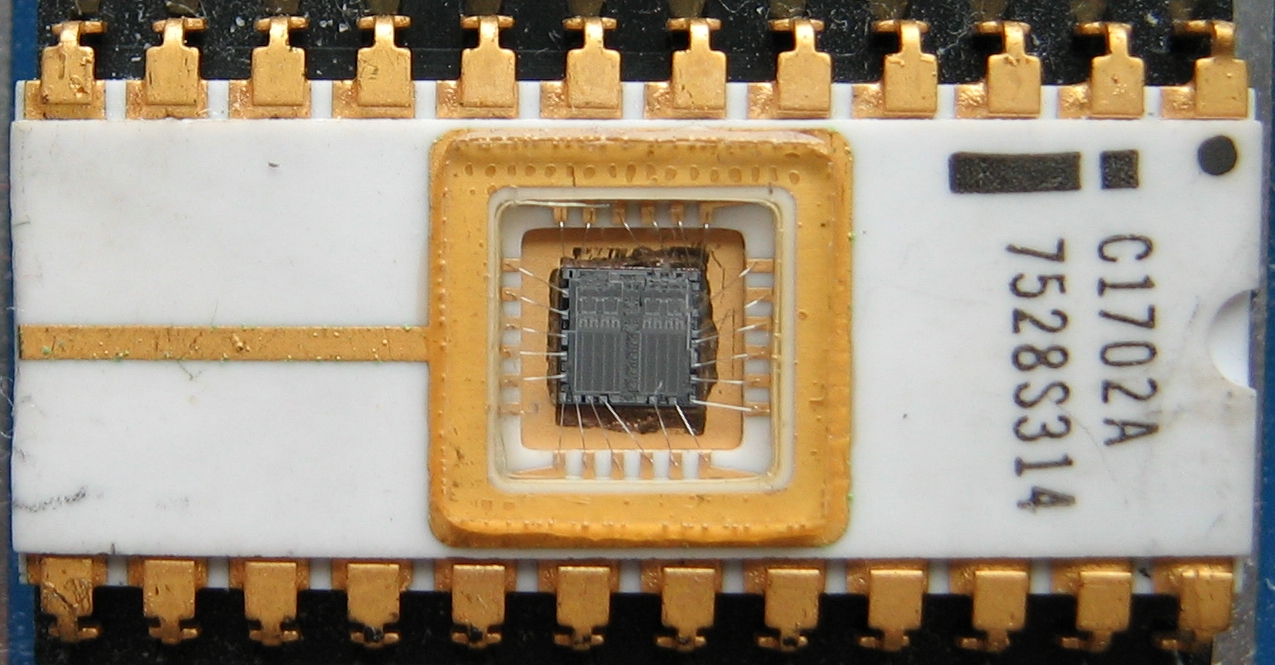 🇺🇸 United StatesEPROM
Non-volatile memory chip erased by ultraviolet lightMemory · 1971
 🇺🇸 United StatesUART
Chip for serial data communication between devicesAnalog · 1971
 🇺🇸 United StatesIntel 1103
First commercially available DRAM integrated circuitMemory · 1970
 🇺🇸 United StatesIntel 8255
Programmable parallel input/output interface chip for early microprocessorsAnalog · 1970