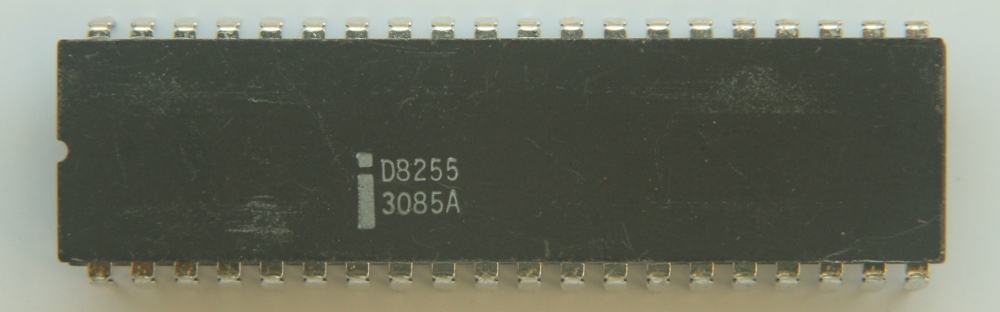
Intel 8255
Programmable parallel input/output interface chip for early microprocessors
The Intel 8255 is a programmable peripheral interface chip developed in the 1970s to manage data flow for the 8080, 8085 and 8086 processors. It provides twenty-four configurable input or output lines and became a standard component in early personal computers and industrial systems.
- Provides 24 programmable parallel input/output lines
- Used in the original IBM PC and MSX home computers
- Features three operational modes for flexible data handling
- CMOS version 82C55 offers lower power consumption
- Cloned by manufacturers in the Soviet Union and Czechoslovakia
What it is
The Intel 8255, also known as the Programmable Peripheral Interface, is an integrated circuit that manages parallel data transfer between a central processor and external devices. Introduced in the first half of the 1970s, it was designed to support the Intel 8080 microprocessor and later joined the MCS-85 family for use with the 8085 and 8086 chips. The device offers twenty-four input or output lines that can be configured in various modes. It allows digital systems to communicate with peripherals such as keyboards, printers or sensors by providing a flexible bridge for data signals.
How it came about
Intel developed this chip in the early 1970s to address the need for reliable input and output management in microcomputer systems. It was originally packaged in a forty-pin dual in-line package and later appeared in a forty-four pin plastic leaded chip carrier. The design proved popular enough that other manufacturers produced clones, including Tesla in Czechoslovakia and Soviet factories under the designation KR580VV55A. A CMOS version, the 82C55, was introduced to reduce power consumption and increase speed, with sampling beginning in late 1985.
Inside the chip
The chip features three eight-bit ports labelled A, B and C. These ports can operate independently or in groups to support different communication needs. Port A and Port B serve as standard eight-bit input or output channels. Port C is more flexible, acting as an eight-bit port, two four-bit ports, or providing handshake signals for the other ports. Users configure these functions by writing specific values to a control register. The device supports simple data transfer, strobed input or output with handshaking, and a bidirectional mode for Port A that allows data to flow in both directions on the same lines.
How it was made
Intel manufactured the original versions of the chip. The later CMOS variant, designated 82C55, was produced by Oki Electronic Industry. This version offered lower current draw and higher operational speeds compared to the earlier models. In recent years, Renesas has continued production of the CMOS type, primarily for expanding input and output capabilities in modern microcontroller applications. The chip was initially available in a forty-pin dual in-line package, with a forty-four pin surface mount package introduced later.
Where it went
This interface chip saw widespread adoption in early microcomputer architectures. It was a key component in the original IBM PC, the PC/XT and the PCjr, as well as their many clones. Home computer systems such as the SV-328 and all models in the MSX range relied on the 8255 for peripheral connectivity. Hobbyists also used it in homebuilt systems like the N8VEM. Its ability to handle handshaking made it suitable for connecting floppy disk controllers and extending system buses to slave processors.
Versions and family
Several versions of the chip were released to meet different performance and environmental needs. The 8255A-5 was an industrial grade option. The 82C55A introduced CMOS technology for better efficiency. In Eastern Europe, local manufacturers produced equivalent circuits, such as the MHB8255A by Tesla in Czechoslovakia and the KR580VV55A in the Soviet Union. These clones ensured availability in regions where direct imports from Intel were difficult. The functionality of the original chip is now often embedded within larger very large scale integration processors.
Why it matters
The 8255 established a standard for programmable parallel input and output in the microcomputer era. Its design influenced how early personal computers managed external devices, providing a reliable method for data exchange before more integrated solutions became common. By offering multiple operating modes, it allowed engineers to tailor the interface to specific hardware requirements, from simple switches to complex handshaking protocols. Its longevity is evident in the continued production of CMOS variants for legacy and embedded systems.

Questions people ask about Intel 8255
What is the main function of the Intel 8255?
It acts as a programmable peripheral interface, providing twenty-four parallel input or output lines. This allows a microprocessor to communicate with external devices by configuring ports for simple data transfer or complex handshaking operations.
Which computers used the Intel 8255 chip?
The chip was widely used in early personal computers, including the original IBM PC, PC/XT and PCjr. It was also a standard component in MSX home computers and the SV-328, as well as various hobbyist and industrial microcontroller systems.
What is the difference between the 8255 and the 82C55?
The 82C55 is a CMOS version of the original 8255. It was designed to operate at higher speeds while consuming less electrical current. This made it more suitable for battery-powered or heat-sensitive applications compared to the earlier NMOS designs.
Good reading and sources
The facts on this page come from the Wikipedia article "Intel 8255", written by its contributors and used under the CC BY-SA 4.0 licence, and from its Wikidata record (CC0). EveryChip rewrote the text in its own words, with AI assistance, and compares every page with the article to make sure no passage is copied. It may be reused under the same CC BY-SA 4.0 licence with a link back.
It may contain mistakes, and figures change over time. Nothing here is investment or buying advice. If something is wrong, tell us. Last refreshed 2026-11-14.
Like Intel 8255
All analog, power and mixed-signal 🇺🇸 United States7400 series
Standardised transistor-transistor logic integrated circuits for digital electronics.Analog · 1964
 🇺🇸 United StatesIntel 8253
Programmable interval timer for early microcomputers and PCsAnalog · 1980
🇺🇸 United StatesIntel 8237
Four-channel DMA controller for early IBM PCsAnalog · Other · 1980
 🇺🇸 United StatesIntel 8282
8-bit latch for Intel 8086 and 8080 systemsAnalog · Other
More from Intel
All of them 🇺🇸 United StatesIntel 1103
First commercially available DRAM integrated circuitMemory · 1970
 🇺🇸 United StatesIntel 4004
The first commercial microprocessor, a 4-bit chip released by Intel in 1971.CPU · Other · 1971
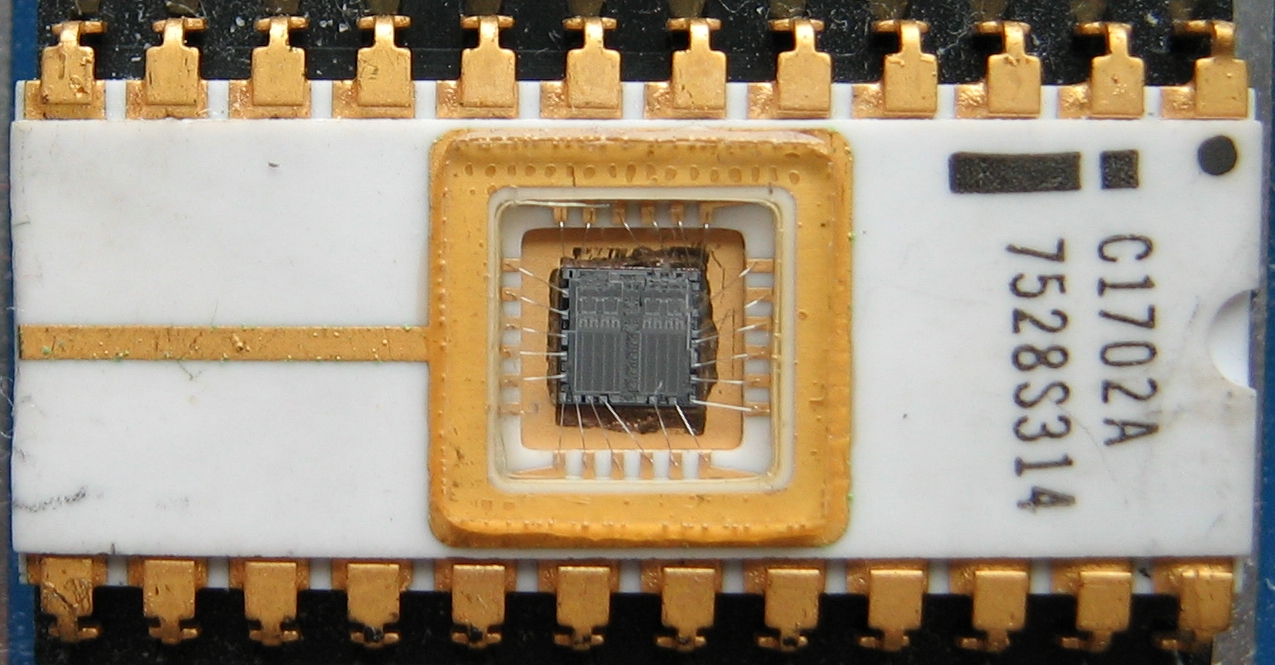 🇺🇸 United StatesEPROM
Non-volatile memory chip erased by ultraviolet lightMemory · 1971
 🇺🇸 United StatesUART
Chip for serial data communication between devicesAnalog · 1971