
7400 series
Standardised transistor-transistor logic integrated circuits for digital electronics.
Texas Instruments launched the 7400 series in 1964 as a standard set of transistor-transistor logic chips. These integrated circuits became the de facto industry standard for digital logic, powering minicomputers and consumer electronics for decades through compatible variants.
- Introduced by Texas Instruments in October 1964
- Became the de facto standard for TTL logic chips
- Powered early minicomputers like the DEC PDP series
- Includes hundreds of compatible logic functions
- Later variants adopted CMOS for lower power use
What it is
The 7400 series is a widely used family of integrated circuits based on transistor-transistor logic. Texas Instruments introduced the first devices in 1964. These chips perform basic digital functions such as logic gating, counting, and data storage. The series established a pin-compatible standard that allowed engineers to swap components from different manufacturers easily. While originally built using bipolar transistors, later versions adopted complementary metal-oxide-semiconductor technology to reduce power usage. They remain common in educational settings and industrial control systems for glue logic tasks.
How it came about
Texas Instruments released the military-grade SN5400 series in October 1964 using ceramic packages. A cheaper plastic commercial version, the SN7400, arrived in late 1966 and quickly dominated the market. Earlier logic families existed from companies like Sylvania and Motorola, but the 7400 series became the industry benchmark. Second sourcing by multiple manufacturers ensured widespread availability. The chips powered many early minicomputers, including models from Digital Equipment Corporation and Hewlett-Packard, during the 1970s and 1980s.
Inside the chip
The original chips used bipolar junction transistors, which offered speed but consumed significant power at a fixed 5-volt supply. The foundational 7400 chip contains four two-input NAND gates in a 14-pin package. Subfamilies emerged to balance speed and energy efficiency, such as the low-power Schottky 74LS and the faster 74S. Later iterations incorporated CMOS technology, allowing operation across a wider voltage range while maintaining logical compatibility. Specialised variants included radiation-hardened parts for aerospace and extended temperature ranges for military use.
How it was made
Initial production involved ceramic flat packs for military specifications and molded epoxy plastic for commercial use. As manufacturing evolved, surface-mount packages replaced the traditional dual in-line packages for high-speed applications. Multiple foundries produced these chips, adhering to a shared numbering scheme that identified function and temperature grade. Soviet and Eastern Bloc manufacturers created clones with metric pin spacing and distinct brownish-green packaging materials. Modern production continues for specific industrial and legacy support needs.
Where it went
These integrated circuits served as the building blocks for central processing units in early minicomputers like the DEC PDP series. They provided arithmetic logic units and control signals for machines from Data General and Hewlett-Packard. Beyond computing, they appeared in digital consumer electronics throughout the 1980s and 1990s. Today, engineers use them for prototyping on breadboards and for implementing simple interface logic in modern embedded systems where complex processors are unnecessary.
Versions and family
The series includes hundreds of specific functions, from simple gates to complex bus transceivers. Temperature grades distinguish military (54 prefix) from commercial (74 prefix) parts. Logic subfamilies include 74H for high speed, 74LS for low power, and 74F for fast operation. CMOS variants like 74HC and 74HCT offer lower power consumption and compatibility with modern voltage levels. Some rare industrial variants used a 64 prefix, though this was short-lived before being revived for specific buffer chips.
Why it matters
This family created a de facto standard that simplified digital design for decades. By ensuring pin compatibility across manufacturers, it fostered a competitive market that lowered costs significantly. The transition from expensive military components to affordable commercial chips enabled the growth of the minicomputer industry. Its numbering system remains a reference point for digital logic education. The longevity of the series demonstrates its utility in both historical computing and contemporary electronic maintenance.


Questions people ask about 7400 series
What is the 7400 series used for?
It provides basic digital logic functions like gates, flip-flops, and counters. Engineers use these chips for glue logic in computers, industrial controls, and educational prototyping due to their simplicity and standardisation.
Who invented the 7400 series?
Texas Instruments introduced the series in 1964. They launched the military-grade SN5400 first, followed by the commercial SN7400 in 1966, which became the industry standard for transistor-transistor logic.
Are 7400 series chips still made today?
Yes, manufacturers still produce them, particularly in surface-mount packages. They are used in modern electronics for interface tasks and remain popular for teaching digital logic concepts in universities and schools.
Good reading and sources
- 7400-series integrated circuits on WikipediaEncyclopedia
- More photos on Wikimedia CommonsPhotos
- Wikidata recordOpen data
The facts on this page come from the Wikipedia article "7400-series integrated circuits", written by its contributors and used under the CC BY-SA 4.0 licence, and from its Wikidata record (CC0). EveryChip rewrote the text in its own words, with AI assistance, and compares every page with the article to make sure no passage is copied. It may be reused under the same CC BY-SA 4.0 licence with a link back.
It may contain mistakes, and figures change over time. Nothing here is investment or buying advice. If something is wrong, tell us. Last refreshed 2026-11-14.
Like 7400 series
All analog, power and mixed-signal 🇺🇸 United StatesIntel 8255
Programmable parallel input/output interface chip for early microprocessorsAnalog · 1970
 🇺🇸 United States4000 series
Versatile CMOS logic chips for low-power digital circuitsAnalog · Other · 1968
 🇬🇧 United KingdomZN414
Single-chip AM radio receiver integrated circuitAnalog · 1972
 🇺🇸 United States555 timer IC
A versatile integrated circuit for timing and pulse generation.Analog · 1972
More from Texas Instruments
All of them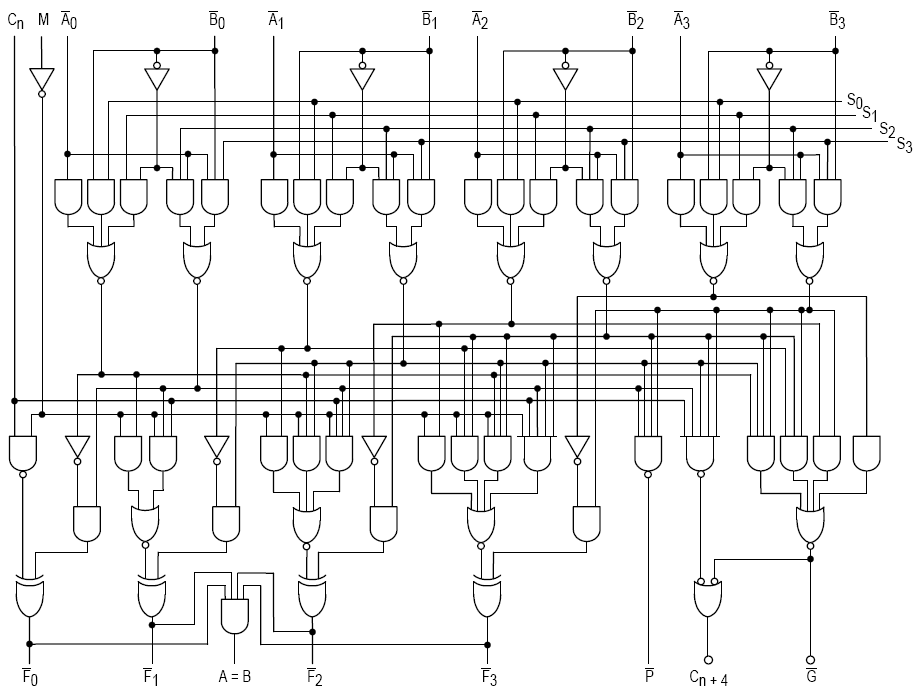 🇺🇸 United States74181
4-bit slice ALU, the first complete arithmetic logic unit on one chipCPU · Other · 1970
 🇺🇸 United StatesEPROM
Non-volatile memory chip erased by ultraviolet lightMemory · 1971
 🇺🇸 United StatesIntel 8008
Early 8-bit microprocessor from Intel, launched April 1972CPU · 8-bit · 1972
 🇺🇸 United StatesTMS1000
A 4-bit microcontroller family with on-chip ROM, RAM and I/O from 1974.Microcontroller · Other · 1974