
555 timer IC
A versatile integrated circuit for timing and pulse generation.
The 555 timer is an integrated circuit designed by Hans Camenzind in 1971 and released by Signetics in 1972. It generates precise time delays and oscillations, becoming one of the most produced chips in history with over a billion units made annually.
- Designed by Hans Camenzind in 1971
- First marketed by Signetics in 1972
- Over a billion units produced annually
- Uses 25 transistors and 15 resistors
- Available in 8-pin DIP package
What it is
The 555 timer is an active integrated circuit widely used for generating time delays, pulses, and oscillations. Designed by Hans Camenzind and first marketed by Signetics in 1972, it uses bipolar junction transistors to create stable timing signals. Its low cost and flexibility have made it a standard component in electronics. Variants like the 556 and 558 pack multiple timers into single packages. By 2017, estimates suggested over a billion units were produced each year, marking it as likely the most popular integrated circuit ever created.
How it came about
Hans Camenzind designed the chip in 1971 while under contract to Signetics. He originally worked on a phase-locked loop but shifted focus during a recession to create a universal timer. Marketing manager Art Fury approved the project and selected the name 555 arbitrarily. The initial design required nine pins, but Camenzind reduced this to eight by using direct resistance, allowing an 8-pin package. Prototypes were ready by October 1971. Twelve companies manufactured the device in 1972, and it quickly became a best-selling product.
Inside the chip
The standard package contains roughly 25 transistors, two diodes, and 15 resistors on a silicon die. Three internal resistors form a voltage divider that sets reference levels at one-third and two-thirds of the supply voltage. Two comparators monitor these levels against external inputs to control a set-reset latch. This latch drives the output stage and a discharge transistor. The chip operates in astable, monostable, or bistable modes, enabling functions from simple switches to complex pulse-width modulation.
How it was made
Signetics initially produced the NE555 using bipolar technology. The commercial version operated from 0 to 70 degrees Celsius, while the SE555 covered military ranges. Packages included metal cans and epoxy plastic dual in-line formats. Later, other manufacturers introduced low-power CMOS versions such as the ICM7555 and TLC555. These modern variants retain the original functionality while reducing power consumption, though the core architecture remains consistent with the 1971 design.
Where it went
Engineers employ the 555 in diverse applications including LED flashers, tone generators, and security alarms. It serves as a clock source for digital logic and can convert analog resistance values into digital pulse lengths. In monostable mode, it creates single pulses for debounce circuits or missing pulse detection. Before dedicated power management chips existed, it was even used in switching-mode voltage regulators. Its ability to drive up to 200 mA allows it to interface directly with small loads.
Versions and family
The 556 integrates two complete 555 timers in a 14-pin package. The 558 and 559 combine four reduced-functionality timers in a 16-pin format. Part numbers indicate temperature ranges and packaging materials, such as the NE555V for plastic commercial use. Low-power CMOS alternatives from companies like Intersil and Texas Instruments offer similar pinouts with lower energy requirements. These derivatives allow designers to save space and power while maintaining compatibility with the original timing principles.
Why it matters
The 555 is considered probably the most popular integrated circuit ever made. Its production volume exceeds a billion units per year according to 2017 estimates. Camenzind noted that most applications were unforeseen, with engineers finding new uses in fields he had not contemplated. The chip’s enduring presence in educational kits and industrial designs highlights its fundamental role in analog electronics. It remains a staple for prototyping and learning due to its simplicity and robustness.


Questions people ask about 555 timer IC
Who invented the 555 timer?
Hans Camenzind designed the 555 timer in 1971 while working under contract for Signetics. He developed it as a universal timing circuit after his work on phase-locked loops was paused.
Why is it called the 555 timer?
Although many believe the name comes from three internal 5 kΩ resistors, Hans Camenzind stated it was chosen arbitrarily by marketing manager Art Fury, who thought the circuit would sell well.
What are the main operating modes?
The chip works in astable mode for continuous oscillation, monostable mode for single pulse generation, and bistable mode as a set-reset latch. It can also function as a Schmitt trigger.
Good reading and sources
The facts on this page come from the Wikipedia article "555 timer IC", written by its contributors and used under the CC BY-SA 4.0 licence, and from its Wikidata record (CC0). EveryChip rewrote the text in its own words, with AI assistance, and compares every page with the article to make sure no passage is copied. It may be reused under the same CC BY-SA 4.0 licence with a link back.
It may contain mistakes, and figures change over time. Nothing here is investment or buying advice. If something is wrong, tell us. Last refreshed 2026-11-14.
Like 555 timer IC
All analog, power and mixed-signal 🇬🇧 United KingdomZN414
Single-chip AM radio receiver integrated circuitAnalog · 1972
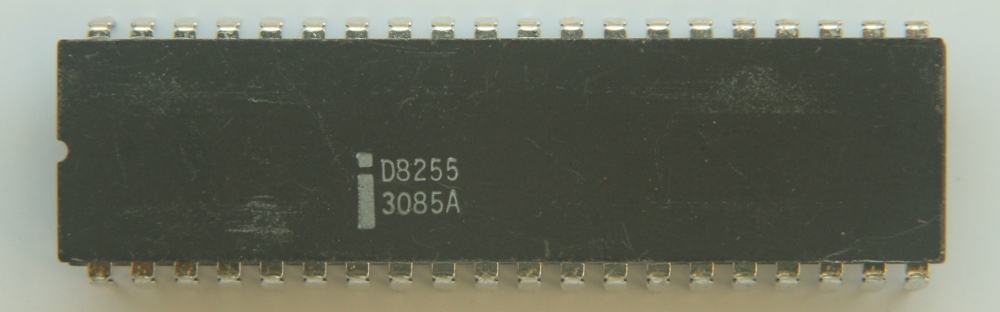 🇺🇸 United StatesIntel 8255
Programmable parallel input/output interface chip for early microprocessorsAnalog · 1970
 🇺🇸 United States and 1 moreLM317
Adjustable positive linear voltage regulator integrated circuitAnalog · 1976
 🇺🇸 United States4000 series
Versatile CMOS logic chips for low-power digital circuitsAnalog · Other · 1968
More from Signetics
All of them 🇺🇸 United StatesSignetics 2650
8-bit microprocessor from 1975 modelled on the IBM 1130 minicomputerCPU · 8-bit · 1975
 🇺🇸 United StatesNational Semiconductor SC/MP
Early 8-bit microprocessor built for low-cost systems and shared-bus multiprocessor useCPU · 8-bit · 1976
 🇺🇸 United States and 1 moreSignetics 8X300
A 1976 bipolar microcontroller and signal processor from SigneticsCPU · Other · 1976
 🇺🇸 United StatesNE5532
Dual low-noise operational amplifier for professional audioAnalog · 1979