
Intel 8282
8-bit latch for Intel 8086 and 8080 systems
The Intel 8282 is an 8-bit latch designed for early Intel processors like the 8086 and 8088. It manages address data from multiplexed buses in microcomputer systems. Licensed to firms such as NEC and Siemens, it offered a standard solution for external memory interfacing in the late 1970s and early 1980s.
- 8-bit latch for Intel 8086/8088 systems
- Comes in a 20-pin dual in-line package
- Licensed to NEC and Siemens for production
- Replaced the 8212 in 8080/8085 designs
- Functionally similar to 74573 octal latch
What it is
The Intel 8282 is an integrated circuit that functions as an 8-bit latch. It was created primarily to support the Intel 8086, 8087, 8088, and 8089 processors. In these systems, the processor shares pins for both address and data signals. The 8282 captures the address portion when signaled, allowing the bus to carry data afterwards. This component is housed in a 20-pin dual in-line package. It serves a critical role in separating mixed signals on the system bus, ensuring that memory and peripherals receive the correct addressing information during operation.
How it came about
Intel developed this chip to accompany its family of 16-bit and 8-bit processors. As systems grew more complex, the need to manage multiplexed buses became essential. The 8282 provided a dedicated hardware solution for latching addresses. Intel licensed the design to other major semiconductor manufacturers, including NEC and Siemens, to ensure broad availability. By 1980, both standard and industrial-grade versions were commercially available. The industrial variant, known as the I8282, commanded a higher price due to its enhanced reliability specifications for harsher environments.
Inside the chip
This device operates as an octal latch, meaning it can store eight bits of data simultaneously. It connects to the Address Latch Enable pin on the processor. When this strobe signal activates, the chip reads the current state of the multiplexed address and data bus. It then holds the address stable while the bus switches to data transfer mode. Connecting the Output Enable pin to ground keeps the chip active. Its functionality mirrors that of the 74573 or 74373 logic chips, though the physical pin arrangement differs slightly. A sibling chip, the 8283, performs the same task but inverts the output data.
How it was made
Intel manufactured the original devices, with production also handled by licensees such as NEC and Siemens. The chips were produced in a 20-pin dual in-line package, a common format for through-hole mounting on printed circuit boards of that era. While specific transistor counts and manufacturing process nodes are not detailed in available records, the device was built using standard metal-oxide-semiconductor technology of the time. The industrial grade version underwent stricter testing to meet higher durability standards for commercial and industrial applications.
Where it went
Engineers used the 8282 in systems based on the Intel 8080 and 8085 processors, where it replaced the older 8212 chip. It was also integral to designs featuring the 8086 and 8088 central processing units. The component enabled compact system designs when paired with ROM-less microcontrollers from the MCS-48 and MCS-51 families, such as the 8035 and 8031. By providing external address latching, it allowed these microcontrollers to interface with external read-only memory or erasable programmable read-only memory chips efficiently.
Versions and family
The primary variant is the I8282, which is an industrial-grade version of the standard chip. It offers the same logical functionality but is rated for wider temperature ranges and tougher conditions. The Intel 8283 is a closely related component that provides identical latching capabilities but outputs inverted data signals. This inversion can simplify certain circuit designs where negative logic is preferred. Both chips share the same 20-pin dual in-line form factor and electrical interface characteristics, making them interchangeable in designs that account for the data polarity.
Why it matters
The 8282 helped standardize bus interfacing for early personal computers and embedded systems. By offering a reliable method to demultiplex address and data lines, it simplified motherboard design for the popular 8086 and 8088 architectures. Its licensing to multiple manufacturers ensured that supply chains remained robust during the rapid expansion of the microcomputer market. The chip remains a reference point for understanding how early microprocessors managed limited pin counts while maintaining high performance through time-multiplexed bus operations.
Questions people ask about Intel 8282
What is the main function of the Intel 8282?
It acts as an 8-bit latch that captures address data from a multiplexed bus. This allows processors like the 8086 to use the same pins for both address and data transmission by holding the address steady during data transfers.
Which processors is the 8282 designed to work with?
It was developed primarily for the Intel 8086, 8087, 8088, and 8089 processors. It can also be used in systems based on the older 8080 and 8085 processors, where it serves as a replacement for the 8212 chip.
How does the 8282 differ from the 8283?
Both chips perform the same latching function and share the same pinout. The only difference is that the 8283 inverts the data output, while the 8282 provides non-inverted output. This makes them suitable for different logic requirements.
Good reading and sources
The facts on this page come from the Wikipedia article "Intel 8282", written by its contributors and used under the CC BY-SA 4.0 licence, and from its Wikidata record (CC0). EveryChip rewrote the text in its own words, with AI assistance, and compares every page with the article to make sure no passage is copied. It may be reused under the same CC BY-SA 4.0 licence with a link back.
It may contain mistakes, and figures change over time. Nothing here is investment or buying advice. If something is wrong, tell us. Last refreshed 2026-11-14.
Like Intel 8282
All analog, power and mixed-signal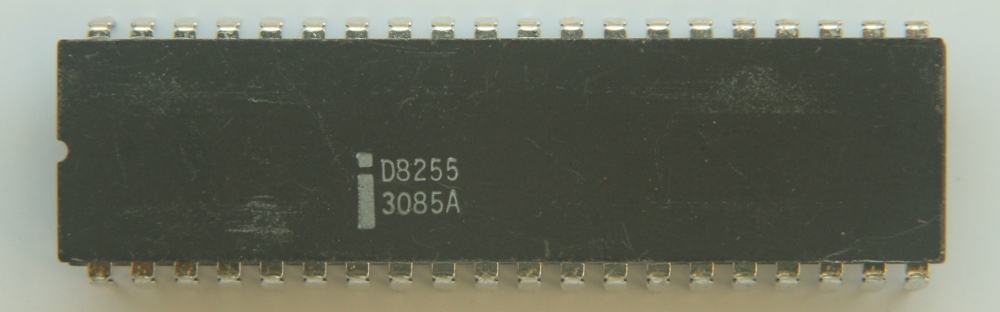 🇺🇸 United StatesIntel 8255
Programmable parallel input/output interface chip for early microprocessorsAnalog · 1970
 🇺🇸 United StatesIntel 8259
Programmable interrupt controller for early Intel microprocessorsAnalog · Other · 1976
 🇺🇸 United StatesIntel 8253
Programmable interval timer for early microcomputers and PCsAnalog · 1980
More from Intel
All of them WorldIntel 8279
Programmable keyboard and display controller for Intel microprocessorsAnalog
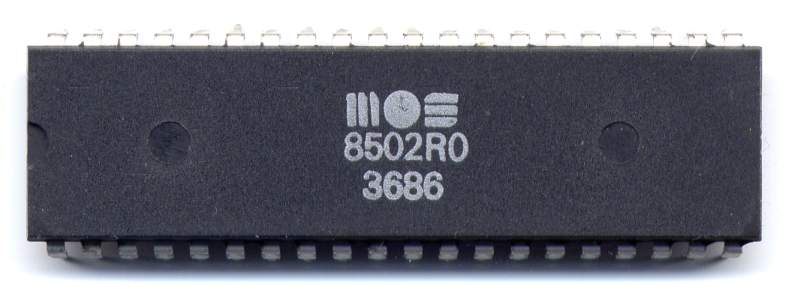 WorldMOS Technology 8502
An 8-bit CPU from MOS Technology that powered the Commodore 128CPU · 8-bit
 🇺🇸 United StatesRapidCAD
A 486DX in a 386 socket, with a dummy FPU chip to match.CPU · x86
🇺🇸 United StatesTolapai
Intel embedded SoC with Pentium M core and security accelerationSoC · x86