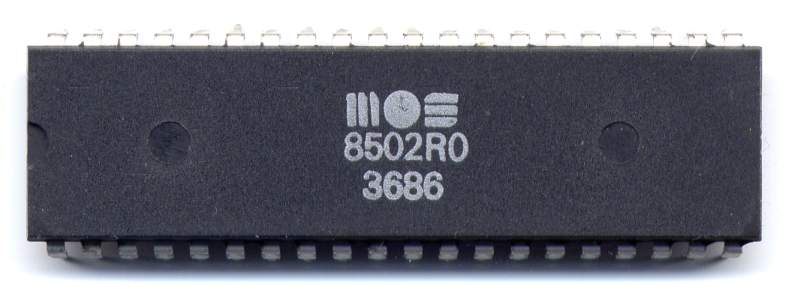
MOS Technology 8502
An 8-bit CPU from MOS Technology that powered the Commodore 128
The MOS Technology 8502 is an 8-bit microprocessor built by MOS Technology, an updated take on the MOS 6510 that ran the Commodore 64. Fabricated with an HMOS process, it packed more transistors into less space, cost less to make and ran cooler, and it let the Commodore 128 work at twice the C64 clock rate under certain conditions.
- 8-bit CPU from MOS Technology, used in the Commodore 128
- Built on Intel's HMOS-II process for a smaller, cooler die
- Clock range of 1.97 MHz to 2.046 MHz
- 40-pin DIP, with a 7-bit on-chip I/O port at addresses 0 and 1
- Follows the MOS 6510; the CSG 65CE02 comes after it
What it is
This is a single-chip 8-bit central processing unit from MOS Technology, the silicon behind the Commodore 128 home computer. It descends from the MOS 6510 that drove the Commodore 64 and keeps that chip's basic NMOS 6502 lineage. What set it apart was the manufacturing method: an HMOS process that squeezed more transistors onto less silicon, trimmed production cost and reduced the heat it gave off. That efficiency opened the door to a faster clock. In the C128 the part could work at roughly double the C64 rate, though only in certain display setups.
How it came about
The design is largely a port of the original 6502 onto Intel's HMOS-II process, which arrived in 1979 and was opened to outside customers. Smaller features meant the same circuitry fit a smaller die, so each unit used less material and more of the wafers came out good, which lowered the price. The smaller die also drew less power and ran cooler, suiting jobs where the older part would be too hot or too bulky. Speeds followed the 6502 grading scheme of A, B and C at 1, 2 and 4 MHz; after the process change most 8502 parts reached 2 MHz, matching a 6502B.
Inside the chip
Like its ancestors, the chip runs on a two-phase clock but touches memory in only one of those phases. That leaves the other half-cycle free for a display chip, so the two never have to negotiate for the bus. The C64 used this trick to let the VIC-II share RAM with the 6510. Speed is set simply by the input clock, so the 8502 can drop between 2 MHz and the 6510's 1 MHz. At full speed there is no spare half-cycle for the VIC, so double-rate running works continuously only alongside the 80-column VDC, which owns its own display memory. The pinout differs slightly from the 6510: one extra I/O line, giving a 7-bit on-chip port at addresses 0 and 1, and no ϕ2 pin.
How it was made
Production used Intel's HMOS-II process, a finer-geometry method that shrank the die and raised transistor density. Because the part occupied less silicon, material costs fell and yields improved, while power use and heat output dropped as well. The chip ships in a 40-pin dual in-line package. Clock figures given for the part run from 1.97 MHz up to 2.046 MHz.
Where it went
Its main home is the Commodore 128. There the processor can sit at double the Commodore 64 rate when paired with the 80-column VDC, since that display chip has memory of its own. In VIC display modes the CPU and VIC again share RAM, and the clock falls back to about 1 MHz. Code that turns the screen off during heavy calculation can hold the faster rate. A middle setting is possible too: switching to 2 MHz only while the VIC draws the blank border at the top and bottom, when it touches no RAM, gains roughly 35% while the picture stays on.
Versions and family
The wider 8502 family also covers the MOS 7501, 8500 and 8501. The part it superseded is the MOS 6510 from the Commodore 64, and the CSG 65CE02 follows it. Original 6502s came in A, B and C grades rated at 1, 2 and 4 MHz, with no layout difference between them; a chip that passed testing at 2 MHz was simply stamped B.
Why it matters
Moving the 6502 line onto a finer process showed how a shrink alone could deliver a cheaper, cooler part with headroom for a higher clock. That let Commodore offer a machine running at twice the C64 rate without a wholesale redesign of the memory system. The timing scheme it inherited, in which the CPU and a display chip alternate access to shared RAM, remained a practical answer to the cost of memory in that era.
Problems and reception
The speed boost came with a clear trade-off. Because the VIC needed free half-cycles to reach RAM, the 2 MHz mode could not run full time in VIC display modes, and programs had to blank the screen to keep the faster clock. The chip's pinout also drifted from the 6510, adding an I/O line and dropping the ϕ2 pin, so boards could not simply swap one for the other.
Questions people ask about MOS Technology 8502
What machine used this processor?
The Commodore 128. There it could run at about twice the clock rate of the Commodore 64, but only under certain display conditions, because the display chip also needed access to shared memory.
How does it differ from the MOS 6510?
It is a refined version of that part, made on an HMOS process that shrank the die, cut cost and heat, and allowed a higher clock. The pinout changes too: one extra I/O line, giving a 7-bit port, and no ϕ2 pin.
Why could it not always run at full speed?
At 2 MHz there is no free half-cycle left for the VIC display chip to reach RAM. Double-speed running works continuously only with the 80-column VDC, which has its own display memory separate from the CPU's.
What package does it come in?
A 40-pin dual in-line package, the familiar rectangular chip with a row of pins down each long side that plugs into a socket on the board.
Good reading and sources
- MOS Technology 8502 on WikipediaEncyclopedia
- More photos on Wikimedia CommonsPhotos
- Wikidata recordOpen data
The facts on this page come from the Wikipedia article "MOS Technology 8502", written by its contributors and used under the CC BY-SA 4.0 licence, and from its Wikidata record (CC0). EveryChip rewrote the text in its own words, with AI assistance, and compares every page with the article to make sure no passage is copied. It may be reused under the same CC BY-SA 4.0 licence with a link back.
It may contain mistakes, and figures change over time. Nothing here is investment or buying advice. If something is wrong, tell us. Last refreshed 2026-11-14.
Like MOS Technology 8502
All CPUs and microprocessors WorldMOS Technology 6510
8-bit 6502-derived CPU with a built-in I/O port, used in the Commodore 64CPU · 8-bit
 🇺🇸 United StatesIntel 8008
Early 8-bit microprocessor from Intel, launched April 1972CPU · 8-bit · 1972
 🇯🇵 JapanHitachi 6309
Hitachi's CMOS 8-bit microprocessor, a faster and richer 6809CPU · 8-bit · 1985
 🇯🇵 JapanHD64180
A Z80-based embedded microprocessor with on-chip MMU and peripheralsCPU · 8-bit · 1985
More from MOS Technology
All of them WorldIntel 8279
Programmable keyboard and display controller for Intel microprocessorsAnalog
🇺🇸 United StatesMOS Technology 6532
Integrated circuit combining RAM, I/O ports and a timer for 1970s systems.Microcontroller · Other
 🇺🇸 United StatesRapidCAD
A 486DX in a 386 socket, with a dummy FPU chip to match.CPU · x86
🇺🇸 United StatesTolapai
Intel embedded SoC with Pentium M core and security accelerationSoC · x86