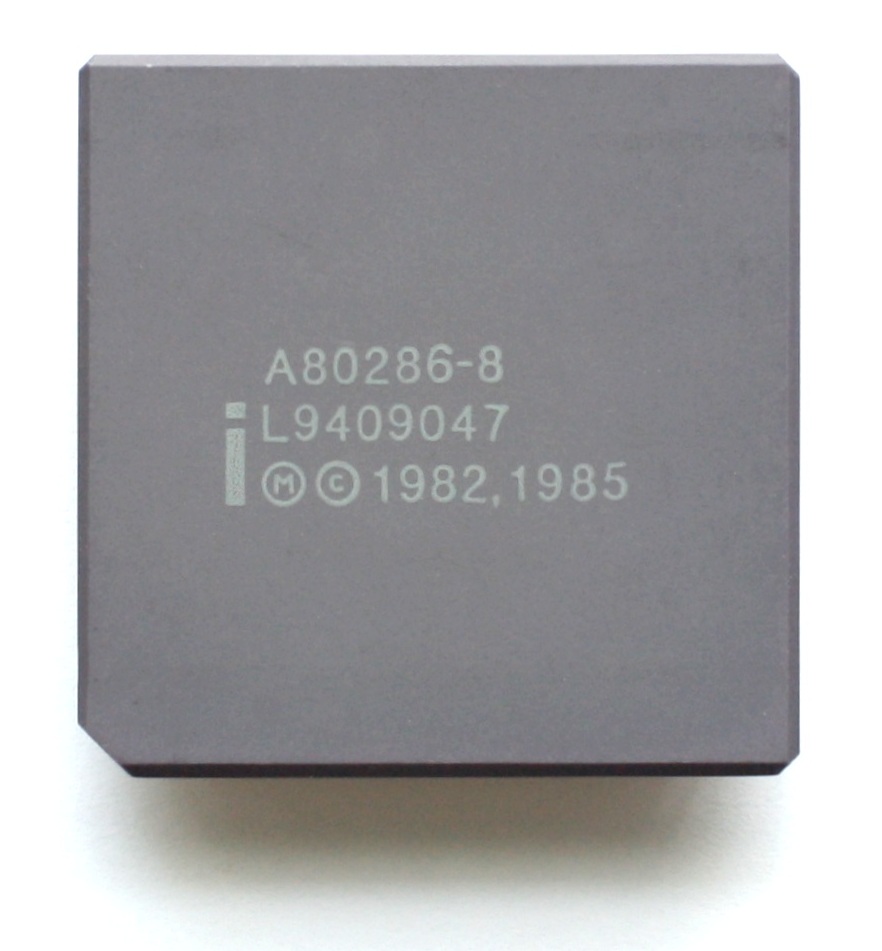
Intel 80286
16-bit microprocessor with protected mode and 16 MB memory support
The Intel 80286 is a 16-bit microprocessor launched in February 1982 as the second generation of the x86 family. It introduced protected mode and 24-bit addressing, enabling up to 16 MB of memory, and powered the IBM PC/AT and compatible systems through the early 1990s.
- Introduced protected mode and 24-bit addressing
- Addresses up to 16 MB of physical memory
- Powered the IBM PC/AT starting in 1984
- Contains approximately 134,000 transistors
- First x86 CPU with separate address and data buses
What it is
The Intel 80286 is a 16-bit microprocessor that debuted in February 1982. It serves as the second generation of the x86 processor family. This chip added protected mode and 24-bit physical addressing while keeping compatibility with software for earlier x86 processors like the 8086 and 8088. It was the first x86 CPU to feature separate address and data buses, along with on-chip memory management capabilities. The design allowed systems to address up to 16 MB of memory, a significant increase from the 1 MB limit of its predecessors. Intel produced the original version using nMOS technology with approximately 134,000 transistors.
How it came about
Intel initially expected the 286 to serve industrial automation and telecommunications rather than personal computers. The chip found its major role in the IBM PC/AT, which launched in 1984. By 1987, Intel had shipped five million units. Early versions suffered from errata in the B-step and C-step revisions, causing issues for programmers. Intel addressed these problems in the later E-stepping level, available around late 1986. Second sourcing agreements allowed companies like Fujitsu, AMD, and Harris to manufacture the chip, with some producing faster variants reaching 25 MHz.
Inside the chip
The processor contains four independent units: address, bus, instruction, and execution. These form a loosely coupled pipeline similar to the 8086. Performance improved significantly because address calculations use a dedicated unit instead of the general ALU. This change, along with non-multiplexed buses, often doubled performance per clock cycle compared to the 8086. The chip supports a 24-bit address bus for 16 MB of physical memory and up to 1 GB of virtual memory via segmentation. Protected mode prevents unauthorized access by assigning privilege levels to memory segments. However, switching back from protected mode to real mode requires a hardware reset, which complicated multitasking for operating systems like Windows.
How it was made
The original 80286 used a 1.5 µm nMOS process, specifically depletion-load HMOS logic. It contained roughly 134,000 transistors. Intel and other manufacturers also produced fully static CMOS versions, such as the 80C286, aimed at battery-powered devices. The chip comes in 68-pin packages, including plastic leaded chip carrier (PLCC), leadless chip carrier (LCC), and pin grid array (PGA) formats. Clock speeds ranged from 4 MHz to 25 MHz, with later releases from AMD and Harris reaching the higher end of this spectrum.
Where it went
This microprocessor powered the IBM PC/AT and most compatible computers until the early 1990s. Intel originally targeted it for multi-user systems, transaction processing, and real-time process control. Operating systems like Microsoft Xenix, Coherent, and Minix utilized its protected mode features. Digital Research developed Concurrent DOS 286 to leverage native-mode operations, though emulation issues delayed its release. IBM adopted derivatives of this OS for their 4680 and 4690 point-of-sale terminals. Despite its capabilities, high memory costs meant many systems shipped with only 1 MB of RAM.
Versions and family
Manufacturers produced several speed grades, starting with 5, 6, and 8 MHz models. Later versions reached 12.5 MHz, with third-party makers offering parts up to 25 MHz. The 80C286 is a CMOS variant designed for lower power consumption. Stepping revisions included the B-step and C-step, which had significant errata, and the E-step, which resolved these issues. The E-2 stepping included microcode changes to improve emulation performance for operating systems attempting to run legacy software in protected mode.
Why it matters
The 80286 enabled IBM compatibles to run advanced multitasking operating systems for the first time. Its protected mode allowed for memory protection and virtual memory, features essential for Unix-like environments. However, the inability to switch easily back to real mode hindered widespread adoption in PC applications. Bill Gates famously criticized the chip as brain-damaged due to its lack of virtual machine support for MS-DOS applications. This limitation contributed to the split between Microsoft and IBM over OS/2 development. The successor, the 80386, addressed these flaws by adding virtual 8086 mode.
Problems and reception
Programmers and operating system writers faced challenges with early B-step and C-step CPUs due to significant errata. The difficulty of running real-mode DOS applications in protected mode limited its utility in personal computing. Many DOS programs directly accessed memory segments, violating protected mode rules. This incompatibility meant protected mode was not widely used until the 32-bit 80386 arrived. Despite these software hurdles, the hardware offered a substantial performance increase over the 8086, with some measurements showing more than 100% improvement per clock cycle.


Questions people ask about Intel 80286
How much memory can the Intel 80286 address?
The 80286 has a 24-bit address bus, allowing it to address up to 16 MB of physical memory. It also supports virtual memory up to 1 GB through segmentation, although most systems of the era shipped with far less RAM due to cost.
Why was protected mode difficult to use on the 80286?
The chip cannot switch from protected mode back to real mode without a hardware reset. This made multitasking MS-DOS applications difficult, as older software required real mode. Operating systems had to use complex workarounds or avoid running legacy apps entirely.
Who manufactured the 80286 besides Intel?
Several companies second-sourced the chip, including AMD, Harris Corporation, Siemens, and Fujitsu. AMD and Harris produced faster versions reaching up to 25 MHz, while others created CMOS variants for low-power applications.
Good reading and sources
The facts on this page come from the Wikipedia article "Intel 80286", written by its contributors and used under the CC BY-SA 4.0 licence, and from its Wikidata record (CC0). EveryChip rewrote the text in its own words, with AI assistance, and compares every page with the article to make sure no passage is copied. It may be reused under the same CC BY-SA 4.0 licence with a link back.
It may contain mistakes, and figures change over time. Nothing here is investment or buying advice. If something is wrong, tell us. Last refreshed 2026-11-14.
Like Intel 80286
All CPUs and microprocessors
🇺🇸 United StatesIntel 80286
16-bit x86 CPU with protected mode and 24-bit addressing, launched in 1982CPU · x86 · 1982
 🇺🇸 United StatesIntel 80186
16-bit microprocessor with integrated peripherals for embedded systemsCPU · x86 · 1982
🇺🇸 United StatesIntel 80286
16-bit microprocessor with protected mode and 16 MB memory supportCPU · x86 · 1982
 🇺🇸 United States and 1 moreIntel 8087
A 1980 floating-point companion chip for the 8086 and 8088 CPUsCPU · x86 · 1980
More from Intel
All of them 🇺🇸 United StatesIntel iAPX 432
Intel's first 32-bit processor, a two-chip stack machine built for AdaCPU · Other · 1981
🇺🇸 United StatesIntel 8061
Automotive microcontroller for Ford engine control unitsMicrocontroller · Other · 1983
 🇺🇸 United StatesIntel MCS-51
An 8-bit microcontroller series for embedded systems.Microcontroller · Other · 1980
🇺🇸 United StatesIntel 8237
Four-channel DMA controller for early IBM PCsAnalog · Other · 1980