
PIC microcontroller
Microchip's long-running family of 8-bit to 32-bit microcontrollers
PIC is a family of microcontrollers made by Microchip Technology, tracing back to the PIC1640 that General Instrument created in 1975 as a companion to its CP1600 processor. First parts shipped in 1976, and by 2013 Microchip was shipping over one billion PIC devices a year for embedded systems worldwide.
- First PIC parts shipped in 1976
- Over twelve billion PIC parts shipped by 2013
- More than one billion PIC microcontrollers shipped per year by 2013
- Harvard architecture with separate code and data paths
- Instruction words of 12, 14, 16 or 24 bits by family
What it is
PIC is a family of microcontrollers built by Microchip Technology. The line began with the PIC1640, a programmable interface controller that General Instrument designed in 1975 to sit beside its CP1600 16-bit processor. Standalone versions followed, and the first parts reached customers in 1976. Devices now span 8-bit, 16-bit and 32-bit data widths, with program instructions of 12, 14, 16 or 24 bits depending on the family. Packages range from tiny 6-pin surface-mount parts to 144-pin chips carrying ADC and DAC blocks, UART, I2C, CAN and USB ports. By 2013 Microchip was shipping more than one billion PIC microcontrollers a year, and the family had reached over twelve billion parts shipped.
How it came about
General Instrument needed an easy way to hang peripherals off the CP1600, whose multiplexed address and data bus was awkward to interface with. The PIC1640 arrived in 1975 as a programmable controller with its own ROM, RAM and small CPU, handling the bus on one side and the device on the other. A standalone PIC1650 followed in 1976 and sold well despite being simpler than Intel's MCS-48. When GI spun off its chip division to form Microchip in 1985, the CP1600 was finished but the PIC line carried on as a core product. EPROM and then EEPROM versions arrived, and the flash-based PIC16F84 launched in 1998.
Inside the chip
PIC chips use a Harvard layout, keeping program code and data on separate internal paths. Baseline parts such as PIC10 and PIC12 have 12-bit instructions, a 32-byte register file and a two-level call stack, with no interrupts on the basic core. PIC16 devices widen instructions to 14 bits, giving 128 directly addressable registers and 2048 words of code, plus an eight-level stack. Lookup tables work through a computed jump into return-with-literal instructions. Later families add 16-bit data memory, and the PIC32MZ series is a 32-bit MIPS design. Higher-end parts include instructions aimed at digital signal processing.
How it was made
The line has been built across many process generations, and no single node or transistor count applies to the family as a whole. Early parts stored code in mask ROM, then EPROM and EEPROM, and all current models use flash memory, with some able to rewrite their own program. Hardware spans 6-pin SMD and 8-pin DIP devices up to 144-pin surface-mount packages. Plessey in the UK also produced NMOS PIC1650 and PIC1655 parts from the GI design.
Where it went
PIC devices appear across a huge range of embedded systems, from floppy disk and keyboard handling in the earliest designs to motor control, serial communications and USB gadgets today. The CP1600 pairing saw real use in the Intellivision game console, roughly three million units. Industrial developers and hobbyists both favour the family for its low cost, wide availability, serial in-circuit programming and reprogrammable flash.
Versions and family
Families are grouped by instruction width: PIC10 and PIC12 at 12 bits, PIC16 at 14 bits, PIC24 and dsPIC at 24 bits, and PIC32MZ as a 32-bit MIPS part. Part numbers marked PICnnCxxx use CMOS with OTP, ROM or EEPROM code storage and are largely not for new designs, while PICnnFxxx parts use flash. The PIC17 series, with 16-bit opcodes and a 16-level stack, was superseded by PIC18. The PIC1670 widened instructions to 13 bits for more address space.
Why it matters
By 2013 Microchip was shipping over one billion PIC microcontrollers a year, and total shipments had passed twelve billion parts. The family helped prove that a cheap, self-contained controller with its own memory could serve a huge range of jobs, and its Harvard layout and compact instruction sets became familiar to generations of embedded engineers.
Problems and reception
The CP1600 that the PIC was first built to support never sold widely, since General Instrument focused on large customers and ignored the low-end market. The PIC itself found a market anyway. The PIC17 line never became popular and is not recommended for new designs. Devices marked "C" are generally classed as not suitable for new development.
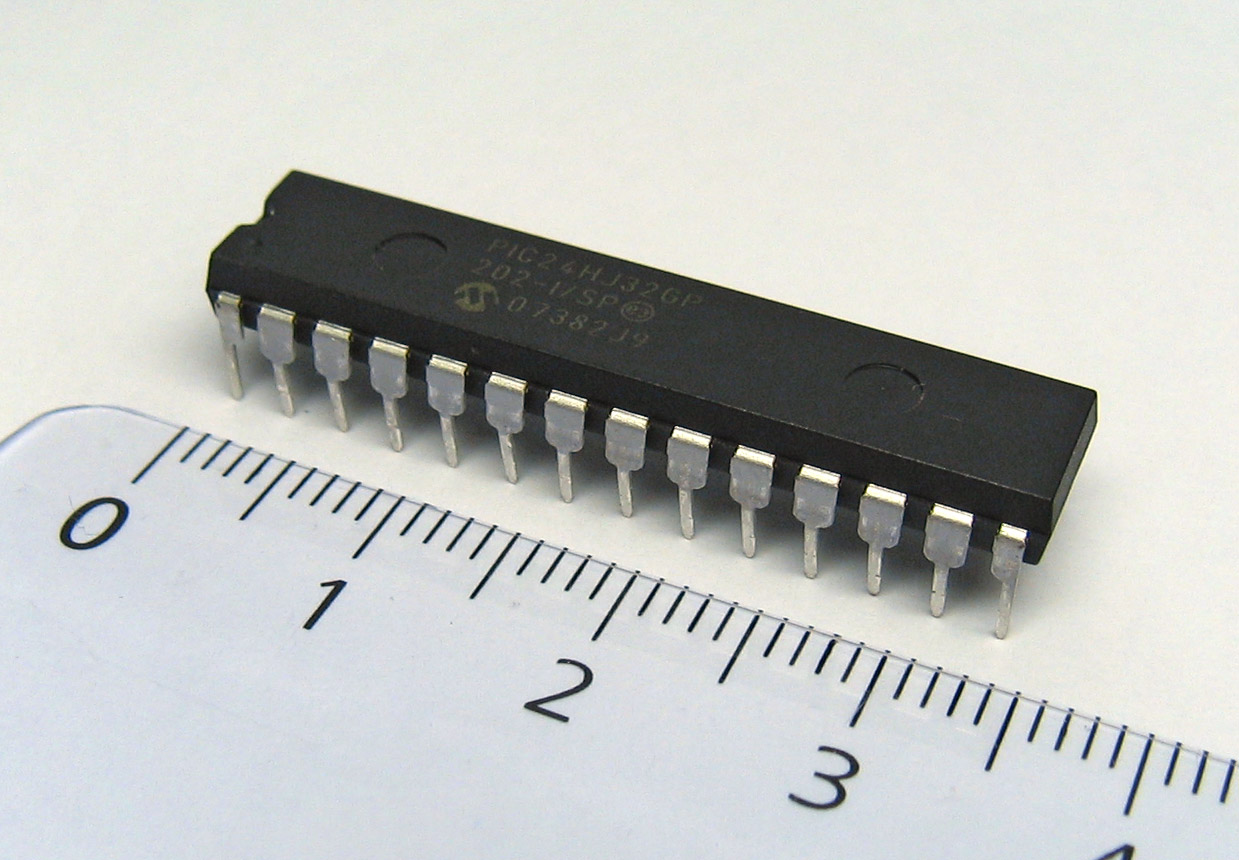


Questions people ask about PIC microcontroller
What does PIC stand for?
It began as Peripheral Interface Controller, then briefly Programmable Intelligent Computer. Microchip now treats PIC and PICmicro as trademarks rather than acronyms, so the letters no longer stand for any particular term.
Who makes PIC microcontrollers?
Microchip Technology makes them today. The design started at General Instrument's Microelectronics Division, which was spun off to form Microchip in 1985, and the PIC became one of the new company's main products.
What kinds of PIC chips exist?
Families are grouped by instruction width: PIC10 and PIC12 use 12-bit instructions, PIC16 uses 14 bits, PIC24 and dsPIC use 24 bits, and PIC32MZ is a 32-bit MIPS-based part. Data memory widths run from 8-bit up to 32-bit in the newest series.
How is a PIC programmed?
Early parts used mask ROM, then EPROM and EEPROM let users program devices in their own facilities. All current models use flash memory, some can reprogram themselves, and Microchip supplies MPLAB X tools plus PICKit programmer/debugger hardware.
Why are PIC chips popular?
They are cheap, widely available, serially programmable and reprogrammable, and backed by a large user base, many application notes and low-cost or free development tools. That suits both industrial developers and hobbyists.
Good reading and sources
- Official websiteOfficial site
- Chip Hall of Fame: Microchip Technology PIC 16C84 MicrocontrollerIEEE Spectrum, Article
- PIC microcontrollers on WikipediaEncyclopedia
- More photos on Wikimedia CommonsPhotos
- Wikidata recordOpen data
The facts on this page come from the Wikipedia article "PIC microcontrollers", written by its contributors and used under the CC BY-SA 4.0 licence, and from its Wikidata record (CC0). EveryChip rewrote the text in its own words, with AI assistance, and compares every page with the article to make sure no passage is copied. It may be reused under the same CC BY-SA 4.0 licence with a link back.
It may contain mistakes, and figures change over time. Nothing here is investment or buying advice. If something is wrong, tell us. Last refreshed 2026-11-14.
Like PIC microcontroller
All microcontrollers 🇺🇸 United States and 1 moreSignetics 8X300
A 1976 bipolar microcontroller and signal processor from SigneticsCPU · Other · 1976
🇺🇸 United StatesS2000
4-bit microcontroller for displays and controlMicrocontroller · Other · 1977
 🇺🇸 United States and 1 moreCOP400
4-bit microcontroller family for embedded control tasksMicrocontroller · Other · 1977
 🇺🇸 United StatesMOS Technology 6502
Low-cost 8-bit microprocessor that powered the home computer revolutionCPU · Other · 1975
More from Microchip Technology
All of them 🇺🇸 United StatesAY-3-8500
First dedicated video game chip for home consolesSoC · Other · 1976
 🇺🇸 United StatesGeneral Instrument CP1600
A 16-bit microprocessor from 1975, best known inside the Intellivision consoleCPU · Other · 1975
 🇺🇸 United StatesAY-3-8910
Three-voice programmable sound generator chip from 1978Analog · 1978
 🇺🇸 United StatesSP0256
Voice synthesis chip by General Instrument from the early 1980sAnalog · Other · 1981