Other and custom
Transputers, Lisp machines, Soviet and Chinese designs and one-off architectures. 263 chips on EveryChip so far.
Not every processor fits a big family. This group holds one-off and national designs: the British transputer built for parallel computing, Intel's ambitious iAPX 432, machines built to run the Lisp language, the Linn Rekursiv, and the Chinese ShenWei chips of the Sunway supercomputers. Some failed commercially but left ideas that later designs reused.
Ambitious experiments
Intel's iAPX 432 of 1981 tried to build object protection and garbage collection into hardware; it was slow and was dropped, while the stopgap 8086 succeeded. Inmos's transputer put serial links on every chip so that processors could be wired into networks. The Rekursiv, designed for the hi-fi maker Linn in the late 1980s, ran object-oriented programs in microcode.
National designs
Countries cut off from Western chips have built their own. The Soviet Union cloned and extended Western designs. China's ShenWei SW26010, with 260 cores, powered the Sunway TaihuLight, the world's fastest supercomputer from June 2016 to June 2018, made entirely with Chinese-designed processors. Loongson's LoongArch, introduced in 2021, is another home-grown instruction set.
Famous other chips

Further reading
 🇺🇸 United States and 1 moreDEC J-11
Two-chip CMOS implementation of the PDP-11 ISA for high-end DEC machinesCPU · Other
🇺🇸 United StatesTMS6100
Serial mask ROM for speech synthesis data storageMemory · Other · 1978
WorldIMP-16
A 1973 bit-slice microprocessor built from five PMOS chipsCPU · Other · 1973
 🇺🇸 United StatesIntel 4040
Intel's second 4-bit microprocessor, a 1974 upgrade of the 4004CPU · Other · 1974
 🇳🇴 NorwayMali
A family of graphics processing unit cores licensed by Arm for mobile and embedded chips.GPU · Other · 2005
 WorldZilog Z8
Microcontroller architecture with extensive on-chip registersMicrocontroller · Other · 1979
🇺🇸 United StatesHP Saturn
HP's 4-bit calculator microprocessor family, introduced in 1984CPU · Other · 1984
🇺🇸 United StatesFour-Phase Systems AL1
An early 8-bit slice CPU built for Four-Phase's System IV/70 minicomputer.CPU · Other · 1970
🇺🇸 United StatesBellmac 32
Bell Labs CMOS microprocessor, first to move 32 bits per clock cycleCPU · Other · 1980
 🇺🇸 United StatesTMS34010
First programmable graphics processor integrated circuitGPU · Other · 1986
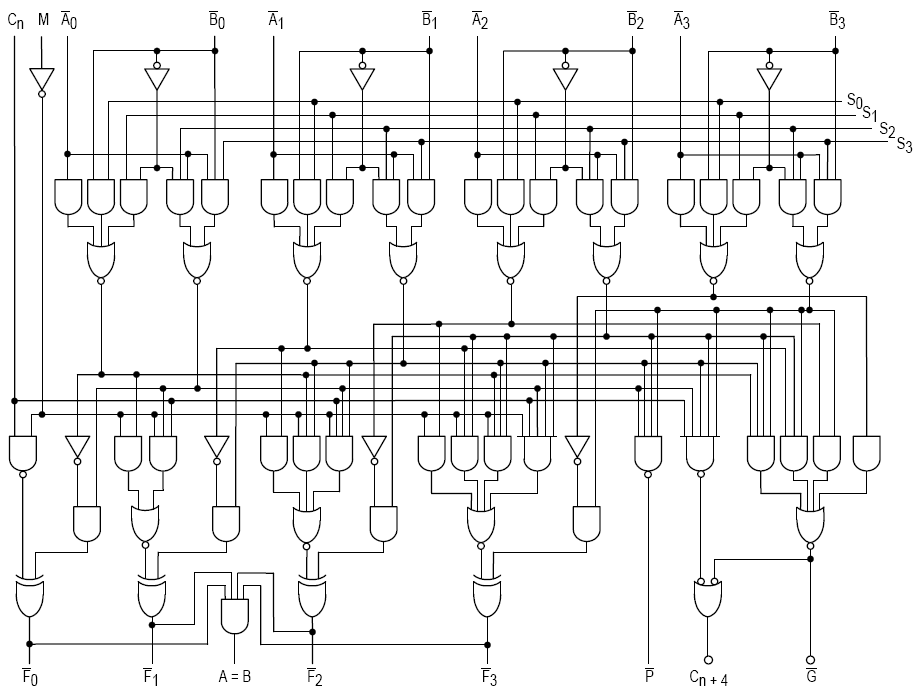 🇺🇸 United States74181
4-bit slice ALU, the first complete arithmetic logic unit on one chipCPU · Other · 1970
 🇺🇸 United StatesF-14 Central Air Data Computer
Custom digital flight-control chipset built for the F-14 Tomcat fighterCPU · Other · 1970
 🇺🇸 United StatesCVAX
DEC's second-generation single-chip VAX microprocessor with DRAM cacheCPU · Other · 1987
 🇺🇸 United StatesMCS-48
Intel's first microcontroller series from 1976Microcontroller · Other · 1976
 🇺🇸 United States and 2 moreMicroVAX 78032
DEC's first single-chip VAX microprocessor, used in MicroVAX II systems from 1985CPU · Other · 1985
 🇺🇸 United StatesPOKEY
Atari I/O chip for sound, keyboard and paddlesAnalog · Other · 1979
 WorldGA144
A 144-core asynchronous stack microprocessor built from tiny F18A nodesCPU · Other · 2011
 🇳🇱 NetherlandsMIFARE
Contactless smart card chip series for tickets, access control and paymentsMining or security · Other
🇺🇸 United StatesMostek MK5065
Early 8-bit PMOS microprocessor from Mostek, aimed at control tasksCPU · Other · 1974
 WorldIntersil 6100
A 12-bit CMOS microprocessor that runs the PDP-8 instruction set on one chipCPU · Other · 1975
🇺🇸 United StatesEssex SX 200
4-bit single-chip microcontroller with on-board ROM, RAM and display driversMicrocontroller · Other · 1976
 🇺🇸 United StatesBELLMAC-8
An 8-bit Bell Labs microprocessor built to run the C languageCPU · 8-bit · 1977
🇬🇧 United KingdomRekursiv
A four-chip object-oriented CPU with a writable microcode instruction setCPU · Other · 1988
 🇺🇸 United StatesIntel 4004
The first commercial microprocessor, a 4-bit chip released by Intel in 1971.CPU · Other · 1971
 🇺🇸 United StatesWD16
A 16-bit CISC microprocessor from Western Digital, built from five DIP chips.CPU · Other · 1976
 🇬🇧 United KingdomTransputer
A 1980s microprocessor series designed for parallel computing with integrated memory and serial links.CPU · Other
 🇺🇸 United StatesItanium
64-bit EPIC server microprocessor family from Intel and HPCPU · VLIW · 2001
 WorldGAL22V10
Programmable logic device with configurable inputs and outputsFPGA · Other
 🇯🇵 JapanSpursEngine
Toshiba media coprocessor for video and 3D tasksCPU · Other · 2007
 🇯🇵 JapanH8 Family
Hitachi and Renesas microcontroller family for embedded systemsMicrocontroller · Other · 1988
🇯🇵 JapanRL78
16-bit embedded microcontroller family by Renesas ElectronicsMicrocontroller · Other · 2010
 🇺🇸 United StatesIntel 8251
Universal synchronous and asynchronous receiver transmitter chip by IntelNetwork chip · Other · 1975
🇯🇵 JapanExmor
Sony's CMOS image sensor series with on-chip conversion and noise reductionSensor · Other · 2008
 🇺🇸 United States and 1 moreAMD Am2900
AMD's 1975 bipolar bit-slice IC family for building custom control unitsCPU · Other · 1975
 🇺🇸 United StatesPIC microcontroller
Microchip's long-running family of 8-bit to 32-bit microcontrollersMicrocontroller · MIPS · 1976
 🇺🇸 United StatesMSP430
A 16-bit mixed-signal microcontroller family designed for very low power use.Microcontroller · Other · 1992
 🇺🇸 United StatesHewlett-Packard Nanoprocessor
An 8-bit control microcontroller with no arithmetic unit, released by HP in 1974Microcontroller · Other · 1974
WorldSHARC
A 32-bit floating-point DSP family from Analog Devices with VLIW instructionsDSP · VLIW · 1999
🇺🇸 United StatesWDC 65C816
16-bit microprocessor from the 6502 family with 24-bit addressingCPU · Other · 1985
 🇺🇸 United StatesGeneral Instrument CP1600
A 16-bit microprocessor from 1975, best known inside the Intellivision consoleCPU · Other · 1975
WorldRTX 2010
Radiation-hardened 16-bit stack processor for real-time space workCPU · Other · 1988
 🇺🇸 United States and 1 moreNS32000
National Semiconductor's 32-bit CISC microprocessor family from the 1980sCPU · Other · 1982
🇺🇸 United StatesAT&T Hobbit
A C-optimised microprocessor from AT&T with a stack cache instead of registersCPU · Other · 1992
🇺🇸 United States and 1 moreMCP-1600
A 1975 multi-chip 16-bit microprocessor from Western DigitalCPU · Other · 1975
 🇺🇸 United StatesElectronic Arrays 9002
An 8-bit CPU with on-chip RAM, sold briefly in the mid-1970s.CPU · Other · 1976
 🇺🇸 United StatesNational Semiconductor PACE
First commercial single-chip 16-bit microprocessor, from National Semiconductor in 1974CPU · Other · 1974
 🇺🇸 United States and 1 moreSignetics 8X300
A 1976 bipolar microcontroller and signal processor from SigneticsCPU · Other · 1976
 🇺🇸 United StatesZilog Z8000
16-bit microprocessor family from Zilog, launched in 1979CPU · Other · 1979
Photo credits on this page
The small pictures above come from Wikimedia Commons under free licences. Some are cropped to fit.
- MIFARE: Adontz, CC BY-SA 4.0, source
- Transputer: NobbiP, CC BY-SA 3.0, source
- Intel 4040: Thomas Nguyen, CC BY-SA 4.0, source
- F-14 Central Air Data Computer: Camera Operator: SSGT MICHAEL D. GADDIS, USAF, Public domain, source
- POKEY: RodCastler, CC BY-SA 3.0, source
- Intersil 6100: Christian Bassow, CC BY-SA 4.0, source
- GAL22V10: Raimond Spekking, CC BY-SA 4.0, source
- Mali: Open Grid Scheduler / Grid Engine, CC0, source
- DEC J-11: Konstantin Lanzet, CC BY-SA 3.0, source
- CVAX: wdwd, CC BY-SA 3.0, source
- 74181: Unknown author, CC BY-SA 3.0, source
- GA144: Cartheur, CC BY-SA 4.0, source
- MicroVAX 78032: Pauli Rautakorpi, CC BY 3.0, source
- Intel 4004: the Science Museum, CC BY 4.0, source
- WD16: RastaKins, CC BY-SA 4.0, source
- Itanium: Konstantin Lanzet (with permission), CC BY-SA 3.0, source
- SpursEngine: Henriok, CC0, source
- Intel 8251: Myself User:ZyMOS, CC BY-SA 4.0, source
- AMD Am2900: Konstantin Lanzet (with permission), CC BY-SA 3.0, source
- PIC microcontroller: Raimond Spekking, CC BY-SA 4.0, source
- MSP430: Travis Goodspeed, CC BY 2.0, source
- Hewlett-Packard Nanoprocessor: Pauli Rautakorpi, CC BY 3.0, source
- General Instrument CP1600: Evan-Amos, CC BY-SA 3.0, source
- NS32000: Konstantin Lanzet, CC BY-SA 3.0, source
- Electronic Arrays 9002: Electronics Arrays, Inc., Public domain, source
- National Semiconductor PACE: Pauli Rautakorpi, CC BY 3.0, source
- Signetics 8X300: Konstantin Lanzet, GFDL, source
- Zilog Z8000: Myself User:ZyMOS, CC BY-SA 4.0, source
- Intel iAPX 432: _brouhaha_, CC BY-SA 2.0, source
- BELLMAC-8: Pauli Rautakorpi, CC BY 3.0, source
- TMS34010: Konstantin Lanzet, CC BY 3.0, source
- MCS-48: Konstantin Lanzet, CC BY-SA 3.0, source
- Zilog Z8: Konstantin Lanzet, CC BY-SA 3.0, source
- H8 Family: Raimond Spekking, CC BY-SA 4.0, source