
Itanium
64-bit EPIC server microprocessor family from Intel and HP
Itanium is a discontinued family of 64-bit Intel microprocessors implementing the IA-64 architecture, jointly developed with Hewlett-Packard from an HP design called PA-WideWord. Launched in June 2001 after a decade of work, it targeted mission-critical servers and high-performance computing, but lost the market to x86-64 and ended production in 2020.
- Jointly designed by Intel and Hewlett-Packard, launched June 2001
- IA-64 uses EPIC, an explicit-parallel form of VLIW computing
- Cores from Merced to Kittson; 180 nm down to 32 nm
- Fourth most deployed enterprise architecture in 2008
- New orders ended 30 January 2020; shipments ceased July 2021
What it is
Itanium is a family of 64-bit microprocessors built by Intel to run the IA-64 instruction set, an architecture that began at Hewlett-Packard and was then developed jointly by HP and Intel. The first chips reached customers in June 2001, aimed at enterprise servers, mission-critical systems and high-performance computing. Its defining idea was Explicitly Parallel Instruction Computing, a form of very long instruction word design in which the compiler marks which instructions can run together. Clock speeds over the family ranged from 733 MHz to 2.66 GHz, with one, two, four or eight cores. Intel stopped taking new orders in January 2020 and finished shipments in July 2021.
How it came about
HP began the work in 1989, hiring VLIW pioneers Bob Rau and Josh Fisher to get past the limits of RISC designs. Their PA-WideWord idea became EPIC. Intel, struggling to stretch x86 to 64 bits under the codename P7, met HP in November 1993 and dropped its own plan in 1994. The first chip, Merced, was led by Intel's John Crawford with HP's Jerry Huck second. A team of 500, many of them new graduates, fought size and timing problems, taped out in July 1999 and slipped repeatedly. Expectations moved to the HP-led McKinley, and the phrase "wait for McKinley" spread.
Inside the chip
IA-64 builds on very long instruction word computing, where one instruction word carries several independent operations that run in parallel. HP's EPIC adds template bits marking which instructions in a bundle of three are independent, so several bundles can issue at once without recompiling. Predication cuts the need for branches, and full interlocking removes delay slots. Hardware still decides which execution unit takes each instruction and when it issues. The chips carry up to 32 KB each of data and instruction L1 cache per core, up to 256 KB data and 1 MB instruction L2 per core, and up to 32 MB of L3. Extensions include EIST, VT-x, VT-d and VT-i.
How it was made
The family was fabricated by Intel on processes from 180 nm down to 32 nm. Merced had to move from the planned 250 nm to 180 nm simply to fit on the die, and its L2 cache was cut to 96 KB to help. Later cores such as Madison, Montecito, Tukwila, Poulson and Kittson shrank the process and added cores. Packages included the Pin Array Cartridge in PAC 418 and PAC 611 sockets, plus flip-chip land grid array and LGA 1248.
Where it went
Itanium went into high-end and mission-critical servers, high-performance computing and high-end workstations. HP and later Hewlett Packard Enterprise built the Integrity Servers line around it, and other manufacturers made systems too. The final generation, Kittson, was used only in HPE mission-critical servers. The chip never sold well outside enterprise servers and HPC, and by 2009 most servers shipped with x86-64 processors instead.
Versions and family
Cores across the family include Merced, McKinley, Madison in 3M, 6M and 9M forms, the low-voltage Deerfield, the dual-processor Fanwood, HP's Hondo with an extra 32 MB L4 cache, then Montecito, Montvale, Tukwila, Poulson and Kittson. Product names moved from Itanium and Itanium 2 through the 9000, 9100, 9300, 9500 and 9700 series. Kittson, released to test customers in February 2017 and in volume that May, was the last.
Why it matters
In 2008 Itanium ranked as the fourth most deployed architecture for enterprise-class systems, behind x86-64, Power ISA and SPARC. Its ambition was far larger: supporters expected it to take over servers, then PCs, and replace RISC and CISC designs altogether. Instead AMD's x86-64, a compatible 64-bit extension of x86 used in Xeon and Opteron, became the dominant path. The dream of one common instruction set was met by AMD64 rather than IA-64.
Problems and reception
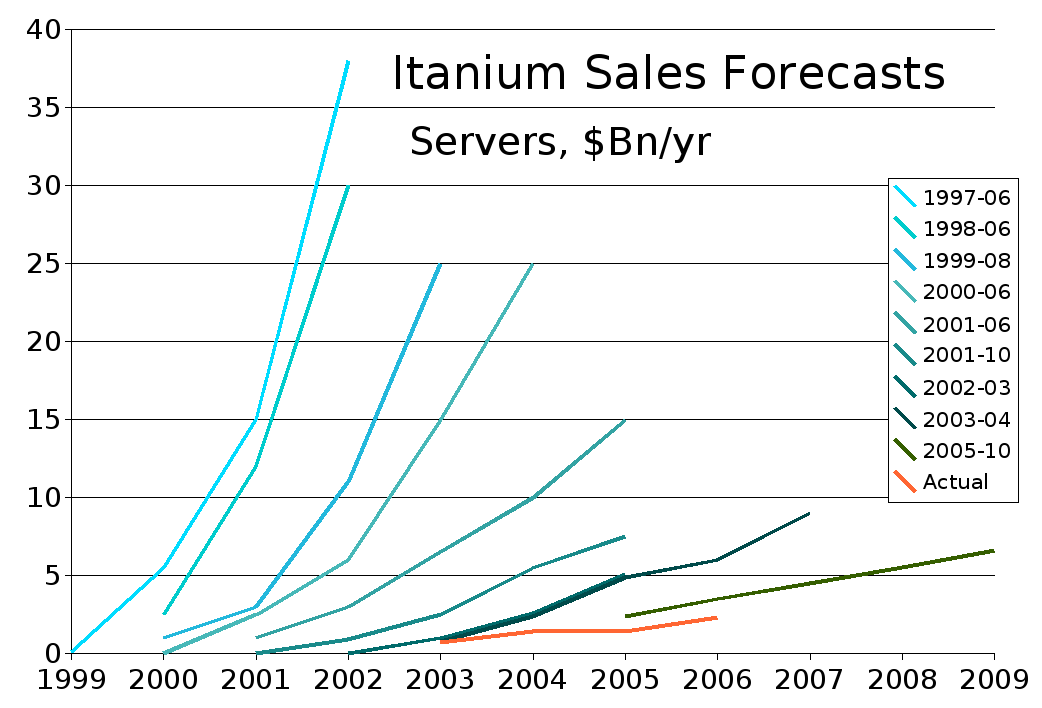
Performance on release in 2001 disappointed next to established RISC and CISC parts, and running existing x86 software through emulation was notably poor. Analysts had warned years earlier that the first chip would be late and slow. Intel's i860 had already shown the risk of parallel features that compilers never used, the same trap Itanium faced. One retrospective blamed weak legacy 32-bit support and the difficulty of writing and maintaining software for the architecture.


Questions people ask about Itanium
What is Itanium?
A family of 64-bit Intel microprocessors running the IA-64 architecture, developed with Hewlett-Packard and launched in June 2001. They were built for mission-critical servers and high-performance computing, not for ordinary desktops or laptops.
What does IA-64 mean?
It is the instruction set Itanium implements, originally called IA-64 and later the Intel Itanium architecture. It grew from HP's EPIC design, a form of very long instruction word computing where the compiler marks instructions that can run in parallel.
Why did it not replace x86?
Performance at launch was weak compared with established RISC and CISC chips, x86 emulation was poor, and software was hard to write and maintain. AMD's x86-64 gave a compatible 64-bit route and took the market.
Who made the chips?
Intel manufactured them, on processes from 180 nm down to 32 nm. HP and later Hewlett Packard Enterprise built the Integrity Servers line around them, and other firms made systems too.
Is it still available?
No. Intel took final orders until 30 January 2020 and stopped shipments by 29 July 2021, as planned. The last generation, Kittson, went to test customers in February 2017 and shipped in volume that May.
Good reading and sources
- Official websiteOfficial site
- Checking your browserAnandTech, Article
- Ten Years After First Delay, Intel's Itanium Is Still LateThe New York Times, Article
The facts on this page come from the Wikipedia article "Itanium", written by its contributors and used under the CC BY-SA 4.0 licence, and from its Wikidata record (CC0). EveryChip rewrote the text in its own words, with AI assistance, and compares every page with the article to make sure no passage is copied. It may be reused under the same CC BY-SA 4.0 licence with a link back.
It may contain mistakes, and figures change over time. Nothing here is investment or buying advice. If something is wrong, tell us. Last refreshed 2026-11-14.
Like Itanium
All CPUs and microprocessors 🇯🇵 JapanSPARC64 V
Single-core SPARC V9 server microprocessor by FujitsuCPU · Other · 2001
 🇺🇸 United StatesPentium Pro
Intel's first sixth-generation x86 CPU, built for servers and workstationsCPU · x86 · 1995
More from Intel
All of them 🇺🇸 United StatesPentium 4
Intel's single-core desktop CPU line built on the NetBurst microarchitectureCPU · x86 · 2000
🇺🇸 United StatesIXP1200
Network processor for mid-range and high-end routersNetwork chip · Arm · 2000
 🇺🇸 United StatesNetBurst
Intel's Pentium 4-era x86 CPU design, built for very high clock speedsCPU · x86 · 2000
 🇺🇸 United StatesXScale
ARM-based microarchitecture for mobile and embedded systemsCPU · Arm · 2002