
Pentium 4
Intel's single-core desktop CPU line built on the NetBurst microarchitecture
Pentium 4 is a family of single-core x86 CPUs that Intel shipped from November 2000 to August 2008 for desktops, laptops and entry-level servers. Built on the NetBurst microarchitecture, it was Intel's flagship until 2004 and pushed clock speeds to 3.8 GHz before the design was displaced by the Core line.
- Shipped from November 20, 2000 to August 8, 2008
- First Intel desktop core to carry SSE2, later SSE3 and 64-bit
- Clock speeds reached 3.8 GHz, far short of the 10 GHz Intel once projected
- Five process steps from 180 nm to 65 nm, up to 188 million transistors
- Introduced Hyper-Threading to the mass desktop market in 2002
What it is
Pentium 4 is a line of single-core processors for desktops, laptops and entry-level servers, designed and made by Intel. The first chips shipped on November 20, 2000 and the last left the factory in August 2008. Every model runs on the NetBurst microarchitecture, the design that followed Intel's P6. Clock speeds across the family span 1.3 GHz to 3.8 GHz, with front side bus rates from 400 MT/s up to 1066 MT/s. The line was Intel's flagship until 2004, when the Pentium Extreme Edition took the top spot. It brought SSE2 to market first and later added SSE3, 64-bit support and Hyper-Threading.
How it came about
Work on the first NetBurst core, codenamed Willamette, began in 1998 while Intel still treated the Pentium II as its long-term line. The design slipped, and the Pentium III appeared before it was finished. Because NetBurst differed so much from P6, Intel could not sell the new core as a Pentium III, so it launched as the Pentium 4 on November 20, 2000 at 1.4 and 1.5 GHz. Many observers saw that launch as a stopgap answer to AMD's Thunderbird Athlon. Bob Bentley of Intel told the Design Automation Conference that validating such a complex IA-32 design was a daunting task, and he hired 60 recent graduates for the job.
Inside the chip
NetBurst used a long instruction pipeline aimed at high clock rates. Instead of a normal code cache it carried a trace cache holding decoded micro-operations, which removed the instruction decoding step but took more die area and power. The chips supported MMX, SSE, SSE2 and, from the Prescott core, SSE3. Level 1 cache was 16 KB, split 8 KB for data and 8 KB for instructions; level 2 grew from 256 KB to as much as 2 MB, and Gallatin parts added 2 MB of level 3. Later models ran two threads on one core through Hyper-Threading. The design drew more power and ran hotter than earlier Intel or AMD processors.
How it was made
Intel fabricated every Pentium 4 in its own plants. The line moved through five process generations: 180 nm with 42 million transistors, 130 nm with 55 million, a 130 nm Gallatin Extreme Edition at 169 million, 90 nm at 125 million, and 65 nm at 188 million. Chips sat in Socket 423, then Socket 478, then LGA 775. Each processor carried an integrated heat spreader to protect the die during cooler fitting. On later Socket 478 and LGA 775 parts that spreader was soldered down.
Where it went
Pentium 4 went into desktop PCs, laptops and entry-level servers. Early systems needed Rambus RDRAM, which was fast but costly, and Intel bundled two RDRAM modules with boxed chips to help sales. In August 2001 the 845 chipset opened the door to cheaper PC133 SDRAM, and DDR SDRAM support followed in January 2002, after which the line replaced the Pentium III as Intel's best-selling mainstream part. Gateway brought the first Hyper-Threading desktop to the mass market in November 2002. The Mobile Pentium 4-M, released April 23, 2002, added SpeedStep and Deeper Sleep for laptops at about 35 W.
Versions and family
The family began with Willamette at 180 nm, product codes 80528 and 80531. Northwood followed in January 2002 at 130 nm with 512 KB of level 2 cache, then Prescott at 90 nm introduced SSE3 and 64-bit capability. Branded lines included Pentium 4-M, Pentium 4 HT, Mobile Pentium 4, Mobile Pentium 4 HT and Pentium 4 HT Extreme Edition. Celeron covered the low end and Xeon the server market. Mobile designs were succeeded by Pentium M, desktops by Pentium D and later Pentium Dual-Core.
Why it matters
Pentium 4 made clock speed the headline number in PC marketing, and buyers often picked the chip with the highest GHz figure. AMD answered with its megahertz myth campaign and a PR-rating scheme. Intel had predicted NetBurst would reach 10 GHz, but leakage at 90 nm and below capped the family at 3.8 GHz. That failure pushed Intel back toward the cooler Pentium M design and then to the Core architecture launched on January 5, 2006, which valued efficiency per clock instead of raw frequency.
Problems and reception
Reviews were mixed. Optimised code could beat the fastest Pentium III, but older software with many branches or x87 floating-point work often ran no better, and a shared one-way bus limited the design. Tom Yager of Infoworld called it the fastest CPU for programs that fit entirely in cache. Developers disliked the new optimisation rules, and AMD's lower-clocked Athlon beat it in maths work until software was rebuilt for SSE2. Critics nicknamed it NetBust and called NetBurst a marketecture. Overclocked early Northwood chips suffered Sudden Northwood Death Syndrome, a slow degradation caused by electromigration.
Questions people ask about Pentium 4
What kind of chip is the Pentium 4?
A single-core x86 CPU for desktops, laptops and entry-level servers. Intel designed and manufactured it. Every model uses the NetBurst microarchitecture, which followed the P6 design used in the Pentium III.
Why did Intel stop developing NetBurst?
Power leakage grew sharply at 90 nm and below, causing heat and clock scaling problems that blocked further speed gains. From 2003 to 2005 Intel moved effort to the cooler Pentium M design, and the Core architecture took over in 2006.
What did Hyper-Threading do on this chip?
It let one physical core run two threads at once, feeding two sets of instructions through the pipeline so resources that would otherwise sit idle could be used. The 3.06 GHz Northwood of November 2002 was the first mass-market desktop model with it.
What memory did early Pentium 4 systems need?
Launch systems required Rambus RDRAM, which was fast but expensive. The 845 chipset of August 2001 allowed cheaper PC133 SDRAM, and DDR SDRAM support arrived in January 2002, easing the cost problem.
Which chips came before and after it?
The Pentium III preceded it. Mobile designs were succeeded by Pentium M, desktops by Pentium D and then Pentium Dual-Core, while the Core 2 brand took over the top of Intel's range.
Good reading and sources
- Intel InsideIntel, Article
- New Pentium 4 rejects Rambus memoryZDNET, Article
- Intel Goes DDRTom's Hardware, Article
- Pentium 4 platform renamedThe Register, Article
The facts on this page come from the Wikipedia article "Pentium 4", written by its contributors and used under the CC BY-SA 4.0 licence, and from its Wikidata record (CC0). EveryChip rewrote the text in its own words, with AI assistance, and compares every page with the article to make sure no passage is copied. It may be reused under the same CC BY-SA 4.0 licence with a link back.
It may contain mistakes, and figures change over time. Nothing here is investment or buying advice. If something is wrong, tell us. Last refreshed 2026-11-14.
Like Pentium 4
All CPUs and microprocessors 🇺🇸 United StatesNetBurst
Intel's Pentium 4-era x86 CPU design, built for very high clock speedsCPU · x86 · 2000
 🇺🇸 United StatesPentium III
Intel's 32-bit P6 desktop and server CPU line, launched in 1999 with SSE.CPU · x86 · 1999
 🇺🇸 United StatesXeon
Intel's x86 processor brand for servers, workstations and embedded systems since 1998CPU · x86 · 1998
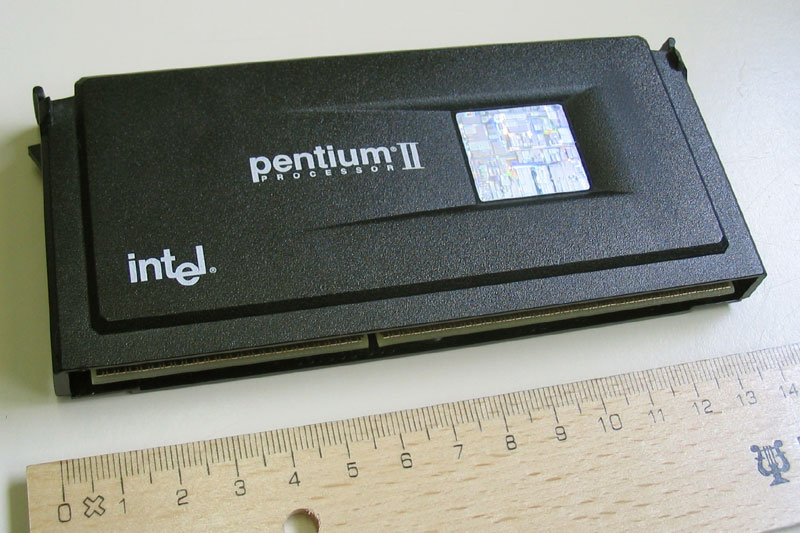 🇺🇸 United StatesPentium II
Intel's 1997 P6 desktop CPU line with MMX, sold in a slot cartridgeCPU · x86 · 1997
More from Intel
All of them 🇺🇸 United StatesBlackfin
Hybrid microprocessor and DSP family by Analog DevicesMicrocontroller · RISC · 2000
🇺🇸 United StatesIXP1200
Network processor for mid-range and high-end routersNetwork chip · Arm · 2000
🇮🇱 IsraelTimna
Cancelled Intel CPU with integrated graphics and memory controllerCPU · x86 · 2000
 🇺🇸 United StatesItanium
64-bit EPIC server microprocessor family from Intel and HPCPU · VLIW · 2001