
MCS-48
Intel's first microcontroller series from 1976
Released in 1976 by Intel, the MCS-48 was the company's first microcontroller family. It featured a modified Harvard architecture and became popular in cost-sensitive consumer electronics like keyboards and toys due to its low price and efficient instruction set.
- First microcontroller series released by Intel in 1976
- Used in IBM PC keyboards and Magnavox Odyssey² console
- Features a modified Harvard architecture with separate memory spaces
- Production continued into the 1990s for legacy support
What it is
The MCS-48 is a series of eight-bit microcontrollers developed by Intel. Launched in 1976, it represents the company's initial entry into the microcontroller market. The family includes models such as the 8048, 8035, and 8748. These chips use a modified Harvard architecture, keeping program and data memory separate. They were originally built using NMOS technology before switching to CMOS in the early 1980s. Production continued into the 1990s to support legacy designs. The series is known for its low cost and compact one-byte instructions, making it suitable for high-volume devices.
How it came about
Intel introduced the MCS-48 in 1976 as its first microcontroller line. The 8048 model became the most prominent member of the family. Initially manufactured with NMOS processes, the chips later adopted CMOS technology to improve efficiency. Although the MCS-51 series eventually succeeded it, the MCS-48 remained widely used through the year 2000. Its longevity stemmed from affordable pricing, broad availability, and mature development tools. This sustained popularity allowed it to serve older designs long after newer architectures appeared.
Inside the chip
The architecture separates input and output mapping from program and data spaces. It supports 64 to 256 bytes of on-chip random access memory. Program memory can reach 4096 bytes, with some variants using external read-only memory. Most arithmetic operations rely on an accumulator. Eight memory locations function as registers, addressable via a three-bit field. Conditional branches are limited to the current 256-byte page, while jump commands can access 2048 locations directly. Instructions execute in one or two machine cycles, with each cycle requiring fifteen external clocks.
How it was made
Early production used n-type metal–oxide–semiconductor technology. By the early 1980s, complementary metal–oxide–semiconductor processes became available. Intel manufactured these chips into the 1990s. Philips Semiconductors also held a license to produce derivatives, creating the MAB8400 family. The manufacturing approach allowed for high-volume output at low cost, which was critical for its adoption in consumer goods. The transition to CMOS helped maintain its relevance as power efficiency became more important in embedded applications.
Where it went
These microcontrollers are common in computer keyboards, where they convert key presses into digital signals. The IBM PC and its predecessor used the 8048 for this purpose. The TRS-80 Model II employed the 8021 variant in its keyboard interface. Consumer electronics like television remotes and toys frequently incorporate these chips. They also appeared in video game consoles such as the Magnavox Odyssey². Musical instruments, including synthesizers from Korg and Roland, utilized the MCS-48 for control tasks. Nintendo’s Donkey Kong arcade game used the 8035 variant for sound generation.
Versions and family
The 8049 model includes two kilobytes of masked read-only memory and 128 bytes of RAM. The ROM-less 8035 allows for external memory connections. The UPI-41 series serves as a peripheral controller with a parallel bus interface. Philips developed the MAB8400 family based on this architecture, adding integrated I²C interfaces for use in Compact Disc players. The MCS-51 series eventually replaced the MCS-48 as Intel’s primary microcontroller line, offering enhanced capabilities for more complex tasks.
Why it matters
The MCS-48 established Intel as a major player in the microcontroller market. Its efficient instruction set and low cost made it a standard choice for simple embedded tasks. The chip’s presence in iconic products like the IBM PC keyboard and early video games cemented its legacy. Even after being superseded by the MCS-51, it remained in production for decades. This longevity demonstrates its effectiveness in cost-sensitive applications where high performance is not required.


Questions people ask about MCS-48
What was the first microcontroller made by Intel?
The MCS-48 series was Intel's first microcontroller family, originally released in 1976. The 8048 is the most well-known model in this initial lineup.
Why did the MCS-48 remain popular for so long?
It stayed popular due to its low cost, wide availability, and efficient one-byte instruction set. Mature development tools and continued manufacturing into the 1990s supported its use in older designs.
What devices commonly used the MCS-48 chips?
They were frequently found in computer keyboards, television remotes, toys, and video game consoles like the Magnavox Odyssey². Synthesizers and arcade games also utilized these microcontrollers.
Good reading and sources
The facts on this page come from the Wikipedia article "Intel MCS-48", written by its contributors and used under the CC BY-SA 4.0 licence, and from its Wikidata record (CC0). EveryChip rewrote the text in its own words, with AI assistance, and compares every page with the article to make sure no passage is copied. It may be reused under the same CC BY-SA 4.0 licence with a link back.
It may contain mistakes, and figures change over time. Nothing here is investment or buying advice. If something is wrong, tell us. Last refreshed 2026-11-14.
Like MCS-48
All microcontrollers 🇺🇸 United States and 1 moreCOP400
4-bit microcontroller family for embedded control tasksMicrocontroller · Other · 1977
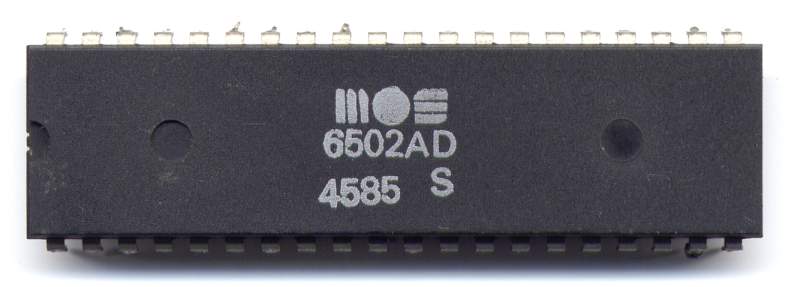 🇺🇸 United StatesMOS Technology 6502
Low-cost 8-bit microprocessor that powered the home computer revolutionCPU · Other · 1975
 🇯🇵 JapanNEC μCOM series
NEC microprocessor and microcontroller family from the 1970s and 1980sCPU · x86 · 1973
 🇺🇸 United StatesIntel MCS-51
An 8-bit microcontroller series for embedded systems.Microcontroller · Other · 1980
More from Intel
All of them 🇺🇸 United StatesIntel 8259
Programmable interrupt controller for early Intel microprocessorsAnalog · Other · 1976
 🇺🇸 United StatesIntel 8085
An 8-bit Intel microprocessor from 1976, the last of its lineCPU · 8-bit · 1976
 WorldFloppy disk controller
Chip that manages reading and writing data to floppy disksAnalog · 1976
 🇺🇸 United StatesAMD Am9080
AMD's reverse-engineered clone of the Intel 8080, made from 1975CPU · 8-bit · 1975