
Floppy disk controller
Chip that manages reading and writing data to floppy disks
A floppy disk controller is a specialised integrated circuit that directs data flow between a computer and a floppy drive. It converts binary data into magnetic patterns for storage and handles drive mechanics like head positioning.
- First single-chip FDC announced by Western Digital in 1976
- NEC μPD765 became standard in original IBM PC in 1981
- Converts binary data to FM or MFM magnetic patterns
- Later models integrated into Super I/O chips
- Supports data transfer rates up to 2 Mbyte/sec
What it is
A floppy disk controller is a hardware component that manages the reading and writing of data to floppy disk drives. It acts as a bridge between the host computer and the physical drive mechanism. The controller translates binary data from the system into specific magnetic patterns on the disk surface using encoding schemes such as FM or MFM. It also handles mechanical tasks like moving the read head to the correct track. Early versions were large circuit boards with many chips, but later designs condensed these functions into single integrated circuits. This evolution reduced cost and complexity for computer manufacturers.
How it came about
The first controllers appeared in 1971 as part of IBM mainframe systems, using hybrid circuits on multiple cards. These early units were proprietary and lacked industry standards. In 1976, Western Digital announced the FD1771, the first special-purpose integrated circuit for this task. NEC followed with the μPD765 in 1978, which became a quasi-standard after its adoption in the original IBM PC in 1981. Intel later introduced highly integrated versions like the 82072 and 82078 series in the late 1980s. By the 1990s, these controllers were often merged into Super I/O chips as floppy drives declined in popularity.
Inside the chip
The controller performs several key functions including data encoding, error detection, and drive command execution. It converts digital bits into magnetic polarity changes using formats like FM for single density or MFM for double density. A phase-locked loop helps recover clock signals from the data stream during reads. The chip interprets commands such as seek, read, and write, while managing head positioning and track selection. External hardware often handles motor control and drive selection, though modern single-chip solutions integrate more of these features. Communication with the host CPU occurs through specific input/output ports for data, status, and control.
How it was made
Early controllers required dozens of integrated circuits on large printed circuit boards. The shift to single-chip solutions began in the mid-1970s with devices like the Western Digital FD1771. Later models from Intel, such as the 82078 series, were produced in 44- and 64-lead QFP packages. These advanced chips supported higher data transfer rates and included power management features. Manufacturing moved towards standard semiconductor processes as the design matured. Some variants offered 3.3-volt support and could reduce power consumption to under 50 microamps when idle.
Where it went
These chips were essential in personal computers from the 1980s and 1990s, including the IBM PC and Apple II. They enabled systems to read and write data on removable media for software distribution and file storage. Controllers were also found in embedded systems and workstations that required reliable removable storage. As hard drives became dominant, the floppy controller was often combined with other interface logic on Super I/O chips. Eventually, USB-based solutions replaced internal controllers for legacy media support in modern systems.
Versions and family
Numerous variants exist from different manufacturers. The NEC μPD765 and its successor the μPD72068 were widely used in IBM-compatible PCs. Intel produced the 82072 and the 82078 series, with the latter supporting higher speeds and lower power. The 82078SL variant featured enhanced power management. Sharp commercialised the LH0110 in 1986. Earlier discrete designs included the IBM FDC for the 3741 system and the Shugart Associates SA4400. Each variant supported different combinations of drive formats and densities.
Why it matters
The standardisation of floppy disk controllers facilitated the growth of the personal computer industry. By providing a common interface for removable storage, it allowed software to be distributed widely. The adoption of the NEC μPD765 in the IBM PC set a de facto standard for compatibility. This consistency helped drive down costs and encouraged third-party peripheral development. The eventual integration of these functions into Super I/O chips reflected the broader trend of consolidating motherboard logic as computing needs evolved.


Questions people ask about Floppy disk controller
What does a floppy disk controller do?
It directs the reading and writing of data to a floppy disk drive. The chip converts binary data from the computer into magnetic patterns on the disk and controls mechanical functions like head movement.
Which chip was used in the original IBM PC?
The NEC μPD765 was adopted for the original IBM PC in 1981. It became a quasi-industry standard for floppy disk control in compatible systems due to this widespread adoption.
How did floppy controllers evolve over time?
They started as large circuit boards with many discrete components. By the late 1970s, single-chip solutions emerged. Later, they were integrated into Super I/O chips as floppy drives became less common.
Good reading and sources
- Floppy disk controller on WikipediaEncyclopedia
- More photos on Wikimedia CommonsPhotos
- Wikidata recordOpen data
The facts on this page come from the Wikipedia article "Floppy disk controller", written by its contributors and used under the CC BY-SA 4.0 licence, and from its Wikidata record (CC0). EveryChip rewrote the text in its own words, with AI assistance, and compares every page with the article to make sure no passage is copied. It may be reused under the same CC BY-SA 4.0 licence with a link back.
It may contain mistakes, and figures change over time. Nothing here is investment or buying advice. If something is wrong, tell us. Last refreshed 2026-11-14.
Like Floppy disk controller
All analog, power and mixed-signal 🇺🇸 United StatesIntel 8259
Programmable interrupt controller for early Intel microprocessorsAnalog · Other · 1976
 🇺🇸 United StatesIntel 8253
Programmable interval timer for early microcomputers and PCsAnalog · 1980
🇺🇸 United StatesIntel 8237
Four-channel DMA controller for early IBM PCsAnalog · Other · 1980
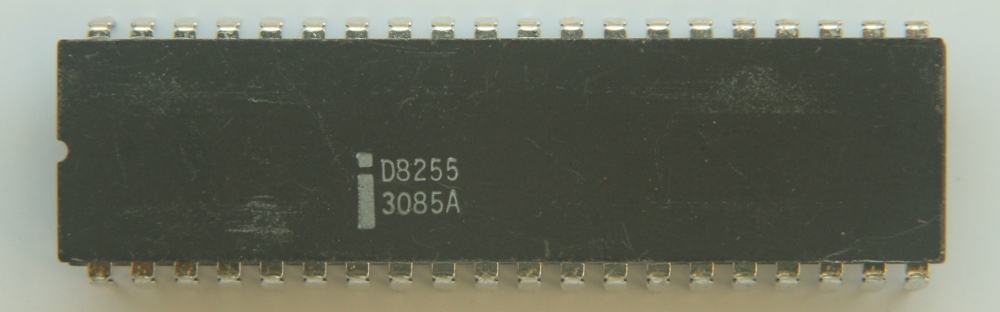 🇺🇸 United StatesIntel 8255
Programmable parallel input/output interface chip for early microprocessorsAnalog · 1970
More from Western Digital
All of them 🇺🇸 United StatesElectronic Arrays 9002
An 8-bit CPU with on-chip RAM, sold briefly in the mid-1970s.CPU · Other · 1976
 🇺🇸 United StatesIntel 8085
An 8-bit Intel microprocessor from 1976, the last of its lineCPU · 8-bit · 1976
 🇺🇸 United StatesWD16
A 16-bit CISC microprocessor from Western Digital, built from five DIP chips.CPU · Other · 1976
 🇺🇸 United StatesZilog Z80
An 8-bit microprocessor released in 1976 that became a staple of early personal computing and embedded systems.CPU · Other · 1976