Other and custom
Transputers, Lisp machines, Soviet and Chinese designs and one-off architectures. 263 chips on EveryChip so far.
Not every processor fits a big family. This group holds one-off and national designs: the British transputer built for parallel computing, Intel's ambitious iAPX 432, machines built to run the Lisp language, the Linn Rekursiv, and the Chinese ShenWei chips of the Sunway supercomputers. Some failed commercially but left ideas that later designs reused.
Ambitious experiments
Intel's iAPX 432 of 1981 tried to build object protection and garbage collection into hardware; it was slow and was dropped, while the stopgap 8086 succeeded. Inmos's transputer put serial links on every chip so that processors could be wired into networks. The Rekursiv, designed for the hi-fi maker Linn in the late 1980s, ran object-oriented programs in microcode.
National designs
Countries cut off from Western chips have built their own. The Soviet Union cloned and extended Western designs. China's ShenWei SW26010, with 260 cores, powered the Sunway TaihuLight, the world's fastest supercomputer from June 2016 to June 2018, made entirely with Chinese-designed processors. Loongson's LoongArch, introduced in 2021, is another home-grown instruction set.
Famous other chips


Further reading
 🇺🇸 United StatesIntel MCS-51
An 8-bit microcontroller series for embedded systems.Microcontroller · Other · 1980
🇯🇵 JapanRL78
16-bit embedded microcontroller family by Renesas ElectronicsMicrocontroller · Other · 2010
🇺🇸 United StatesMOS Technology 6532
Integrated circuit combining RAM, I/O ports and a timer for 1970s systems.Microcontroller · Other
🇩🇪 GermanyXC2000
16-bit automotive microcontroller from InfineonMicrocontroller · Other
 🇺🇸 United StatesTMS1100
PMOS microcontroller family from Texas Instruments launched in 1975Microcontroller · Other · 1975
🇩🇪 GermanyAURIX
32-bit automotive microcontroller family by InfineonMicrocontroller · Other
WorldXE166
16-bit microcontroller family for industrial motor controlMicrocontroller · Other · 2007
 WorldR8C
16-bit microcontroller family from RenesasMicrocontroller · Other
 🇯🇵 JapanH8 Family
Hitachi and Renesas microcontroller family for embedded systemsMicrocontroller · Other · 1988
 🇯🇵 Japan78K
NEC and Renesas 8- and 16-bit microcontroller family for embedded control.Microcontroller · Other · 1986
 🇯🇵 JapanToshiba TLCS
Toshiba microcontroller families with CISC and RISC designsMicrocontroller · RISC · 1973
 🇯🇵 JapanNEC μCOM series
NEC microprocessor and microcontroller family from the 1970s and 1980sCPU · x86 · 1973
 🇺🇸 United StatesMOS Technology 6522
I/O controller chip for 6502 microprocessorsMicrocontroller · Other
🇺🇸 United StatesMOS 6530
Integrated circuit with ROM, RAM, I/O and timerMicrocontroller · Other
WorldIntel MCS-296
High-performance microcontroller for embedded DSP and controlMicrocontroller · Other
 🇺🇸 United StatesMC14500B
One-bit CMOS microprocessor for industrial control logicMicrocontroller · Other · 1977
 🇷🇺 Russia and 1 more1801 series
Soviet 16-bit microprocessors compatible with DEC PDP-11CPU · Other · 1978
 🇺🇸 United StatesTMS320
Texas Instruments' long-running family of digital signal processorsDSP · Other · 1983
🇺🇸 United StatesCOP8
8-bit microcontroller with low EMI and integrated peripheralsMicrocontroller · Other · 1988
 🇺🇸 United StatesTMS1000
A 4-bit microcontroller family with on-chip ROM, RAM and I/O from 1974.Microcontroller · Other · 1974
WorldS1C6x
4-bit microcontroller family by Epson with specialised peripheralsMicrocontroller · Other
 🇺🇸 United StatesPIC microcontroller
Microchip's long-running family of 8-bit to 32-bit microcontrollersMicrocontroller · MIPS · 1976
 🇺🇸 United StatesMSP430
A 16-bit mixed-signal microcontroller family designed for very low power use.Microcontroller · Other · 1992
 🇺🇸 United StatesHewlett-Packard Nanoprocessor
An 8-bit control microcontroller with no arithmetic unit, released by HP in 1974Microcontroller · Other · 1974
 🇺🇸 United StatesElectronic Arrays 9002
An 8-bit CPU with on-chip RAM, sold briefly in the mid-1970s.CPU · Other · 1976
 🇺🇸 United States and 1 moreSignetics 8X300
A 1976 bipolar microcontroller and signal processor from SigneticsCPU · Other · 1976
🇺🇸 United StatesS2000
4-bit microcontroller for displays and controlMicrocontroller · Other · 1977
🇺🇸 United StatesEssex SX 200
4-bit single-chip microcontroller with on-board ROM, RAM and display driversMicrocontroller · Other · 1976
 🇺🇸 United StatesMCS-48
Intel's first microcontroller series from 1976Microcontroller · Other · 1976
 🇺🇸 United States and 1 moreMCS-96
A 16-bit microcontroller family for embedded control systems.Microcontroller · Other
🇺🇸 United StatesIntel 8061
Automotive microcontroller for Ford engine control unitsMicrocontroller · Other · 1983
 🇺🇸 United StatesZ8 Encore!
Zilog microcontroller with DMA and debug supportMicrocontroller · Other
 WorldSTM8
Low-cost 8-bit microcontroller family by STMicroelectronicsMicrocontroller · Other
 WorldZilog Z8
Microcontroller architecture with extensive on-chip registersMicrocontroller · Other · 1979
 🇺🇸 United States and 1 moreCOP400
4-bit microcontroller family for embedded control tasksMicrocontroller · Other · 1977
 🇺🇸 United StatesATmega88
8-bit AVR microcontroller with 8K flash memoryMicrocontroller · Other
 🇺🇸 United StatesATtiny
Compact 8-bit AVR microcontroller family for simple embedded tasksMicrocontroller · Other · 1999
WorldOOPic
Object-oriented PIC microcontroller with virtual circuitsMicrocontroller · Other
🇯🇵 JapanR8C Tiny
Low-cost 16-bit microcontroller series by RenesasMicrocontroller · Other
🇺🇸 United StatesAxcent
Audio-visual control microcontroller by AMXMicrocontroller · Other
 🇯🇵 JapanRX Microcontroller Family
32-bit microcontrollers for industrial and automotive controlMicrocontroller · Other · 2009
🇳🇴 NorwayZPU
Open-source stack microprocessor for FPGAsMicrocontroller · Other · 2008
WorldJStik
A microcontroller that runs Java bytecode as native machine code.Microcontroller · Other
 🇳🇱 NetherlandsNexperia
Brand for NXP media and mobile system-on-chipsSoC · Arm · 1999
🇯🇵 JapanΜCOM-4
NEC original 4-bit single-chip microprocessor from 1973Microcontroller · Other · 1973
 WorldZ80182
Enhanced Z80 microprocessor with integrated peripheralsMicrocontroller · Other
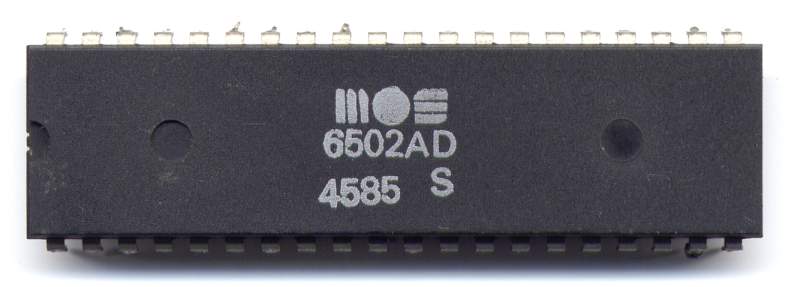 🇺🇸 United StatesMOS Technology 6502
Low-cost 8-bit microprocessor that powered the home computer revolutionCPU · Other · 1975
 🇯🇵 JapanMemory Management Controller
Special chips in NES cartridges that expand console memory limitsMicrocontroller · Other · 1985
Photo credits on this page
The small pictures above come from Wikimedia Commons under free licences. Some are cropped to fit.
- Transputer: NobbiP, CC BY-SA 3.0, source
- MOS Technology 6502: Dirk Oppelt, CC BY-SA 3.0, source
- ATtiny: Torsten Landschoff, Public domain, source
- PIC microcontroller: Raimond Spekking, CC BY-SA 4.0, source
- MSP430: Travis Goodspeed, CC BY 2.0, source
- Hewlett-Packard Nanoprocessor: Pauli Rautakorpi, CC BY 3.0, source
- Electronic Arrays 9002: Electronics Arrays, Inc., Public domain, source
- Signetics 8X300: Konstantin Lanzet, GFDL, source
- Intel iAPX 432: _brouhaha_, CC BY-SA 2.0, source
- Intel MCS-51: Konstantin Lanzet (with permission), CC BY-SA 3.0, source
- MCS-48: Konstantin Lanzet, CC BY-SA 3.0, source
- MCS-96: Konstantin Lanzet, CC BY-SA 3.0, source
- Z8 Encore!: DnaX, CC BY-SA 3.0, source
- STM8: Raimond Spekking, CC BY-SA 4.0, source
- Zilog Z8: Konstantin Lanzet, CC BY-SA 3.0, source
- COP400: Seanriddle, CC BY-SA 4.0, source
- ATmega88: Raimond Spekking, CC BY-SA 4.0, source
- TMS1100: Konstantin Lanzet (with permission), CC BY-SA 3.0, source
- R8C: Raimond Spekking, CC BY-SA 4.0, source
- H8 Family: Raimond Spekking, CC BY-SA 4.0, source
- 78K: NobbiP, CC BY-SA 3.0, source
- Toshiba TLCS: NobbiP, CC BY-SA 3.0, source
- NEC μCOM series: Konstantin Lanzet, CC BY-SA 3.0, source
- MOS Technology 6522: Raimond Spekking, CC BY-SA 4.0, source
- MC14500B: JPL, CC BY-SA 4.0, source
- 1801 series: Konstantin Lanzet, CC BY-SA 4.0, source
- RX Microcontroller Family: Cristiano Tomás, CC BY-SA 4.0, source
- Nexperia: Ikknmnmnm, CC BY-SA 4.0, source
- Memory Management Controller: Evan-Amos, Public domain, source
- TMS320: Raimond Spekking, CC BY-SA 4.0, source
- TMS1000: Pauli Rautakorpi, CC BY 3.0, source
- Z80182: Raimond Spekking, CC BY-SA 4.0, source