
Memory Management Controller
Special chips in NES cartridges that expand console memory limits
Memory Management Controllers are custom integrated circuits placed inside Nintendo Entertainment System game cartridges. They allow developers to bypass the console's strict 40KB ROM limit by switching memory banks, enabling larger and more complex games.
- First used in Ninja Jajamaru-kun in late 1985
- MMC5 supports up to 2MB total ROM capacity
- VRC6 adds three extra sound channels to the Famicom
- MMC1 uses serial input requiring five writes per command
What it is
Memory Management Controllers, often called mappers, are specialized chips embedded within game cartridges for the Nintendo Entertainment System and Famicom. The base console hardware supports only 40KB of read-only memory, a limit reached quickly by early titles. These controllers extend system capabilities by managing memory banks, allowing for larger games with more graphics and code than the console could address directly. Developers like Nintendo, Konami, and Sunsoft designed various versions to suit different game needs.
How it came about
The need for expanded memory arose within two years of the Famicom launch. Ninja Jajamaru-kun, released in late 1985, was the first to use CNROM, the earliest banking hardware. As games grew more complex, manufacturers developed custom integrated circuits. Nintendo introduced the MMC1 in 1986, followed by the MMC3 in 1988. Third-party companies like Konami and Namco also created their own chips to add features such as extra sound channels or larger graphics sets.
Inside the chip
These chips manage how the console accesses program and character data. Basic models like UNROM use discrete logic to switch fixed memory banks. Advanced units like the MMC1 use serial input, requiring multiple write commands to change banks, which slows switching but saves pins. The MMC3 added an interrupt request timer for split-screen scrolling and faster bank switching via parallel registers. Some chips, like the VRC6 and MMC5, include extra audio hardware, adding square wave or FM synthesis channels beyond the console's built-in sound.
How it was made
Manufacturers produced these chips using various processes. Nintendo manufactured its own MMC series, while Sharp and NEC produced variants of the MMC3. Konami created the VRC series, and Sunsoft developed the FME-7. The chips range from simple discrete logic components in early CNROM boards to complex custom integrated circuits in the MMC5. Packaging and board layouts varied by manufacturer, with some third parties creating unique cartridge shells to house their proprietary hardware.
Where it went
These controllers enabled iconic titles such as The Legend of Zelda, Super Mario Bros. 3, and Castlevania III. The MMC1 supported battery-backed saves for adventure games. The MMC3 powered platformers requiring smooth scrolling and sprite management. Konami's VRC6 allowed the Japanese version of Castlevania III to feature enhanced audio not present in the Western release. Rare used the AOROM mapper for titles like Battletoads, utilizing one-screen mirroring for specific graphical effects.
Versions and family
Nintendo produced several MMC versions, including the MMC1 through MMC6. The MMC2 and MMC4 were used in only a few titles, featuring automatic graphic switching. Third-party options included Konami's VRC1 through VRC7, Namco's 109 and 163, and Bandai's FCG series. The VRC7 included FM synthesis audio, while the Namco 163 supported extra wave samples. Sunsoft's FME-7 offered flexible bank switching for both program and character data.
Why it matters
These chips defined the technical ceiling of the NES era. They allowed developers to push beyond the console's original specifications, creating deeper and visually richer experiences. The variety of mappers meant that emulation requires specific support for each chip type. The existence of these custom circuits demonstrated how cartridge-based systems could evolve over time without changing the core console hardware.


Questions people ask about Memory Management Controller
Why do NES cartridges need extra chips?
The base console can only access 40KB of memory. These chips, called mappers, switch between different memory banks, allowing games to be much larger and have more complex graphics than the original hardware supports alone.
Which chip is the most common?
The MMC1 is the most widely used first-party mapper. It supports battery-backed saves and multi-directional scrolling, appearing in major titles like The Legend of Zelda and Metroid.
Do all mappers add sound features?
No. Most mappers only handle memory. However, advanced chips like Konami's VRC6 and Nintendo's MMC5 include extra audio hardware, adding new sound channels that the base console does not have.
Good reading and sources
- Memory management controller on WikipediaEncyclopedia
- More photos on Wikimedia CommonsPhotos
- Wikidata recordOpen data
The facts on this page come from the Wikipedia article "Memory management controller", written by its contributors and used under the CC BY-SA 4.0 licence, and from its Wikidata record (CC0). EveryChip rewrote the text in its own words, with AI assistance, and compares every page with the article to make sure no passage is copied. It may be reused under the same CC BY-SA 4.0 licence with a link back.
It may contain mistakes, and figures change over time. Nothing here is investment or buying advice. If something is wrong, tell us. Last refreshed 2026-11-14.
Like Memory Management Controller
All microcontrollers 🇺🇸 United States and 1 moreCOP400
4-bit microcontroller family for embedded control tasksMicrocontroller · Other · 1977
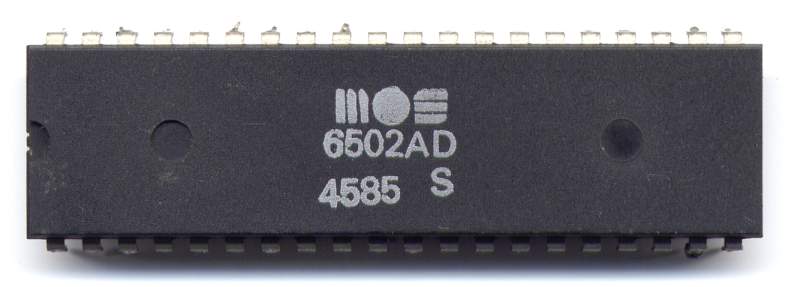 🇺🇸 United StatesMOS Technology 6502
Low-cost 8-bit microprocessor that powered the home computer revolutionCPU · Other · 1975
 🇯🇵 JapanToshiba TLCS
Toshiba microcontroller families with CISC and RISC designsMicrocontroller · RISC · 1973
🇺🇸 United StatesMOS Technology 6532
Integrated circuit combining RAM, I/O ports and a timer for 1970s systems.Microcontroller · Other
More from Nintendo
All of them 🇯🇵 Japan10NES
Nintendo's authentication chip for the NES consoleMicrocontroller · MCU family · 1985
 🇯🇵 JapanRicoh 2A03
8-bit CPU and sound chip for the Nintendo Entertainment SystemCPU · 68k · 1983
 WorldSuper FX
SNES cartridge coprocessor for 3D polygon renderingConsole chip · RISC · 1992
 🇺🇸 United StatesRDRAM
High-bandwidth serial memory developed by Rambus for PCs and consoles.Memory · 1996