
1801 series
Soviet 16-bit microprocessors compatible with DEC PDP-11
The 1801 series comprises 16-bit Soviet microprocessors first released in 1980. Designed by Angstrem and others, these chips offered binary compatibility with DEC PDP-11 systems. They powered home computers, industrial controllers, and military hardware throughout the 1980s.
- Binary compatible with DEC PDP-11 systems
- Powered the popular Elektronika BK home computer
- Used in the Buran space shuttle programme
- Clock speeds ranged from 100 kHz to 12 MHz
- Manufactured by Angstrem and other Soviet plants
What it is
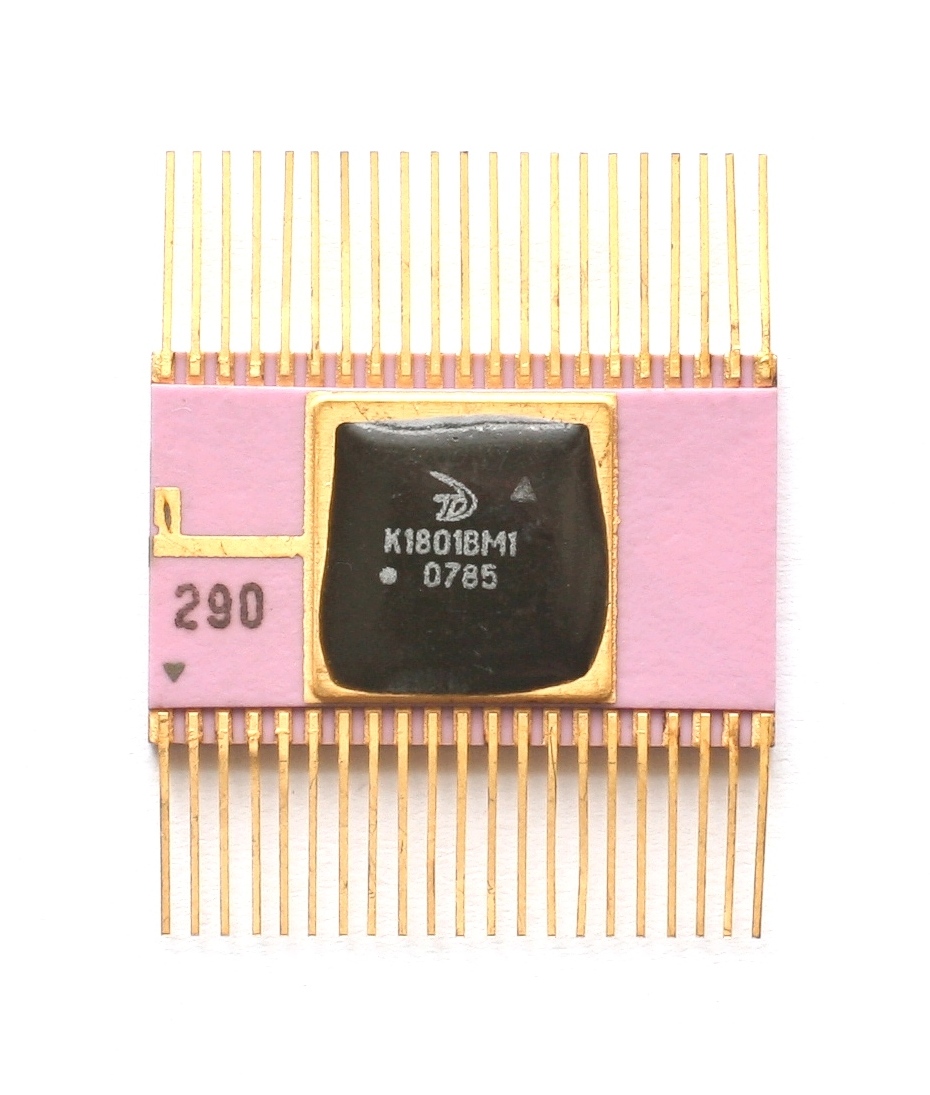
The 1801 series represents a family of 16-bit microprocessors developed in the Soviet Union. First produced in 1980, these chips were designed to be binary compatible with the Digital Equipment Corporation PDP-11 architecture. This compatibility allowed Soviet engineers to leverage existing software ecosystems while using domestic hardware. The series includes central processing units and microcontrollers. They became the standard for many Soviet embedded systems, military applications, and personal computers during the 1980s. Notable models include the K1801VM1 and K1801VM3. The chips were manufactured by several state-owned plants, primarily Angstrem in Zelenograd.
How it came about
Development began in the early 1970s at the Special Computing Center in Zelenograd. Led by D.I. Yuditsky, the team created the Elektronika NC-1 minicomputer in 1973. It used bit-slice processors that were complex to implement. The industry sought a single-chip solution. In 1976, bureaucratic shifts disbanded the center. Its assets moved to Angstrem and other institutes. The new leadership favoured copying Western standards over indigenous designs. This led to the adoption of the LSI-11 instruction set. The first chip, K1801VE1, arrived in 1980. It was followed by the simplified K1801VM1 in 1982, which became widely adopted.
Inside the chip
These processors use a 16-bit architecture based on the Elektronika NC core. Later models implemented the LSI-11 instruction set. The K1801VE1 was a microcontroller with on-chip memory. Subsequent chips like the VM1 and VM2 removed peripheral circuits to focus on processing. The VM2 introduced dual address spaces for faster instruction handling. The VM3 added a memory management unit and support for floating-point coprocessors. Clock speeds ranged from 100 kHz to 12 MHz. Early versions used nMOS technology with 5 µm or 4 µm processes. Later variants shifted to CMOS for better power efficiency. Address buses expanded to 22 bits in later models.
How it was made
Manufacturing relied on nMOS and later CMOS processes. The K1801VM1 used a 5 µm node with roughly 16,600 transistors. The VM2 used 4 µm technology with about 18,500 transistors. Angstrem in Zelenograd was the primary producer. Second sources included Exiton in Pavlovsky Posad and the Solnechnogorsk Electro-Mechanical Plant. Some gate arrays were also made by Intermos in Hungary. Packages varied from 40-pin ceramic dual in-line packages to 64-pin quad flat packs. The shift to CMOS in the 1806 series reduced power consumption while maintaining functional equivalence.
Where it went
These chips powered a wide range of Soviet electronics. They were central to the BK series of home computers, which gained a cult following. Educational machines like the UKNC and professional micros like the DVK used them. Industrial applications included CNC controllers for lathes and graphing calculators like the Elektronika MK-85. Military and space programmes also utilized the series, including the Buran space shuttle. Hungarian computers such as the Mikrosztar 1123 incorporated these processors. Their versatility made them a staple in both consumer and heavy industry sectors.
Versions and family
The series evolved through several key models. The K1801VE1 was the initial microcontroller variant. The K1801VM1 became the standard general-purpose CPU. The VM2 added instruction extensions, while the VM3 included memory management. Floating-point tasks were handled by the separate K1801VM4 coprocessor. The 1806 series translated these designs into CMOS technology, offering higher clock speeds up to 25 MHz in the N1836VM3. The KA1013VM1 integrated peripheral logic onto a single die for calculator use. Each variant addressed specific needs in speed, integration, or power usage.
Why it matters
The 1801 series dominated Soviet microcomputing in the 1980s. Its compatibility with PDP-11 systems facilitated software porting and education. Many programmers first encountered UNIX-like environments on DVK machines powered by these chips. The BK home computer fostered a vibrant demoscene in later years. By standardising on a single architecture, the Soviet industry simplified development for embedded and military systems. The chips remain iconic among Russian engineers for their role in early personal computing and industrial automation.


Questions people ask about 1801 series
What architecture is the 1801 series based on?
The series is based on the indigenous Elektronika NC microarchitecture. However, most models were redesigned to be binary compatible with the DEC LSI-11 instruction set, allowing them to run PDP-11 software.
Which computers used the 1801 processors?
They were used in the Elektronika BK home computers, DVK professional micros, UKNC educational machines, and the Soyuz-Neon PC. They also powered industrial CNCs and the Buran space shuttle.
Who manufactured these chips?
Primary manufacturing was done by Angstrem in Zelenograd. Second sources included Exiton in Pavlovsky Posad, the Solnechnogorsk Electro-Mechanical Plant, and Intermos in Hungary.
Good reading and sources
- 1801 series CPU on WikipediaEncyclopedia
- More photos on Wikimedia CommonsPhotos
- Wikidata recordOpen data
The facts on this page come from the Wikipedia article "1801 series CPU", written by its contributors and used under the CC BY-SA 4.0 licence, and from its Wikidata record (CC0). EveryChip rewrote the text in its own words, with AI assistance, and compares every page with the article to make sure no passage is copied. It may be reused under the same CC BY-SA 4.0 licence with a link back.
It may contain mistakes, and figures change over time. Nothing here is investment or buying advice. If something is wrong, tell us. Last refreshed 2026-11-14.
Like 1801 series
All CPUs and microprocessors 🇺🇸 United StatesIntel MCS-51
An 8-bit microcontroller series for embedded systems.Microcontroller · Other · 1980
 🇺🇸 United States and 1 moreSignetics 8X300
A 1976 bipolar microcontroller and signal processor from SigneticsCPU · Other · 1976
 WorldIntersil 6100
A 12-bit CMOS microprocessor that runs the PDP-8 instruction set on one chipCPU · Other · 1975
 🇺🇸 United States and 1 moreAMD Am2900
AMD's 1975 bipolar bit-slice IC family for building custom control unitsCPU · Other · 1975