
SpursEngine
Toshiba media coprocessor for video and 3D tasks
Toshiba launched the SpursEngine in 2007 as a dedicated media coprocessor. It uses four Synergistic Processing Elements to handle video encoding and 3D graphics in consumer electronics.
- Announced by Toshiba in September 2007
- Uses four Synergistic Processing Elements
- Consumes less than 20 watts of power
- Features 128 MB of XDR DRAM memory
- Built using a 65 nm CMOS process
What it is
The SpursEngine is a microprocessor developed by Toshiba to assist with media tasks. Announced in September 2007, it acts as a coprocessor for 3D graphics and video processing. It targets consumer devices like set-top boxes and personal computers. The chip relies on four Synergistic Processing Elements, similar to those found in the Cell processor used in the PlayStation 3. Unlike the Cell, it lacks a main central processing unit on the die and instead connects to an external host CPU.
How it came about
Toshiba designed this chip to handle heavy media loads efficiently. The company announced the processor on 20 September 2007. By April 2008, sample units of the SE1000 reference board were shipped to partners. This timeline allowed hardware makers to integrate the accelerator into products later that year. The design aimed to provide high performance for video tasks while keeping power consumption low compared to earlier architectures.
Inside the chip
The architecture features four Synergistic Processing Elements optimized for stream processing. These cores are smaller than their predecessors, with a circuit layout reduced by thirty per cent. A proprietary 32-bit control core manages communication with the host system. Dedicated codecs for H.264 and MPEG-2 formats sit on the chip to speed up video work. The processor uses exclusive XDR DRAM for its working memory, ensuring high bandwidth for data-intensive tasks.
How it was made
Manufacturing uses a 65 nm bulk CMOS process with seven layers of copper interconnect. The die measures roughly 103 square millimetres and contains 239.1 million transistors. Logic circuits account for 134 million of these, while static random-access memory makes up the rest. The chip is packaged in a 624-pin Flip Chip-Ball Grid Array format. This construction supports a maximum frequency of 1.5 GHz while maintaining a thermal design power under 20 watts.
Where it went
This processor appears in Toshiba Qosmio laptop models F50, G50 and G55, released in late 2008. Third-party manufacturers also created accelerator cards based on the SE1000 platform. Leadtek produced internal and external PCIe cards, while Thomson-Canopus announced a Blu-ray encoding accelerator. Software support is primarily available through device drivers for Windows and Linux, focusing on video editing and encoding applications.
Versions and family
The primary commercial variant is the SE1000, which serves as a PCIe-based reference board. This module includes 128 MB of XDR DRAM with a bandwidth of 12.8 GB per second. Hardware partners adapted this platform into specific products like the WinFast PxVC1100 and the Firecoder Blu. No direct successor or predecessor model is listed in the available records for this specific product line.
Why it matters
The SpursEngine brought Cell Broadband Engine technology to mainstream consumer laptops and PCs. It allowed for efficient video processing without the high power draw associated with full central processors. By offloading media tasks to this dedicated unit, systems could handle high-definition content more smoothly. Its integration into Qosmio laptops demonstrated a practical application of specialized accelerators in portable computing environments.

Questions people ask about SpursEngine
What is the SpursEngine used for?
It is a media oriented coprocessor designed for 3D graphics and video processing. It handles tasks like H.264 and MPEG-2 encoding in consumer electronics such as laptops and set-top boxes.
How many cores does the SpursEngine have?
The processor contains four Synergistic Processing Elements. These cores are derived from the Cell processor architecture but are optimized for lower power and smaller size in this implementation.
Which laptops featured the SpursEngine?
Toshiba included the processor in its Qosmio laptop series. Specifically, the F50, G50 and G55 models shipped with the chip in the third quarter of 2008 to enhance media performance.
Good reading and sources
The facts on this page come from the Wikipedia article "SpursEngine", written by its contributors and used under the CC BY-SA 4.0 licence, and from its Wikidata record (CC0). EveryChip rewrote the text in its own words, with AI assistance, and compares every page with the article to make sure no passage is copied. It may be reused under the same CC BY-SA 4.0 licence with a link back.
It may contain mistakes, and figures change over time. Nothing here is investment or buying advice. If something is wrong, tell us. Last refreshed 2026-11-14.
Like SpursEngine
All CPUs and microprocessors 🇩🇪 Germany and 3 moreU880
East German clone of the Zilog Z80 microprocessorCPU · Other · 1980
 🇺🇸 United States and 1 moreSignetics 8X300
A 1976 bipolar microcontroller and signal processor from SigneticsCPU · Other · 1976
 🇯🇵 JapanNEC µPD780C
Zilog Z80 compatible 8-bit microprocessor by NECCPU · Other
 🇺🇸 United StatesEfficeon
Low-power x86 processor using software translationCPU · x86 · 2004
More from Toshiba
All of them 🇺🇸 United StatesCell Broadband Engine
A multi-core RISC processor pairing one PowerPC core with eight vector coprocessors.CPU · Power · 2007
🇺🇸 United StatesPower Processing Element
64-bit PowerPC core for PlayStation 3 and Xbox 360CPU · Power · 2005
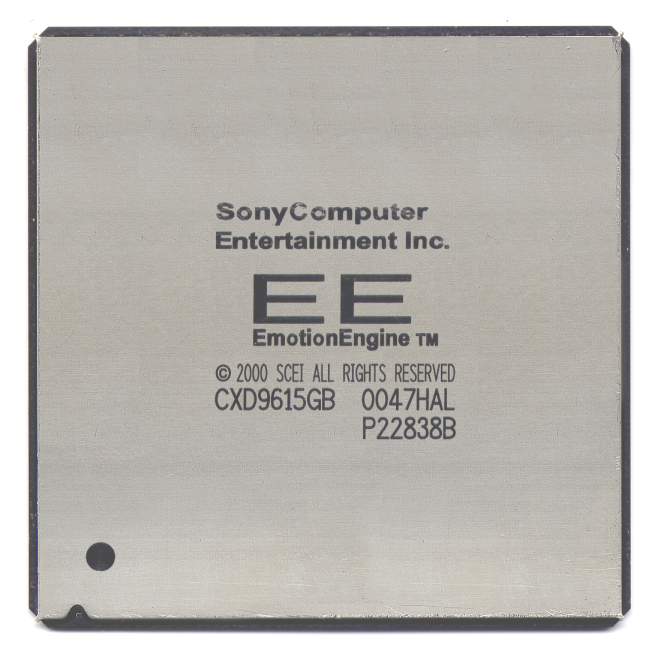 🇯🇵 JapanEmotion Engine
Sony and Toshiba's CPU for the PlayStation 2 consoleCPU · MIPS · 1999
 🇺🇸 United StatesR10000
A superscalar MIPS IV microprocessor for workstations and servers.CPU · MIPS · 1995