
U880
East German clone of the Zilog Z80 microprocessor
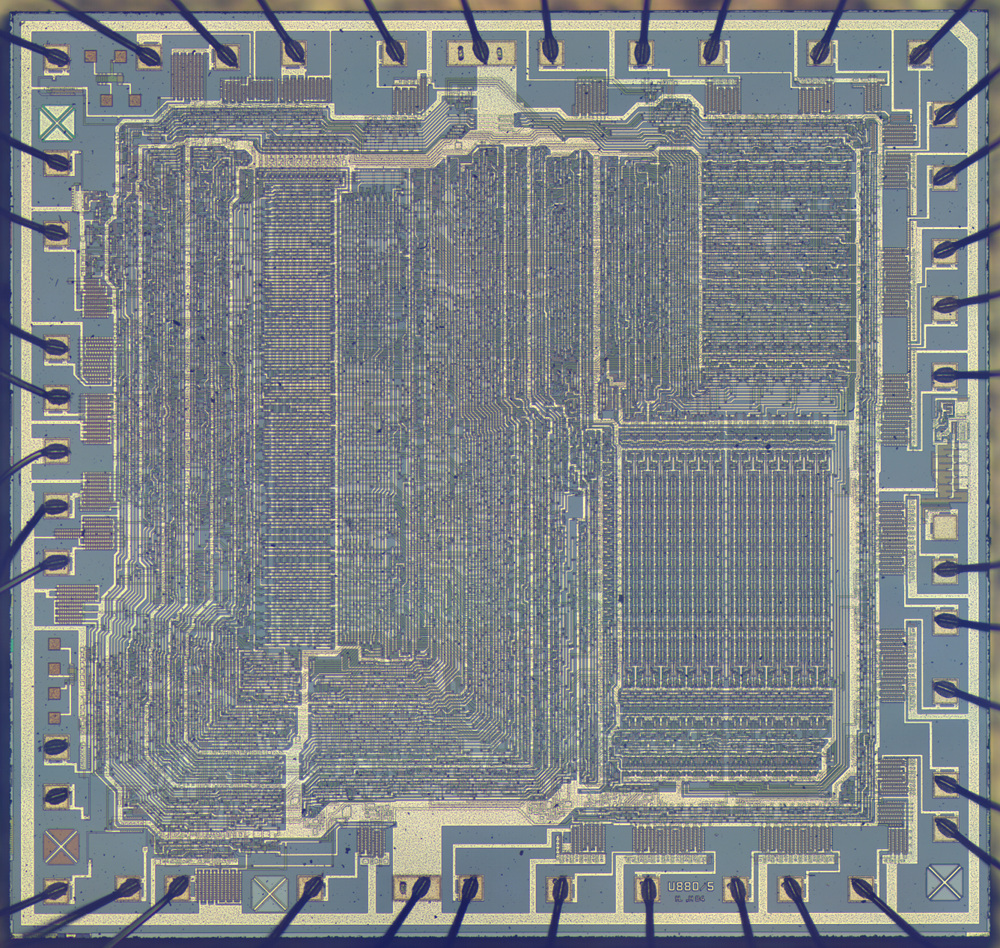
The U880 is an 8-bit microprocessor produced in the German Democratic Republic from 1980. It serves as an unlicensed copy of the Zilog Z80, powering most computers in the Eastern Bloc during the Cold War era.
- Unlicensed clone of the Zilog Z80 microprocessor
- Most widely used CPU in the German Democratic Republic
- Production ran from 1980 until approximately 1996
- Supported illegal opcodes and bug compatibility
- Used in computers across the entire Eastern Bloc
What it is
The U880 is an 8-bit central processing unit manufactured in the German Democratic Republic. Production began in 1980 at VEB Funkwerk Erfurt, which later became VEB Mikroelektronik Karl Marx. This chip is an unlicensed replica of the Western Zilog Z80 processor. It replicates the original instruction set, including undocumented commands and hardware errors, with only trivial deviations. For many years, it stood as the most advanced eight-bit processor available within the Eastern Bloc nations.
How it came about
Manufacturing started in 1980 to provide a local alternative to Western silicon. The facility in Erfurt produced these units using NMOS technology. As political and economic structures shifted after 1990, the state-owned enterprise was privatized into ERMIC GmbH and later Thesys. These successor companies continued production for a short time. A smaller version of the die appeared in 1990, allowing higher speeds. Legal threats from Zilog were avoided when Thesys became a distributor for the original American company instead.
Inside the chip
This processor mimics the architecture of the Zilog Z80. It runs on clock speeds between one and eight megahertz. The standard package is a forty-pin dual in-line layout with 2.5 mm pin spacing for domestic use. Export models used the wider 2.54 mm Western standard. Military grades carried a specific MEK 4 marking. Support chips were also made with matching temperature ratings. A later CMOS variant, the U84C00, was developed but never reached mass production due to economic changes.
How it was made
The chips were fabricated using NMOS processes at the Erfurt plant. Early versions used plastic packaging, while Russian variants sometimes utilized ceramic cases. After 1991, bare dies were shipped to Russia and Ukraine for final packaging. Companies like Angstrem in Zelenograd and Kvazar in Kiev assembled these under local part numbers such as KR1858VM1. The final iterations allowed for faster operation up to eight megahertz through a reduced die size.
Where it went
This microprocessor powered the majority of personal and office computers in East Germany. Notable machines include the Robotron A 5120 and the KC 85 home computer. It also drove the Poly Play arcade cabinet. Beyond its home country, the chip saw widespread adoption across the Eastern Bloc. Computers in Poland, Czechoslovakia, Hungary, Romania, Bulgaria, and the Soviet Union relied on this processor because clones of the older Intel 8080 were less capable than the Z80 architecture it replicated.
Versions and family
Several revisions existed, including a hobbyist grade marked with an S1 suffix. The military version featured distinct markings. Successors included the sixteen-bit U8001 and U8002, though these saw limited adoption compared to the original. A planned clone of the Intel 80286, called the U80601, remained in pilot stages. The U880/6 represented a shrunk die design that enabled higher clock rates. Later Russian rebrands included the T34VM1 and KM1858VM1 for different package types.
Why it matters
The U880 defined computing in the German Democratic Republic and influenced hardware standards across the Eastern Bloc. It allowed these nations to build compatible systems without relying on Western imports. Its dominance lasted until MS-DOS and Intel-based architectures became the global standard. The transition to privatization saw the technology persist briefly under new corporate identities before fading from mainstream production.



Questions people ask about U880
Is the U880 exactly the same as the Zilog Z80?
It is an unlicensed clone that supports the same instruction set. It even replicates the illegal opcodes and hardware bugs of the original Z80, with only very minor differences in behavior.
Which countries used the U880 processor?
It was primarily used in the German Democratic Republic. It also powered computers in Poland, Czechoslovakia, Hungary, Romania, Bulgaria, and the Soviet Union throughout the Eastern Bloc.
What was the maximum clock speed of the U880?
The standard versions operated between 1 MHz and lower speeds. Later variants, specifically the U880DC08 and Thesys Z80H using a shrunk die, achieved clock rates up to 8 MHz.
Did the U880 have any successors?
Yes, VEB Mikroelektronik produced the 16-bit U8001 and U8002. They also developed a U80601 clone of the Intel 80286, but these saw far less use than the original U880.
Good reading and sources
The facts on this page come from the Wikipedia article "U880", written by its contributors and used under the CC BY-SA 4.0 licence, and from its Wikidata record (CC0). EveryChip rewrote the text in its own words, with AI assistance, and compares every page with the article to make sure no passage is copied. It may be reused under the same CC BY-SA 4.0 licence with a link back.
It may contain mistakes, and figures change over time. Nothing here is investment or buying advice. If something is wrong, tell us. Last refreshed 2026-11-14.
Like U880
All CPUs and microprocessors 🇯🇵 JapanNEC µPD780C
Zilog Z80 compatible 8-bit microprocessor by NECCPU · Other
 🇺🇸 United States and 1 moreSignetics 8X300
A 1976 bipolar microcontroller and signal processor from SigneticsCPU · Other · 1976
 🇺🇸 United StatesZilog Z80
An 8-bit microprocessor that powered early personal computers and game consoles.CPU · Other · 1976
 🇺🇸 United StatesZilog Z80
An 8-bit microprocessor that powered early personal computers and game consoles.CPU · Other · 1976