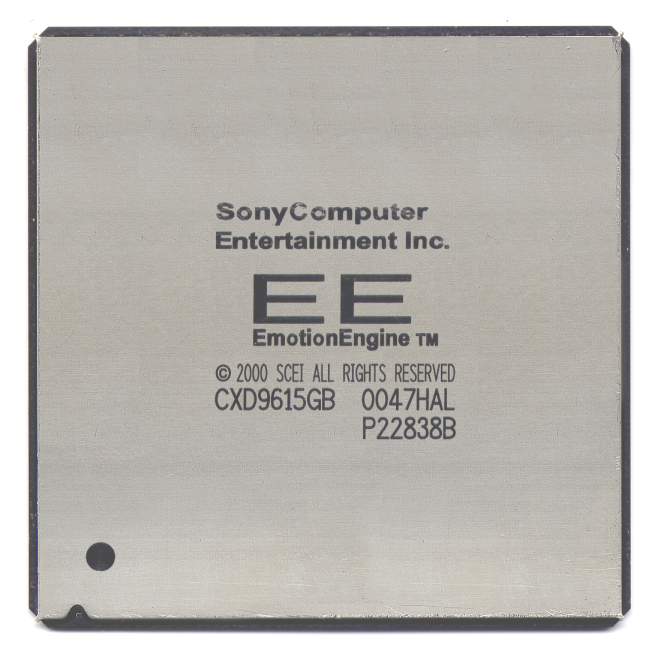
Emotion Engine
Sony and Toshiba's CPU for the PlayStation 2 console
The Emotion Engine is a central processing unit built by Sony Computer Entertainment and Toshiba for the PlayStation 2. Mass production ran from 1999 until late 2012, and early PlayStation 3 models carried one to run PlayStation 2 games.
- 13.5 million transistors on a 240 mm2 die
- 0.25 μm CMOS process, 0.18 μm effective gate length
- Two vector units alongside a MIPS R5900 core
- Mass production ran 1999 to late 2012
- 540-contact plastic ball grid array package
What it is
The Emotion Engine is the main processor inside Sony's PlayStation 2 console, designed and manufactured jointly by Sony Computer Entertainment and Toshiba. It combines a MIPS-based CPU core with two vector units, a DMA engine, a memory controller and an MPEG-2 decoder on one die. Mass production started in 1999 and stopped in late 2012 when the PlayStation 2 ended. Early PlayStation 3 units in Japan and North America also carried one so they could run PlayStation 2 discs. Its mix of general-purpose code, parallel maths and media decoding in a single chip made it stand out among console processors of its era.
How it came about
Sony Computer Entertainment and Toshiba developed the chip together, with mass production beginning in 1999. It served as the CPU of the PlayStation 2 throughout the console's life, and production ended in late 2012 when that machine was discontinued. The design later influenced the Cell Broadband Processor used in the PlayStation 3, which arranged its CPU and vector units in a similar way.
Inside the chip
Eight units share one die: a CPU core, two vector processing units, a 10-channel DMA unit, a memory controller and an Image Processing Unit. The core is a MIPS R5900, two-way superscalar and in-order, running MIPS III plus part of MIPS IV and Sony's own 107 multimedia instructions that work on 128-bit groups of smaller values. It has a six-stage integer pipeline and a 15-stage floating-point one, with 16 KB of instruction cache, 8 KB of data cache and 16 KB of scratchpad RAM. VPU0 works alongside the core while VPU1 handles geometry and lighting on its own under microcode.
How it was made
The chip packed 13.5 million transistors onto a 240 mm2 die. Sony and Toshiba fabricated it on a 0.25 μm CMOS process with an effective gate length of 0.18 μm and four metal levels. It shipped in a 540-contact plastic ball grid array package, running at 1.8 V and drawing 15 W.
Where it went
Its main job was as the processor of the PlayStation 2. The first PlayStation 3 revisions sold in Japan and North America included one on the board for PlayStation 2 backwards compatibility; later models dropped the chip and used software emulation on the Cell processor instead. The same hardware also appeared in the PSX digital video recorder and in Sony televisions, including the WEGA HVX HDTV and the BRAVIA KDL22PX300.
Versions and family
Clock speed rose from 294.912 MHz to 299 MHz in later versions. Slim PlayStation 2 models dropped the hard disk support and PCMCIA connector that earlier units used through the I/O interface. Early PlayStation 3 revisions carried a physical Emotion Engine, while second revisions replaced it with software emulation and later ones removed the Graphics Synthesizer too.
Why it matters
The Emotion Engine powered the PlayStation 2 across a production run from 1999 to late 2012. Its arrangement of a CPU core paired with two vector units directly inspired the Cell Broadband Processor in the PlayStation 3. The design showed how a console chip could combine game code, geometry, lighting and video decoding on one piece of silicon.
Problems and reception
A common misconception held that the chip was a 128-bit processor because of its wide SIMD registers. In fact neither its addresses nor its integers were 128-bit; only the shared registers were, much like Intel's SSE on 32-bit x86. Sony kept some of its custom instructions unpublished for competitive reasons.


Questions people ask about Emotion Engine
What exactly is the Emotion Engine?
It is the central processing unit of Sony's PlayStation 2, built by Sony Computer Entertainment and Toshiba. One die holds a MIPS CPU core, two vector units, a DMA controller, a memory controller and an MPEG-2 decoder, so it can run game code, do 3D maths and decode video.
Is it really a 128-bit processor?
No. Its SIMD registers are 128 bits wide and its internal data paths are 128 bits, but memory addresses and integers are not 128-bit. The custom instructions simply operate on groups of four 32-bit, eight 16-bit or sixteen 8-bit values at once.
Why did some PlayStation 3 consoles contain one?
The first PlayStation 3 revisions sold in Japan and North America included a physical Emotion Engine so they could play PlayStation 2 discs. Later revisions dropped it to cut costs and used software emulation on the Cell processor instead.
Who actually manufactured the chip?
Sony and Toshiba fabricated it themselves on a 0.25 μm CMOS process with four levels of interconnect. The die measures 240 mm2 and holds 13.5 million transistors.
Good reading and sources
- Emotion Engine on WikipediaEncyclopedia
- More photos on Wikimedia CommonsPhotos
- Wikidata recordOpen data
The facts on this page come from the Wikipedia article "Emotion Engine", written by its contributors and used under the CC BY-SA 4.0 licence, and from its Wikidata record (CC0). EveryChip rewrote the text in its own words, with AI assistance, and compares every page with the article to make sure no passage is copied. It may be reused under the same CC BY-SA 4.0 licence with a link back.
It may contain mistakes, and figures change over time. Nothing here is investment or buying advice. If something is wrong, tell us. Last refreshed 2026-11-14.
Like Emotion Engine
All CPUs and microprocessors 🇺🇸 United States and 1 moreMicrosoft XCPU (Xenon)
Three-core PowerPC CPU at the heart of the Xbox 360 consoleCPU · Power · 2003
 WorldMOS 6507
A low-cost 8-bit 6502 variant in a 28-pin package with an 8 KB address rangeCPU · Other · 1975
 🇯🇵 JapanNEC μCOM series
NEC microprocessor and microcontroller family from the 1970s and 1980sCPU · x86 · 1973
 🇺🇸 United StatesAthlon
AMD's x86 desktop processor brand, from the first 1 GHz chip to entry-level Zen APUsCPU · x86 · 1999
More from Sony Computer Entertainment
All of them 🇺🇸 United StatesR10000
A superscalar MIPS IV microprocessor for workstations and servers.CPU · MIPS · 1995
🇯🇵 JapanSony Handheld Engine
ARM-based SoC for Sony CLIE PDAs with integrated multimedia featuresSoC · Arm · 2003
 🇺🇸 United StatesR8000
MIPS IV microprocessor chipset for scientific computing workstations and servers.CPU · MIPS · 1994
 🇺🇸 United StatesR4600
A low-cost 64-bit MIPS microprocessor for workstations and embedded systems.CPU · MIPS · 1993