🇺🇸 Chips of the United States
733 chips from the United States, best known first.
The United States has launched a major federal programme to rebuild its domestic semiconductor supply chain. New legislation directs tens of billions of dollars toward building fabrication plants, funding research centres, and training engineers. These measures aim to reduce reliance on foreign suppliers while restricting advanced chip production in rival nations.
- Legislation allocates $52.7 billion in direct appropriations for chip manufacturing.
- Subsidy recipients cannot produce transistors smaller than 28 nanometres in China or Russia.
- Tax credits cover 25% of approved fabrication equipment purchases.
- Programmes aim to create between 25,000 and 45,000 new technical jobs.
- Empty factory construction allows firms to secure funding before installing heavy machinery.
Chips in the United States
American semiconductor manufacturing relies on a mix of domestic design houses and international partners. To secure this supply chain, the federal government introduced a sweeping industrial policy focused on local production. The strategy centres on financial incentives for constructing new fabrication facilities, known as foundries, where raw silicon wafers are etched into complex circuit patterns. It also channels money into academic research and technical education. By tying public funds to national security goals, the programme seeks to keep critical hardware development within American borders. This approach reshapes how the nation approaches microelectronics, moving from passive market dependence to active state sponsorship.
History
The legislative framework emerged from two separate proposals merged in early 2022. Lawmakers combined a technology research bill with a manufacturing incentive plan to address growing supply vulnerabilities. Key senators drafted the initial versions after diplomatic efforts encouraged overseas producers to consider American sites. The final package cleared both chambers with cross party backing before receiving presidential approval. Earlier drafts had proposed larger funding pools and broader regional innovation networks, but the enacted version narrowed its scope to focus primarily on microelectronics and allied scientific fields.
Companies
Major manufacturers have adjusted their expansion plans to align with the new funding rules. Some firms are constructing empty factory shells before purchasing heavy machinery, a tactic designed to avoid future market oversupply. International producers previously discussed relocating assembly lines to American soil to access these incentives. Domestic leaders have welcomed the financial support while expressing caution about the restrictions placed on overseas operations. Industry representatives generally back the initiative, though they worry that compliance requirements might slow down rapid facility upgrades.
Fabs and places
New fabrication plants, or foundries, will concentrate on producing logic chips and memory devices. The legislation encourages construction across multiple states, with several existing industrial zones selected for redevelopment. Recipients must commit to maintaining these facilities for a decade and cannot expand advanced node production in certain Asian markets. Advanced nodes refer to transistor sizes smaller than 28 nanometres, which require precise lithography equipment. The rules also mandate that funded sites hire local workers and partner with technical colleges to build a steady talent pipeline.
Policy and support
Federal agencies distribute grants and loan guarantees through a structured application process. Companies receive tax credits covering 25% of their equipment costs, alongside direct cash awards for facility construction. A portion of the budget supports university programmes, public research institutes, and workforce development initiatives. The law also establishes ethics guidelines and security protocols for all funded laboratories. Recipients face strict export controls, including a 10-year prohibition on developing cutting edge processors for restricted countries. Bureaucratic processing times remain lengthy, and some research allocations have faced congressional reductions.
Today
Recent assessments indicate that the programme has triggered dozens of proposed manufacturing and research ventures. Analysts project hundreds of billions in private capital will follow the initial public commitments. Employment forecasts suggest 25,000–45,000 new technical roles will emerge across engineering and plant operations. Implementation continues to navigate administrative bottlenecks and labour market gaps. Despite these friction points, the funding architecture remains active, guiding capital toward domestic semiconductor infrastructure and sustaining long term investment cycles in the national electronics sector.
The facts in this overview come from the Wikipedia article "CHIPS and Science Act", written by its contributors and used under the CC BY-SA 4.0 licence. EveryChip rewrote the text in its own words, with AI assistance, and compares every page with the article to make sure no passage is copied. It may be reused under the same CC BY-SA 4.0 licence with a link back.
 🇺🇸 United StatesMicroSPARC
Low-end SPARC V8 microprocessor for workstationsCPU · SPARC · 1992
🇺🇸 United States and 1 moreTurboSPARC
Low-end SPARC V8 microprocessor for workstation upgradesCPU · SPARC · 1996
 🇺🇸 United StatesMC88110
Second-generation Motorola RISC microprocessor for workstationsCPU · RISC · 1992
 🇺🇸 United StatesMC88100
First Motorola RISC microprocessor implementing the 88000 architecture.CPU · RISC · 1988
🇺🇸 United StatesRHPPC
Radiation-hardened PowerPC 603e processor for aerospace useCPU · Power
🇺🇸 United StatesR2000
Early 32-bit RISC microprocessor chipset from MIPSCPU · MIPS · 1986
 🇺🇸 United StatesR4600
A low-cost 64-bit MIPS microprocessor for workstations and embedded systems.CPU · MIPS · 1993
 🇺🇸 United StatesR5000
64-bit MIPS microprocessor for workstations and embedded systemsCPU · MIPS · 1996
🇺🇸 United StatesMIPS-X
A 32-bit RISC microprocessor architecture from Stanford UniversityCPU · RISC · 1987
 🇺🇸 United StatesUltraSPARC II
Sun Microsystems SPARC V9 microprocessor from 1997CPU · SPARC · 1997
 🇺🇸 United StatesROMP
IBM RISC microprocessor for workstations and office systemsCPU · RISC · 1986
🇺🇸 United StatesIBM 801
Experimental CPU that pioneered the RISC design philosophyCPU · RISC · 1975
 🇺🇸 United StatesSandy Bridge
A 2011 x86-64 microarchitecture from Intel featuring integrated graphics and AVX support.CPU · x86 · 2011
🇺🇸 United StatesPowerPC e200
32-bit Power ISA microprocessor cores for automotive and industrial controlMicrocontroller · Power · 2007
 🇺🇸 United StatesPowerPC e300
32-bit embedded microprocessor core by FreescaleCPU · Power · 2004
🇺🇸 United StatesPowerPC e6500
Multithreaded 64-bit Power ISA microprocessor core by FreescaleCPU · Power · 2012
 🇺🇸 United StatesPowerPC G4
32-bit PowerPC microprocessor family with AltiVec vector processingCPU · Power · 1999
🇺🇸 United StatesPWRficient
Power-efficient PowerPC microprocessor series by P.A. SemiCPU · Power · 2007
 🇺🇸 United StatesPowerPC 400
Embedded 32-bit RISC processor cores for diverse applicationsCPU · Power · 1994
 🇺🇸 United StatesI.MX
ARM-based system-on-chip family for multimedia and embedded systems by NXP Semiconductors.SoC · Arm
 🇺🇸 United StatesXeon
Intel's x86 processor brand for servers, workstations and embedded systems since 1998CPU · x86 · 1998
 🇺🇸 United StatesIntel 4004
The first commercial microprocessor, a 4-bit chip released by Intel in 1971.CPU · Other · 1971
🇺🇸 United StatesARM Cortex-A78
64-bit ARMv8.2-A CPU core designed by ARM for mobile and embedded devices.CPU · Arm · 2020
 🇺🇸 United StatesIntel 8080
An 8-bit microprocessor released in 1974 that launched the personal computer era.CPU · x86 · 1974
 🇺🇸 United StatesZilog Z80
An 8-bit microprocessor released in 1976 that became a staple of early personal computing and embedded systems.CPU · Other · 1976
🇺🇸 United StatesLoihi 2
Second-generation neuromorphic research processor from Intel LabsAI accelerator · Other
🇺🇸 United StatesEdge TPU
AI accelerator chip for edge devices by Google CoralAI accelerator · RISC-V
🇺🇸 United StatesNorthPole
Brain-inspired AI inference chip by IBM ResearchAI accelerator · Other
🇺🇸 United StatesQualcomm Cloud AI 100
AI inference accelerator for data centres and edge devicesAI accelerator · VLIW · 2021
 🇺🇸 United StatesMotorola 68000 series
32-bit CISC microprocessor family from MotorolaCPU · 68k · 1979
 🇺🇸 United StatesIntel 80186
16-bit microprocessor with integrated peripherals for embedded systemsCPU · x86 · 1982
 🇺🇸 United StatesI486
32-bit microprocessor with on-chip cache and FPUCPU · x86 · 1989
 🇺🇸 United StatesPowerQUICC
Freescale PowerPC microcontrollers for networking and embedded systemsMicrocontroller · Power · 1995
🇺🇸 United StatesIBM PALM processor
16-bit CPU module used in early IBM portable computersCPU · Other · 1975
 🇺🇸 United StatesATtiny
Compact 8-bit AVR microcontroller family for simple embedded tasksMicrocontroller · Other · 1999
 🇺🇸 United StatesMC68451
Memory management unit for Motorola 68000 series processorsAnalog · 68k
 🇺🇸 United StatesIntel 2700G
Mobile graphics co-processor for XScale PXA27xGPU · GPU architecture · 2004
 🇺🇸 United StatesCyrix Cx486
x86 desktop microprocessor competing with Intel 486CPU · x86 · 1993
🇺🇸 United StatesMC68340
32-bit microprocessor with integrated DMA and system functionsMicrocontroller · 68k
🇺🇸 United StatesAxcent
Audio-visual control microcontroller by AMXMicrocontroller · Other
 🇺🇸 United States and 1 moreMC10800
4-bit bit-sliced processor in ECL logic from 1979CPU · Other · 1979
🇺🇸 United StatesSandy Bridge-E
32 nm server and workstation processors from IntelCPU · x86 · 2011
 🇺🇸 United States and 2 moreEEPROM
Byte-erasable non-volatile memory for small data storageMemory · 1978
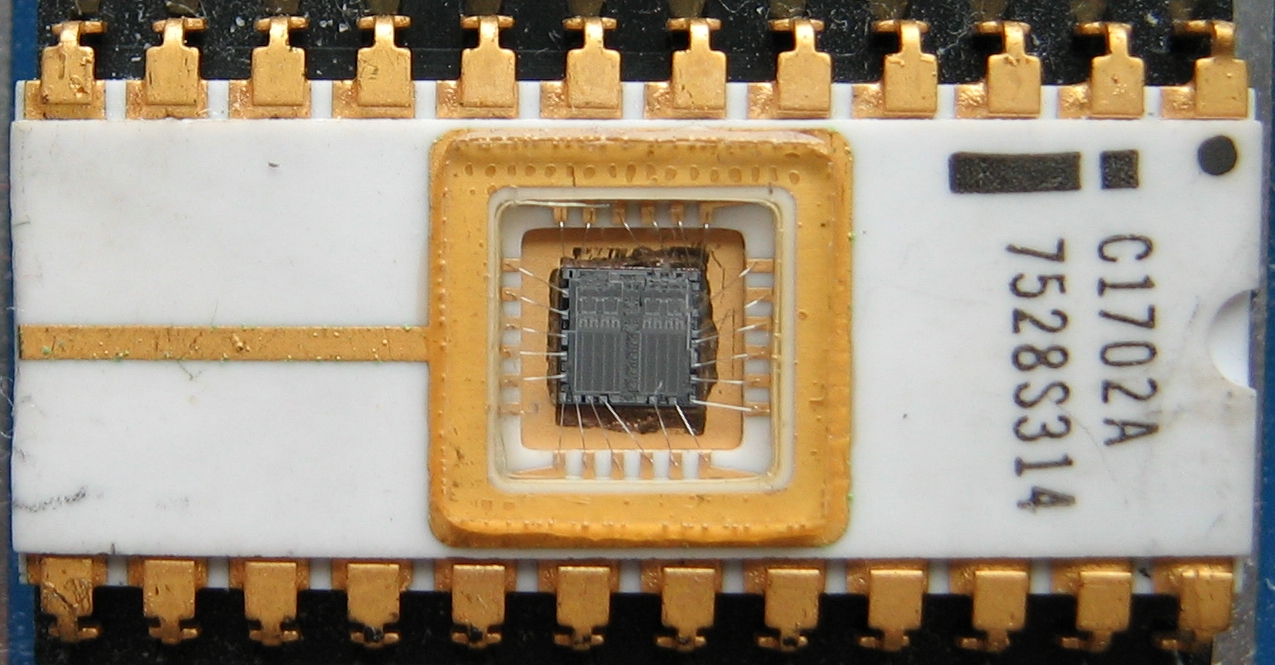 🇺🇸 United StatesEPROM
Non-volatile memory chip erased by ultraviolet lightMemory · 1971
 🇺🇸 United StatesUART
Chip for serial data communication between devicesAnalog · 1971
 🇺🇸 United StatesIntel Core
Multi-core x86 CPUs for PCs and servers by Intel.CPU · x86 · 2006
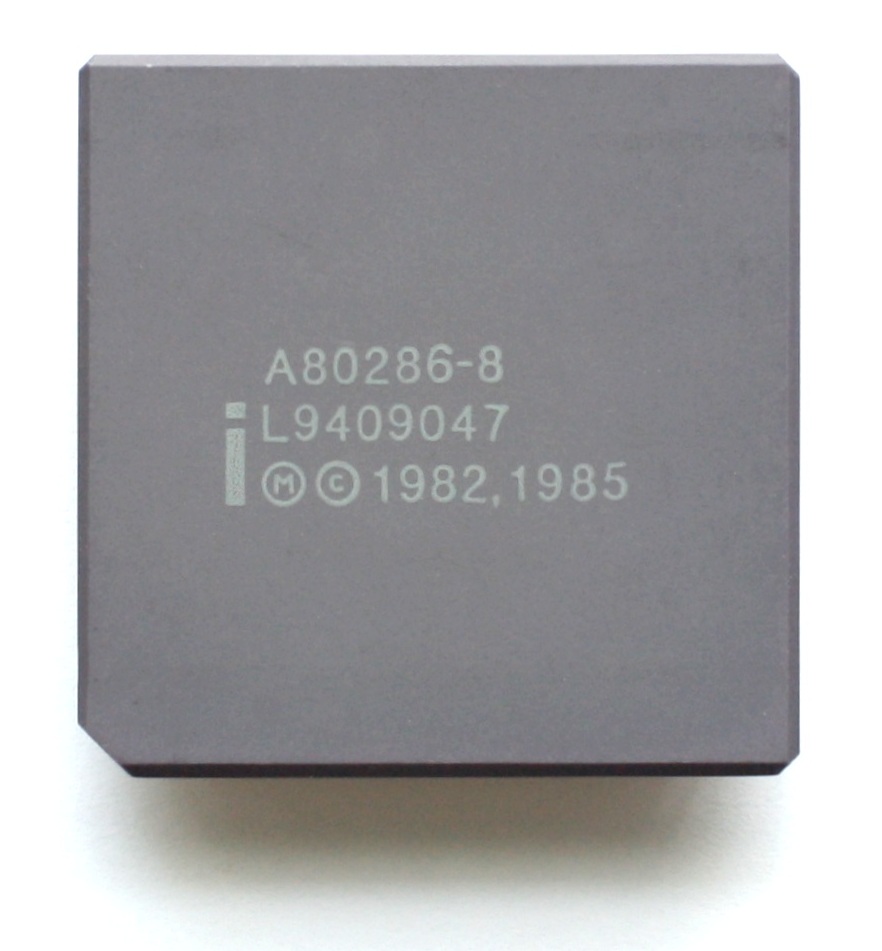 🇺🇸 United StatesIntel 80286
16-bit microprocessor with protected mode and 16 MB memory supportCPU · x86 · 1982
 🇺🇸 United StatesIntel Edison
Small computer module for wearables and IoT devicesSoC · x86 · 2014
Photo credits on this page
The small pictures above come from Wikimedia Commons under free licences. Some are cropped to fit.
- Xeon: Rjluna2, CC BY-SA 4.0, source
- Intel 80286: Konstantin Lanzet (with permission), CC BY-SA 3.0, source
- Intel 4004: the Science Museum, CC BY 4.0, source
- Intel 8080: Christian Bassow, CC BY-SA 4.0, source
- Intel 2700G: Pinchies, CC BY-SA 4.0, source
- MicroSPARC: Pauli Rautakorpi, CC BY 3.0, source
- MC88100: Pauli Rautakorpi, CC BY 3.0, source
- ATtiny: Torsten Landschoff, Public domain, source
- EEPROM: Nevit Dilmen ( talk ), CC BY-SA 3.0, source
- I.MX: Raimond Spekking, CC BY-SA 4.0, source
- MC68451: David Monniaux, CC BY-SA 3.0, source
- Motorola 68000: en:User:ArnoldReinhold, CC BY-SA 3.0, source
- Zilog Z80: Zilog Inc., Public domain, source
- Cyrix Cx486: Appaloosa, CC BY-SA 3.0, source
- PowerPC 5000: Genesi, CC BY-SA 4.0, source
- MC88110: Konstantin Lanzet, GFDL, source
- R4600: Konstantin Lanzet (with permission), CC BY-SA 3.0, source
- R5000: Konstantin Lanzet, CC BY-SA 3.0, source
- UltraSPARC II: Konstantin Lanzet, CC BY-SA 3.0, source
- PowerPC G4: Henrik Wannheden, Public domain, source
- Intel 80186: Armin Kübelbeck, CC BY-SA 3.0, source
- MC10800: Konstantin Lanzet, CC BY-SA 3.0, source
- I486: Konstantin Lanzet, GFDL, source
- UART: Raimond Spekking, CC BY-SA 4.0, source
- EPROM: Author : Poil 01:10, 17 Apr 2005 (UTC), CC BY-SA 3.0, source
- Intel Core: Köf3, CC BY-SA 3.0, source
- Intel Edison: Mwilde2, CC BY-SA 4.0, source
- Sandy Bridge: Jud McCranie, CC BY-SA 4.0, source
- PowerQUICC: Henrik Wannheden, CC BY-SA 4.0, source
- PowerPC 400: Henriok, CC0, source
- ROMP: TerraFrost at English Wikipedia, CC BY-SA 3.0, source